









Deformation monitoring on dike reinforcement projects
Text Roel van GilsImage Van Monsjou & Partners
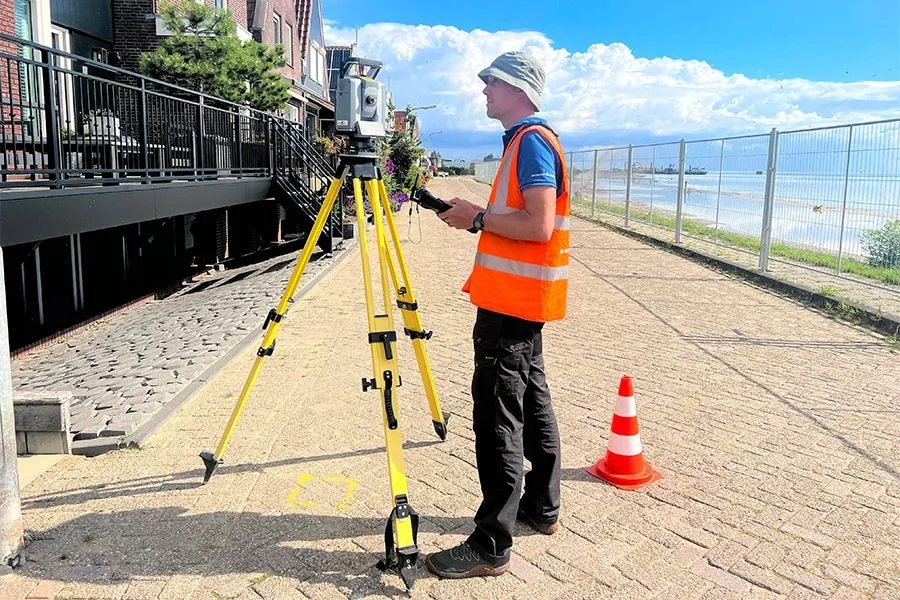
After more than 25 years, there are few secrets left in the world of monitoring environmental impacts for Van Monsjou & Partners. As well as carrying out building surveys and vibration and noise measurements, the independent inspection and consultancy firm is busy conducting precision levelling and deformation monitoring. In recent years, demand for this expertise has been growing on quay and dike reinforcement projects.
Van Monsjou & Partners works every day on a wide range of projects with thirteen motivated colleagues. “The focus is on monitoring the surroundings and specifically documenting the condition and sensitivity of buildings and other structures,” says founder and owner Sander van Monsjou. “The current condition and position are carefully recorded in advance, after which we actively monitor vibration, tilting, crack formation, groundwater, noise and so on during the project. Because we have broad expertise across all types of monitoring, our clients have just one point of contact for inspection and monitoring work.”
Precision levelling
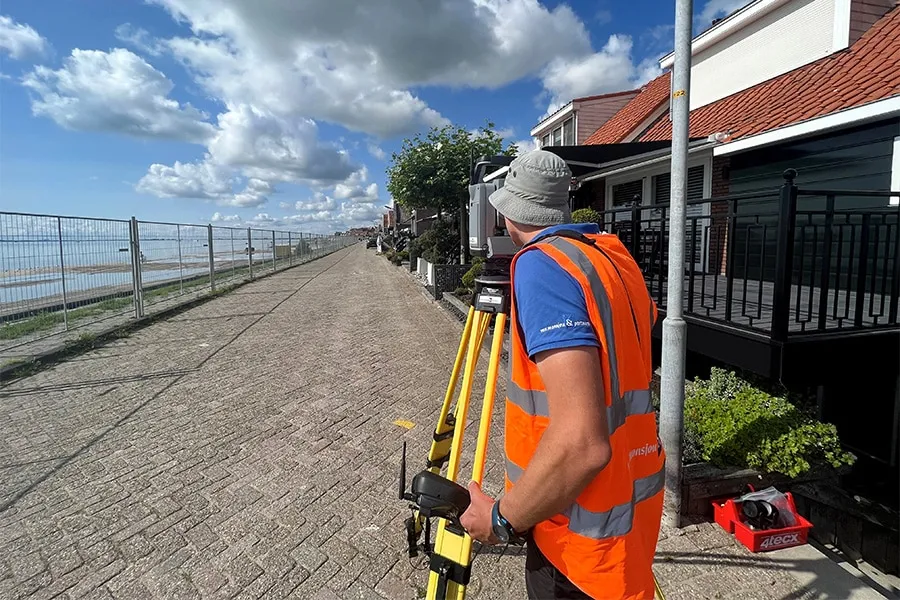
In recent years, Van Monsjou & Partners has been called in more and more often for dike reinforcement projects. “We have been working on the Markermeerdijken since 2015,” Sander continues. “Well before the Alliantie began work on site, all the buildings in the immediate vicinity of the dike were surveyed. Along a 33-kilometre stretch between Hoorn and Durgerdam, more than 1,800 elevation markers have been installed on 450 buildings, and these have been surveyed every six months using precision levelling since 2015. This provides a picture of normal movement and settlement behaviour over an extended period. The measurements show, among other things, that buildings on piles experience little or no settlement, while more settlement-sensitive structures can settle by around 2 to 5 mm per year. These measurements also help the Alliantie to assess more accurately whether the work is affecting the surrounding area.”
Deformation monitoring
During more intensive work closer to buildings, such as preloading and driving sheet piles, you need to know exactly how nearby structures are behaving. “In those cases, elevation measurements are not sufficient,” Sander explains. “You also need to be able to check for horizontal displacement. By installing mini-prisms near the corners of buildings and surveying them against fixed reference points, displacement can be measured to an accuracy of less than 2-3 mm.”
Van Monsjou & Partners is currently carrying out deformation monitoring on around 70 homes as part of sand placement on the northern side of Volendam. “More than 200 mini-prisms have been installed here, and we survey them every two weeks.” Sander is proud that Van Monsjou & Partners has been entrusted with monitoring the Markermeerdijken. “It is a large-scale, dynamic and highly fascinating project, in a very beautiful setting too.”
Question about this story? Ask your question
Keep following this
Get an email when a new story is published. No account needed.
- ThemeFlood protection and climate-resilient water management
- SubjectWater infrastructure







