









Combining parking space with water treatment
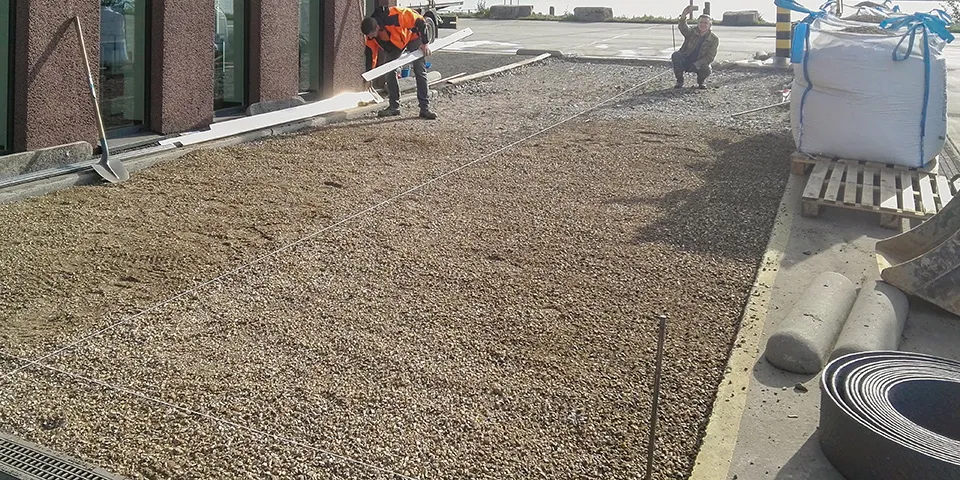
Treating the wastewater from 16 people in the space occupied by one car? It sounds like science fiction, but recently it has become a reality. Phytoparking is an innovation developed by Rietland with support from Argex. A pilot project ran over the past year at the manufacturer of expanded clay pellets. The promising results have opened up a wealth of new prospects for both companies. Argex is best known for its work in groundworks, roads, water engineering and civil engineering. With the development of Phytoparking, the company has shown that it is innovative and continues to move forward.
Rietland has specialised in building (aerated) reed beds for many years. In recent years, Dion van Oirschot has been developing an idea for a new, sustainable application. “The findings of a recent German study got me thinking. Their research showed that an aerated system without reeds performed at least as well as an aerated reed bed. Later, when I looked for more information about grass pavers, I thought it would be worthwhile to investigate whether combining grass cover with an aerated system could offer new possibilities.”
Pilot project
Van Oirschot, Jean-Paul Dues and Pieter D’hont, the latter two sales managers at Argex, got together to discuss the idea. Argex has supplied the well-known expanded clay pellets for many years. They are one of the materials used in the substrate of aerated reed beds. The company was interested in the idea and agreed to take part in a pilot project.
“We started work in May 2017, installing a water treatment system beneath two parking spaces,” says Pieter D’hont. “The parking spaces have a natural grass cover. The pipes and the treatment system itself are underneath. The biggest challenge was getting the load-distribution layer properly balanced to stabilise the layers below.”
Dry spell
During the testing phase, it was important, among other things, to test the load-bearing capacity of the system and ensure that cars could park on it without any problems. The partners soon found the right composition. “It was a dry spell while the parking areas were being built, so we immediately had to anticipate another potential problem,” continues Dion van Oirschot. “It is important to water the grass, especially during a dry spell, so that it can take root. If you do not, it will wither. It was useful to be able to address that issue straight away.”
The Phytoparking treatment method is largely similar to that of an aerated reed bed. The designers mainly had to find a way to make the pipes accessible. “That is not a problem with a reed bed, but with Phytoparking the grass pavers above make it difficult to reach them. So we decided to install the pipes in drainage channels. Simply removing the covers gives easy access to the pipes.”
Once those challenges had been addressed, the system proved to work well. In fact, a single parking space can treat the wastewater from 16 people (population equivalents). The two spaces at Argex are therefore able to treat all the wastewater from the entire office. “The water comfortably meets the Vlarem II standards (BE), so it is very clean. At the moment, we are effectively discharging clean water into the sewer, even though we could just as easily let it flow into the nearby Scheldt,” says Dion van Oirschot.
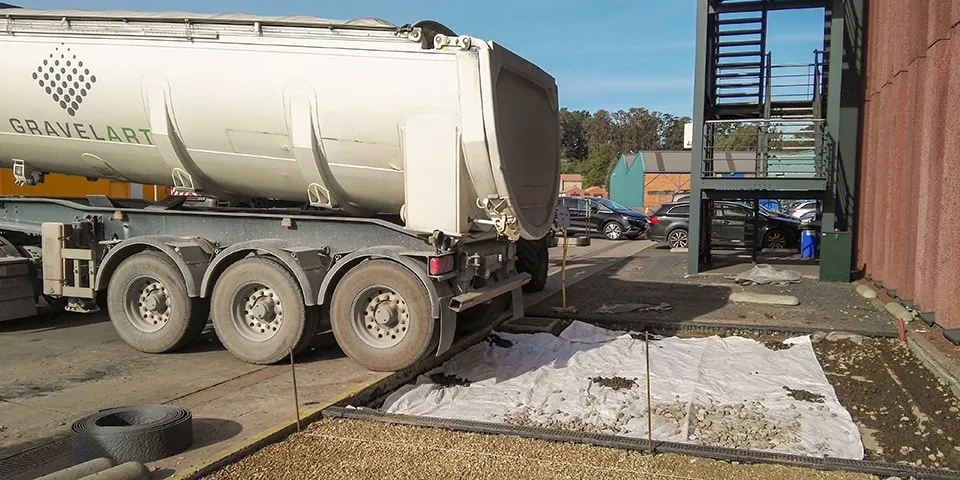
Because they are lightweight, the pellets are much cheaper to transport than, for example, gravel.
Space-saving
This recently developed system immediately opens up some interesting possibilities, particularly for industry. “Companies considering investing in a reed bed sometimes have reservations because it takes up a considerable area. Not every company has enough space for one. But every company normally has its own car park. If you can install the water treatment system underneath it, you kill two birds with one stone. It could even be three, as some companies have solar car parks and can also generate renewable energy in the same space.”
Tests of the project at Argex showed that Phytoparking performs as well as an aerated reed bed. However, Dion van Oirschot does not believe this means the end of (aerated) reed beds. “Not at all, the two systems can exist perfectly well alongside one another. Because it requires an additional cover and grass pavers, Phytoparking is a slightly more expensive investment than an aerated reed bed. A reed bed will therefore remain an option for companies with enough space. Phytoparking can be integrated almost anywhere: in roadside car parks in residential areas, in healthcare, industry and offices, and so on. We can develop a solution for virtually any application, even truck parks. We would simply need to find a different design for the load-distribution layer.”
Commercialisation through licensing
Rietland has now applied for a Belgian patent for Phytoparking and will also apply for an international patent later this year. The company intends to roll out the innovation worldwide through a licensing system. “We want to market the system ourselves in the Benelux, Germany and France. We are already seeing a lot of interest in the United States, Canada, Spain, Portugal and China. The potential in China is particularly huge. In some cities, the system could be used for tertiary treatment at a wastewater treatment plant, with a capacity of no less than 30,000 m³ per day. The added value of our system is that the relatively long retention time, combined with the use of Argex pellets, enables it to remove pharmaceutical residues and micropollutants from the water, something a conventional wastewater treatment plant cannot do,” says Dion van Oirschot.
Argex pellets do indeed play a crucial role in the system. “They provide the substrate on which a film of bacteria forms. The bacteria do the treatment work,” says Pieter D’hont. “The porous nature of the clay pellets gives the bacteria plenty of room to grow. The pellets also contain iron, which has phosphate-binding properties, providing an additional benefit.”
The pellets also offer important advantages in the construction of (aerated) reed beds. “Because they are lightweight, they are much cheaper to transport than, for example, gravel. We also save a lot of time and effort when spreading the pellets, as a blowing system allows us to distribute them evenly across the reed bed or Phytoparking. Phytoparking is certainly a promising new market segment for us,” explains Pieter D’hont.
Question about this story? Ask your question
Keep following this
Get an email when a new story is published. No account needed.
- ThemeFlood protection and climate-resilient water management
- SubjectWater infrastructure







