









Accelerating with vision: strengthening the Havendijk in Den Helder
Text Romee Huisman (projectmanager bij HHNK), Jibbe Poppen (projectdirecteur bij TAUW) en Tom Sikkema (sectorhoofd Waterbouw en projectmanager Waterveiligheid bij Iv)Image HHNK, Flying Focus and Iv
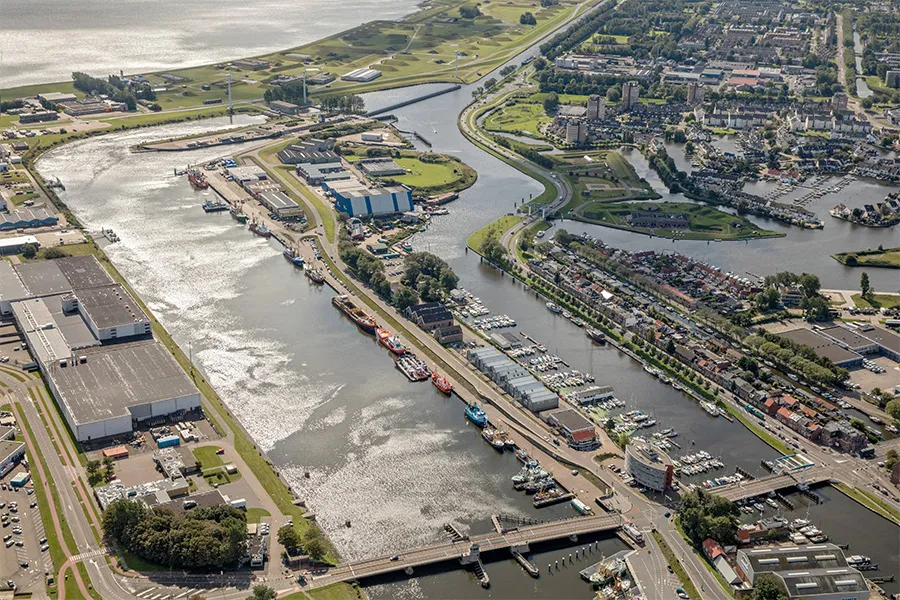
Work is under way on a distinctive dike reinforcement project along the Havendijk in Den Helder. The section of dike is relatively short, but the challenge is considerable. A traditional project to reinforce a primary flood defence, from exploration through to completion, can easily take eight years. Here, the work is on track to be completed in just five years.
The Havendijk in Den Helder no longer meets safety standards and has therefore been included in the Flood Protection Programme (HWBP). The middle section of the route is particularly urgent in terms of flood safety. This is because the dike no longer meets the requirements for outward stability, and the sheet-pile wall along this section is also in a poorer condition. The area around the Havendijk is a dynamic one, where a range of interests converge. The flood defence lies opposite the Koninklijke Marine site, close to residential areas and directly alongside the existing harbour area, which is due to be expanded. A traditional phased approach involving years of studies and design work was not an option. Hoogheemraadschap Hollands Noorderkwartier decided to accelerate the dike reinforcement project, with the exploration phase to be completed within one year. The contract for this challenge was awarded to the Iv & TAUW joint venture. A project team was formed together with Hoogheemraadschap Hollands Noorderkwartier, with each of the three parties contributing its own expertise.
A pace that reflects the urgency
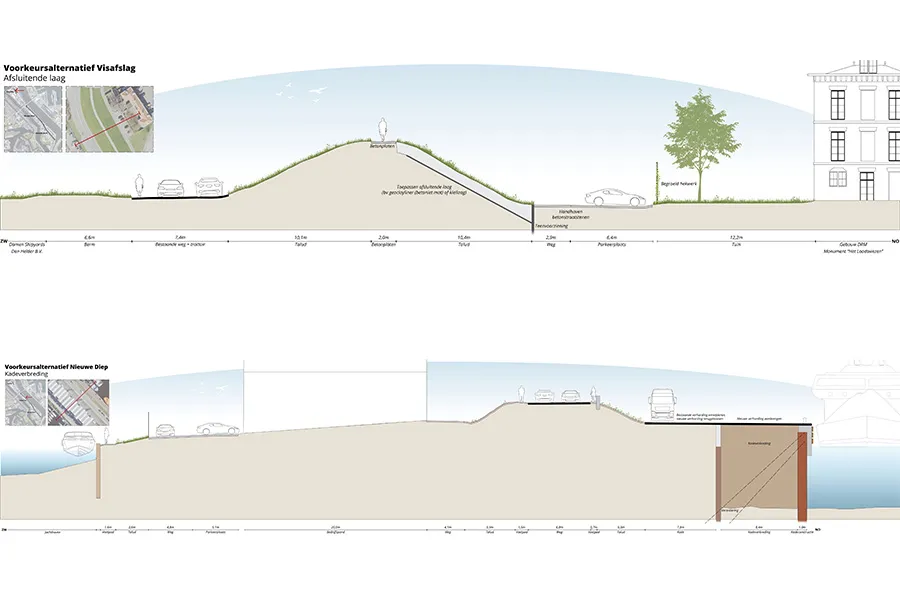
Although the Havendijk project is relatively small in scale (655 metres), the route presents considerable technical variation. Each section of dike requires a specific approach. At the northern end of the route, for example, near the Visafslag, the dike is an earth embankment. Its protective covering will be upgraded by removing the existing top layer and laying a new, less permeable clay layer. This measure will improve the dike’s stability without changing its original shape or the appearance of the landscape. The solution will be combined with a structure at the toe of the dike.
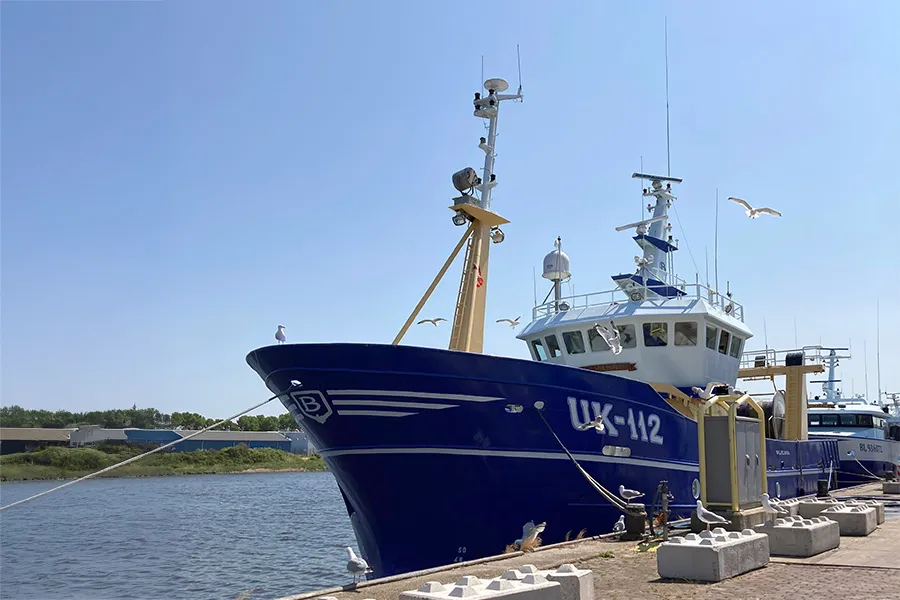
The middle section of the route is the most technically demanding and challenging part of the project. Here, a heavily deteriorated sheet-pile wall runs directly alongside the harbour quay. The outward stability of the dike also no longer meets requirements here. At the same time, Port of Den Helder, which manages the area, and the municipality of Den Helder had a clear ambition to expand the harbour area. Rather than carrying out two separate interventions, the project team opted for an integrated approach: the existing quay will be replaced with a new combined wall structure, made up of heavy sheet piles with deep anchoring, robust enough to allow larger vessels to moor safely. Moving the quay outwards will create around 5,000 square metres of new land that can be used for work or storage.
An integrated approach? Yes, but quickly
This will not only strengthen the dike, but also deliver immediate benefits for the surrounding area. In other projects, opportunities like these often cause delays because decision-making or funding does not fit the preferred schedule for the dike reinforcement. In this project, the team made a conscious effort to avoid this by making the schedule the priority. From the outset, the project team followed clear rules: opportunities were welcome, provided that the parties initiating them took an active part, arranged their financial contributions in good time and formalised the necessary agreements with the relevant authorities. The dike reinforcement would not wait. This approach ensured that the parties involved were focused from the start, worked together and acted quickly. As a result, it was possible to include the harbour expansion in the project within a relatively short timeframe. And the exploration phase, completed in just one year? Mission accomplished!
The project was accelerated not by skipping stages, but by fundamentally changing the way the work was done. The key lies in the way the parties work together. Instead of separate parties with divided responsibilities, the project team operates as a close-knit whole, putting knowledge and expertise first. In practice, this means joint working days, shared schedules, trust, mutual respect and equality.
A role for sustainability
Sustainability is central to the design. One key consideration is the reuse of materials generated during the works, such as clay, soil and existing structural components like sheet piles or concrete. During the exploration phase, the team is already assessing whether these materials are suitable for recycling or reuse within the project, for example as fill material or in the new dike covering. It is also investigating whether regional stakeholders, such as Port of Den Helder, the municipality of Den Helder or parties initiating other infrastructure projects, could use the materials generated. This avoids unnecessary transport and waste, and supports a circular approach to the project. Sustainability is also being taken seriously during preparations for construction: the aim is to use as much zero-emission equipment as possible and to plan the works intelligently to limit transport movements.
A future-proof flood defence and an inspiring project
The preferred alternative has now been approved by the relevant authorities. Over the coming years, the project team will develop the plans in preparation for construction: the contract is due to be awarded in 2026, with work on site scheduled to start in 2027. If all goes to plan, the dike will be reinforced by the end of 2028 and will once again meet the required standard. From exploration to completion in just five years. That is exceptionally fast, particularly for the reinforcement of a primary flood defence involving different designs and a range of stakeholders around the dike. The Havendijk project shows that acceleration is possible without compromising on substance. Once the dike is safe from flooding again, it will provide a safe, future-proof flood defence, as well as an approach that can inspire other projects.
Een zakelijke vraag aan TAUW | Advies- en ingenieursbureau? Get in touch
Companies in this story

Keep following this
Get an email when a new story is published. No account needed.
- ProjectHavendijk
- ThemeFlood protection and climate-resilient water management
- SubjectWater infrastructure
- CompanyTAUW | Consultancy and engineering firm







