









“NLCS makes my work tidier, clearer and more enjoyable” Wesley Kleinveld (DAGnl) on the Dutch CAD Standard
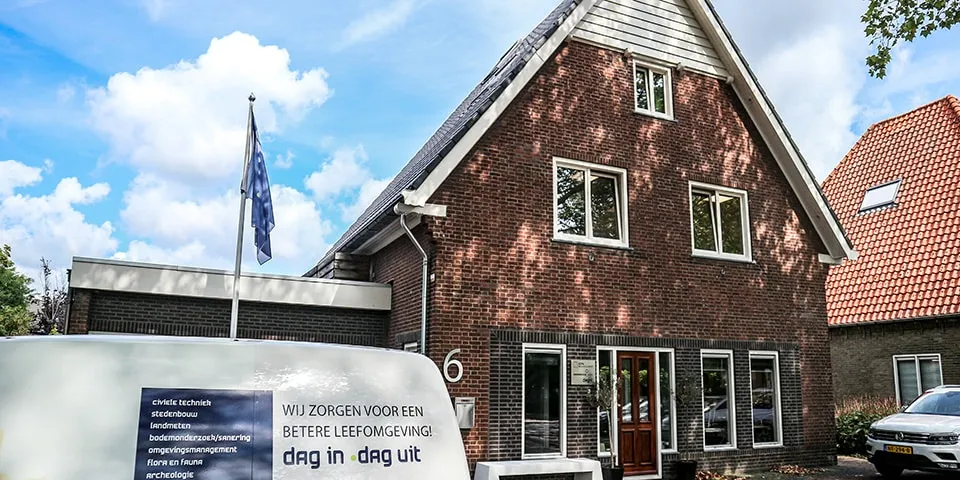
Wesley Kleinveld can no longer imagine a career without NLCS. The project manager at engineering consultancy Civil Management (Huissen) was one of the ‘early adopters’ of the Dutch CAD Standard. By far its greatest benefit is the interchangeability of drawing work.
Kleinveld has worked at Civil Management since 2012. It is an integrated project management consultancy where, according to its website, ‘professionally obsessed’ people work with commitment and passion for their profession. Civil Management is also one of the entities within DAGnl, a group comprising various consultancies, each with its own specialism in civil engineering (see box). The project manager explains: “DAGnl is a partnership between several market players. Thanks to our large network, we can take on projects of any size. Through our partners, we have all the knowledge, expertise and capacity we need, while still keeping our lines of communication short. Another advantage of this structure is that, through DAGnl, we can procure services together, such as IT solutions. Each company retains its own identity, but we all work in the same way.”

Wesley Kleinveld
Interchangeability
Kleinveld has always delivered drawing work in accordance with NLCS. “Interchangeability is by far the greatest benefit of NLCS,” he says. “It is a clear drawing standard that everyone understands at a glance. That makes our work much easier. It also saves a great deal of time and, therefore, money.”
In the past, for example, he could easily spend half a day working on a drawing from a third party before making it usable for his own work. “There’s nothing more frustrating than a drawing that isn’t georeferenced and has no layer structure. In short, one that hasn’t been created to a consistent drawing standard. If you receive the same drawing in NLCS format, you can sort it out in 15 minutes. Working to NLCS therefore saves us a considerable amount of time. Take the project for the Municipality of Haaksbergen, where we designed the road connection to the new N18. Everything was done in accordance with NLCS. As a result, there were very few differences in interpretation and construction went very smoothly.”
Consistent appearance
Within DAGnl, too, the interchangeability of drawing work is one of the greatest benefits of NLCS. What’s more, NLCS ensures that our external-facing work always has the same, recognisable appearance. That consistency has improved even further since DAGnl started using InfraCAD, a tool for drawing in accordance with NLCS. Kleinveld says: “A few years ago, we started looking for a suitable tool for working with NLCS. We had developed our own tool in the past, but maintaining it took a lot of time and effort. NLCS continues to evolve, just like AutoCAD. And of course, we would rather spend our time on our work than on developing and maintaining software.”
In the end, they chose InfraCAD. “It’s a very user-friendly, intuitive tool that has clearly been developed with the user’s needs in mind. After adjusting a few personal settings, you can get started.
Using symbols, creating layers, setting up a clear, company-specific library: it all comes naturally. Our drawings are now instantly recognisable as DAGnl designs, regardless of where they were produced or who drew them. That’s the consistent appearance we had in mind.”
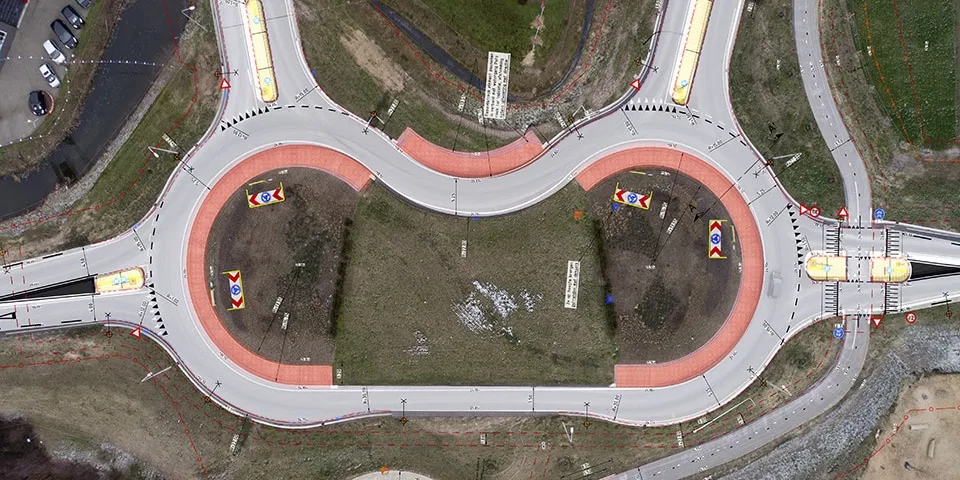
Road connection to the new N18, commissioned by the Municipality of Haaksbergen: NLCS design overlaid on the completed works
NLCS and BIM
Kleinveld benefits every day in practice from the common language they speak at DAGnl. “Take the construction of Park 15, a 120-hectare sustainable business park on the A15, centrally located between the ports of Rotterdam and the German Ruhr region. Work on the project has been under way since 2015. But because we delivered all the drawing work in NLCS format at the time, those designs can still be transferred without any problems, for example to a civil engineering contractor who needs the drawings to develop a plot.”
The fact that NLCS is also a BIM Level 1 standard plays a positive role. “Although BIM is a broad term,” the project manager says. “In principle, any piece of information you attach to a drawing object is already a form of BIM. We produce most of our 3D models in accordance with NLCS: we develop our 2D drawings into
3D models while retaining the layer structure. This is useful, for example, when creating machine models for our construction
partners.”
Tidier and clearer
All in all, Kleinveld sees a future for NLCS, even though not all parties in the civil engineering sector use the Dutch CAD Standard yet. “But more and more are adopting it. After all, public authorities have made NLCS mandatory for the delivery of drawing work. That’s a good thing. If it were up to me, everyone would soon be working to this standard. Some clients still use their own drawing standards, often because their entire system is built around them. I understand that they can’t simply throw them out, but on the other hand, if we all speak the same language, the work becomes much clearer for everyone. Another benefit is that it reduces the risk of errors, because interpreting drawings raises far fewer questions. That, in turn, has a positive effect on the cost estimates you prepare and the contracts you draw up. Thanks to NLCS, your work is tidier, clearer and more enjoyable.”
Question about this story? Ask your question
Keep following this
Get an email when a new story is published. No account needed.
- ThemeDigitalisation from design to construction
- SubjectSpecials







