









A9 BaHo: MNE’s fast, safe and sustainable dismantling work
Text Suzanne van Gaale Images MNE
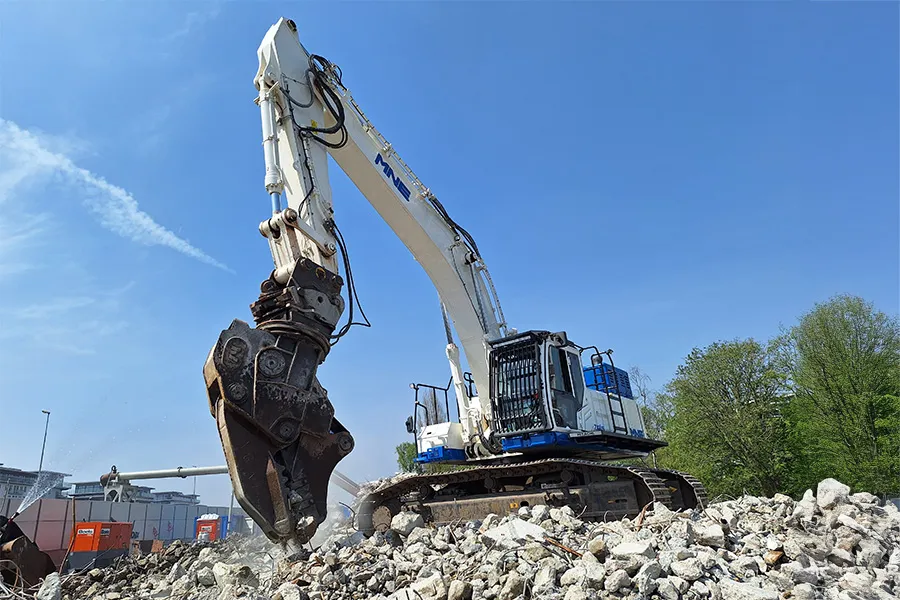
Several bridges and viaducts are being replaced as part of the widening of the A9 between Badhoevedorp and Holendrecht. This involves a huge amount of demolition and dismantling work. How do you carry it out safely, efficiently and sustainably? It is a question that MNE, based in Mijdrecht, is ideally placed to answer. The demolition contractor has already demolished, dismantled and processed thousands of tonnes of steel and concrete.
MNE is no stranger to specialist demolition work. From entire harbour cranes and old coal-fired power stations to storage tanks and bridge bascules, the company has experience with challenging projects. Founded in 2011 by brothers Marc and Edward van Golen, MNE has quickly built a solid reputation in the civil engineering, water and road construction sector. Its reference projects include the refurbishment of Haringvlietbrug and the decommissioning of the former power station on Hemweg in Amsterdam. “This is our core business,” says Fred Hulshof, project manager at MNE. “We manage demolition projects from A to Z, from engineering through to execution. We have our own fabrication workshop, transport, cranes and experienced tradespeople.” Sustainability also plays a major role. “We always look at whether and how materials can be reused or recycled. We offer anything that is still usable through our network.”
Challenges on the A9
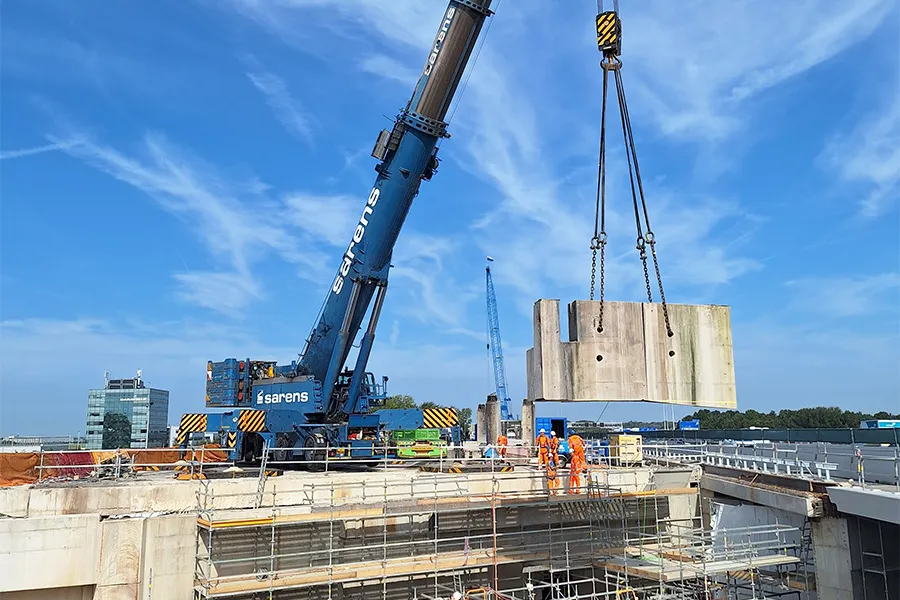
Working for Hollandia, MNE carried out the demolition and dismantling of the Schiphol bridges on the A9 route. “Hollandia built the new steel bridges for Schipholbrug. They are a valued partner of ours. Their scope included removing the old bridge, which is how we became involved in the A9 project.” Two structures stood out for their complexity: the viaduct over Beneluxbaan and Schipholbrug. Work on Schipholbrug had to be carried out in phases to avoid disruption to traffic. “First, we removed the bridge control cabin and the movable section of the bridge on the northern side, while all traffic was routed over the southern side,” Hulshof explains. “The same was then done on the southern side.”
The limited working space and the huge dimensions of the concrete sections, some weighing up to 70 tonnes, made the job challenging. Even so, everything was completed within the tight schedule. The work involved 450 tonnes of steel and more than 1,800 tonnes of concrete, handled in just 2x four-week periods.
Smart demolition
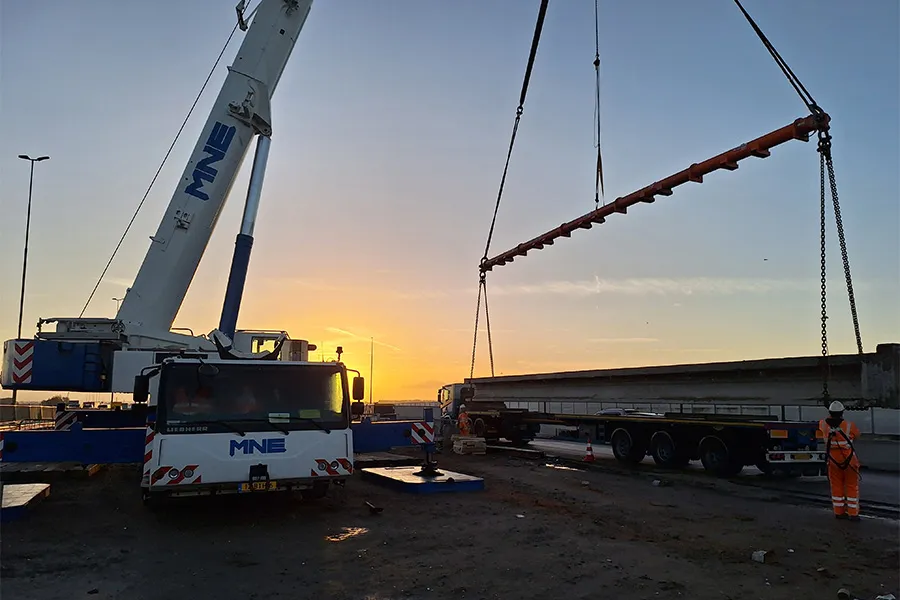
MNE began by dismantling the old northern steel bridge. The first step in demolishing the southern bridge was to lift out, remove and scrap the steel bascule, including its ballast chamber and operating mechanism, as well as the temporary auxiliary bridge. MNE cut the steel structure into sections, which were transported by water to an external demolition site. “That’s typical of MNE: we handle everything in-house.” The concrete superstructure was dismantled after the steel bridge sections. The basement was sawn into sections and lifted out by crane. “What made it even more complex was that the sections were not straight, but had irregular shapes. This required precision when sawing and lifting. We suspended the landing from a steel beam structure to lift it safely.”
Dismantled in a single weekend
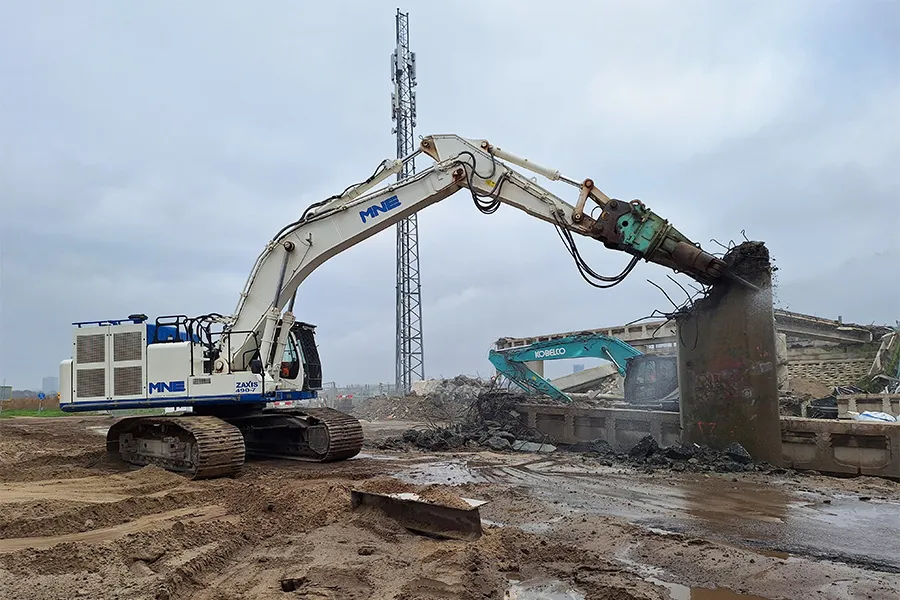
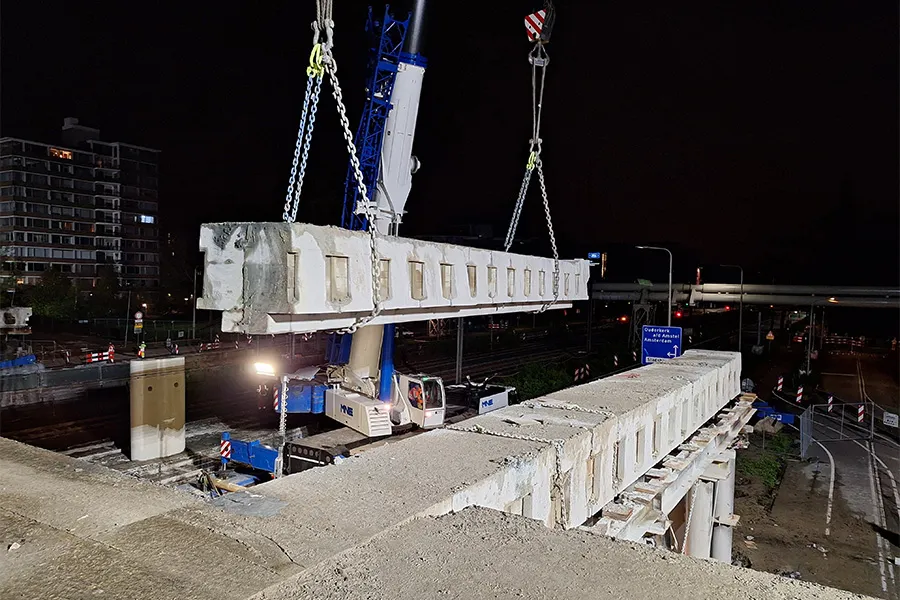
Another structure demolished by MNE was the viaduct carrying the A9 over Beneluxbaan. After two weeks of intensive preparation, building temporary supports, drilling and sawing, MNE dismantled the entire viaduct in a single weekend. “The main challenge was that the VeenIX consortium and Rijkswaterstaat could not fully close the A9 and the underlying road network. We also had to contend with a tram track. We designed a support structure so that the girders and the entire substructure could be sawn free, after which they could be dismantled rapidly. The great thing is that we reused material from another demolition project for that structure.” Nearly 3,000 tonnes of concrete sections were dismantled in total, including 84 concrete girders, 6 pier beams and 6 columns.
Circularity
Circularity has been the common thread through all six structures MNE has demolished so far on the A9 project. It began with the relatively small structure over Holendrechterzijweg in Ouderkerk aan den Amstel. “That was where we started salvaging the concrete girders. Working with specialist sawing and drilling companies, we developed a method for dismantling the girders without damaging them. To date, nearly 300 girders have been successfully salvaged by us on this project, ready for reuse in another structure in the future.”
Capturing dust and water
An additional challenge in dismantling the viaducts was capturing the large amounts of dust and water generated during concrete sawing. “Here, too, we came up with an inventive solution. We sealed the joints underneath with plastic strips. This allowed us to capture the sawing water and dust effectively, preventing any impact on the underlying road network. A simple but very effective solution.”
Looking ahead: more opportunities for reuse
Hulshof looks back on the project with pride. “On the A9, we have shown that demolition and reuse go hand in hand. This is the future: fast, safe and sustainable dismantling. We see plenty of opportunities to reuse materials in future projects. Collaboration with the various parties involved has been excellent. Together, we have developed practical, effective solutions.”
Have a business enquiry for MNE B.V.? Get in touch
Who worked on A9 BaHo
- geotechnical site investigation and advice
 FugroMentioned in Sustainable use of foundations for viaducts and bridges
- foundation contractor consortiumDe Vries TitanMentioned in A9 BaHo: Bauer installs 12,000 anchor piles up to 45 metres deep
- foundation contractor consortiumBAUER Funderingstechniek B.V.Mentioned in A9 BaHo: Bauer installs 12,000 anchor piles up to 45 metres deep

Keep following this
Get an email when a new story is published. No account needed.
- ProjectA9 BaHo
- ThemeExtending the life of roads and civil engineering structures
- SubjectSpecials
- CompanyMNE B.V.







