









Sustainable use of foundations for viaducts and bridges
Text Roel van GilsImage Fugro
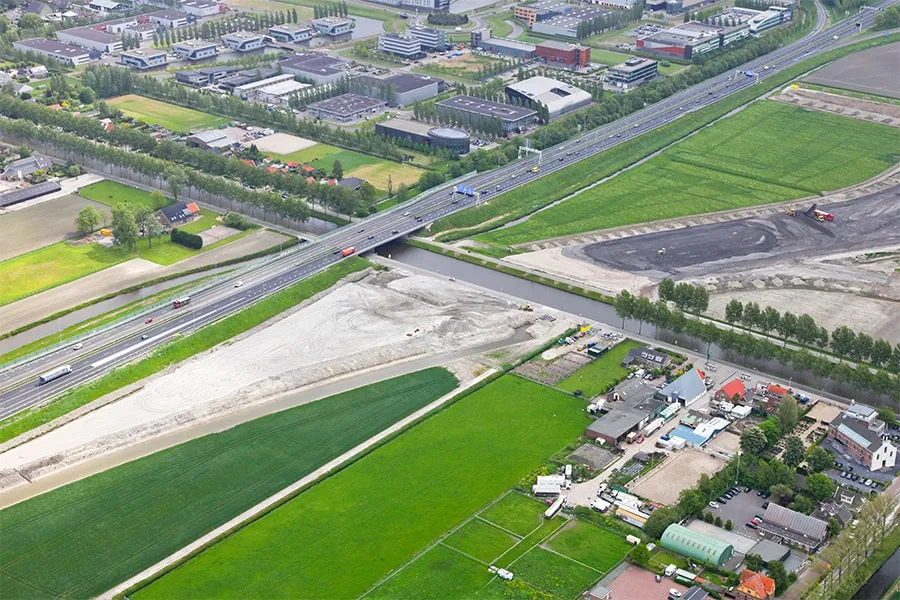
In the construction industry, it is increasingly common to consider whether existing pile foundations can be reused, in whole or in part, during reconstruction, extension or complete redevelopment. In infrastructure, by contrast, this has not yet been done on a large scale. Thanks to Fugro’s expertise, that is now changing as the A9 between Badhoevedorp and Holendrecht (BaHo) is widened and lowered, with at least five viaducts set to benefit.
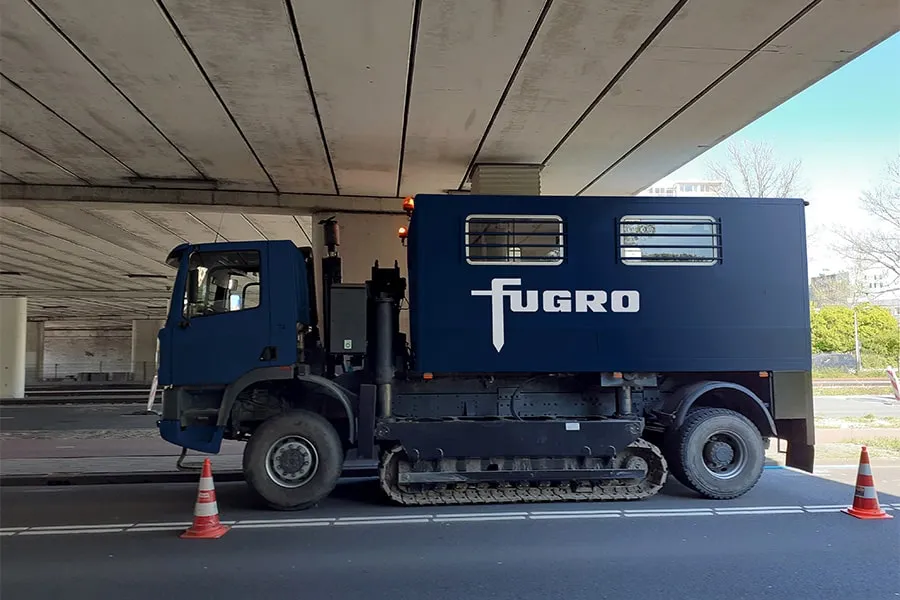
“Because of the challenging soft ground, particularly in Amstelveen, VeenIX asked us, as an established specialist, to support it with geotechnical ground investigations and advice,” says Diederick Bouwmeester, Infrastructure Sector Manager at Fugro.
Geotechnical risks
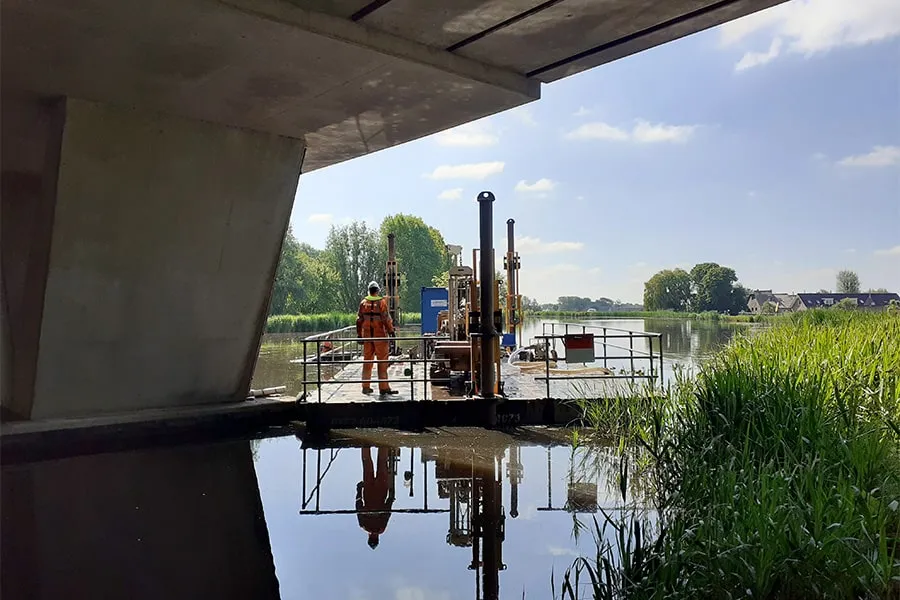
“We analysed the ground investigation data already available, including information in our archives,” Bouwmeester continues. “We have carried out a great deal of investigation around Amsterdam over the years. We then brought the information together and assessed what additional ground investigation would be needed, using CPTs and boreholes, to establish the geotechnical soil parameters accurately. We also considered whether further geological investigation was needed. It is important to establish whether there are several geological deposits, which would mean that different sets of parameters have to be used.
For this project, Fugro investigated more than 2,500 locations using CPTs and boreholes. “On that basis, we prepared a geotechnical baseline report and a 3D ground model, or 3D Ground Information Model (GIM), for everyone to work with. Together with Rijkswaterstaat, we are the geotechnical point of contact within VeenIX, as well as for all the design consultancies and subcontractors.”
Fugro also drew up a monitoring proposal so that, during earthworks, any deviations could be closely monitored using settlement gauges, pore pressure meters, inclinometers and standpipes, and immediately assessed against the design requirements.
Design rules
Eleven viaducts on the project are being demolished and rebuilt in a wider form. Rijkswaterstaat required components from various viaducts to be reused. “In its tender design, VeenIX identified the foundations that could be reused and whose suitability would have to be verified during the project,” says Johan Schuringa, Geotechnical Consultant at Fugro. “The aim was mainly to reuse foundations dating from the 1960s and 1970s. However, they were designed to different standards from those that apply to foundation design today. Special design rules have been drawn up to assess the old piles. The main requirement is that the pile load must not increase by more than 15% (see NEN8707). Otherwise, the design has to comply with the latest standards, and the pile foundations will not have sufficient bearing capacity. This is particularly because the design rules were tightened in 2016, when the pile factors for end-bearing capacity were reduced by 30%.”
Pile bearing capacity
If existing foundation piles are to be reused, the first step is to check whether the pile load will increase by less than 15% in the new design. “That is really a question for the structural engineer,” says Schuringa. It has now been concluded that the pile foundations of five viaducts can be reused in whole or in part, and Fugro has completed the concept calculations for Structure 4 (KW4, a viaduct on the west side of Amstelveen, ed.). Fugro’s geotechnical team worked closely with the structural engineer on KW4. Their estimate was that the total weight of KW4 would increase by 11% in the new design, within the permitted limits. The viaduct is being widened from 27.5 to 50 metres. “So we had cleared the first hurdle, but in the initial design phase the pile bearing capacity still fell just short. Even so, we had enough options to keep going, because we could still introduce additional mitigation measures.”
Additional mitigation measures
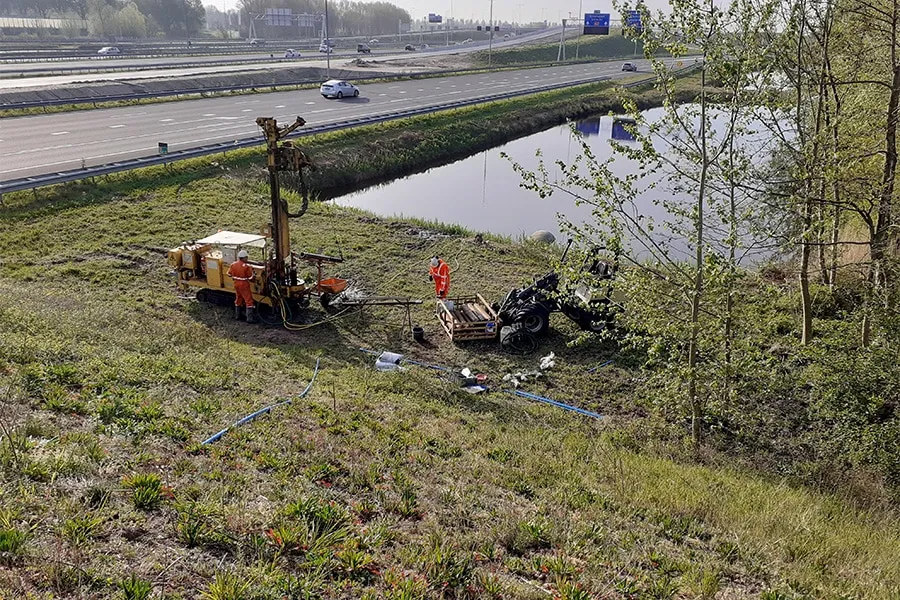
If the required bearing capacity is not achieved, as is the case for almost all the existing viaducts on the A9 BaHo, additional CPTs can be carried out, for example, to assess the homogeneity of the ground in more detail. “A CPT provides information about just one point. The reasoning behind this measure is that the more investigations you carry out, in this case CPTs, the more confidently you can assess the homogeneity of the ground,” Bouwmeester explains. “The design rules include a ξ factor, a correlation factor based on the number of soil tests. This factor often improves as more ground investigations are carried out, which in turn gives a more favourable bearing capacity. This means additional capacity can be credited to the existing pile foundation. Further ground investigation therefore pays off.”
Differences in stiffness
The old piles will ultimately form the foundation for the new, widened viaduct together with the new piles.
“However, old piles are considerably less stiff than new piles because they were traditionally driven to refusal, just into the Pleistocene sand,” Schuringa explains. “Under the current design rules, new piles have to extend much deeper to achieve the required bearing capacity. This creates considerable differences in stiffness within the foundation, which can adversely affect load transfer. That also has to be calculated. In addition, the construction work must avoid installation damage or a temporary reduction in the bearing capacity of the old foundation caused by installing the new piles. These are important points to consider during construction.”
Verification CPTs
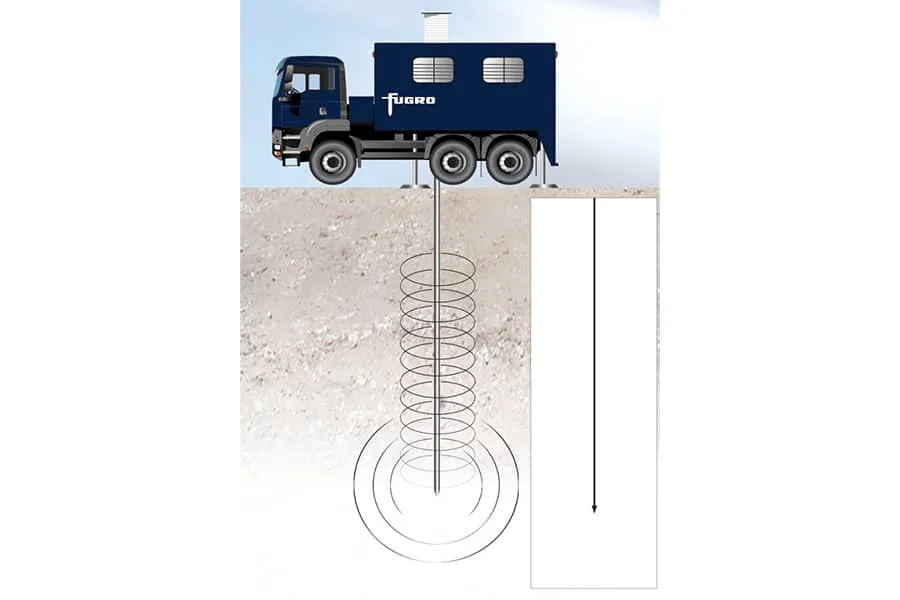
Fugro had access to old contract drawings from the 1960s and 1970s showing how the viaducts were built and where the piles were located, whether they were driven at an angle or vertically, their dimensions and their pile toe levels. “Experience shows that the drawings do not guarantee that the structures were built exactly as shown,” says Bouwmeester. “We need to assess any piles proposed for reuse thoroughly, so that we can be sure they extend deep enough into the Pleistocene sand. This can be done in several ways. At KW4, CPTs were carried out using a so-called magnetometer cone, a special cone that detects the reinforcement in the pile. The CPT had to be carried out within 1.5 metres of the pile. Since most of the piles were driven at an angle, this also required careful planning. Wherever feasible, we carried out verification CPTs, which allowed us to establish the actual pile toe levels with reasonable certainty.”
In the end, all 208 old piles at KW4 were incorporated into the final design for the new foundation. According to Fugro, this also saves around 200 new piles, equivalent to 1,200 tonnes of CO2 emissions (about ten return transatlantic flights). Every pile that does not need to be installed also saves on concrete, reinforcement, transport and installation, meaning savings in both time and money. “And that is just for KW4,” Schuringa emphasises. “There are four other viaducts where piles will be reused in whole or in part, including the bridge over the Bullewijk and the bridge over the Amstel.” ■
A business enquiry for Fugro? Get in touch
Who worked on A9 BaHo
- foundation contractor consortiumDe Vries TitanMentioned in A9 BaHo: Bauer installs 12,000 anchor piles up to 45 metres deep
- foundation contractor consortiumBAUER Funderingstechniek B.V.Mentioned in A9 BaHo: Bauer installs 12,000 anchor piles up to 45 metres deep



Keep following this
Get an email when a new story is published. No account needed.
- ProjectA9 BaHo
- ThemeExtending the life of roads and civil engineering structures
- SubjectBridge construction
- CompanyFugro







