









Dewatering for Hooipolder’s 100-hour operation
Text Roel van Gils Image ALSÉÉN
Brief, but effective
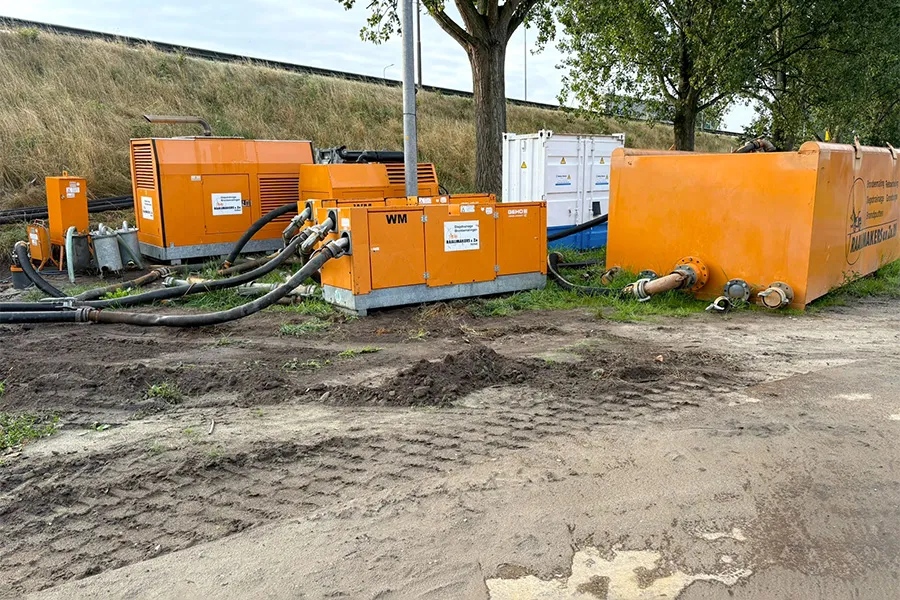
Although Hooipolder’s 100-hour operation was a huge undertaking, by then it was no longer especially challenging for Raaijmakers en Zn. Bronbemaling. They had completed the work in advance. This helped ensure the successful sliding operation, as their four deep wells had left the sand layer beneath the A27 ‘bone dry’ to a depth of 2.5 metres below
ground level.
In spring 2024, construction consortium ALSÉÉN approached us to handle the dewatering both at the preconstruction site and later on the A27, in preparation for Hooipolder’s 100-hour operation, says William Raaijmakers of Raaijmakers en Zn. Bronbemaling, an operating company of Van Tongeren Watertechniek, Bronbemaling.com. “Ground improvement was needed at the preconstruction site to prevent the enormous structure from sinking into the existing loam layer.” The dewatering system was designed in collaboration with the ‘slot team’ and ALSÉÉN’s geohydrologists. “It consisted of a conventional wellpoint system with vacuum wellpoints, installed at 2-metre centres and to a depth of 8 metres. Together with four dewatering pumps, this temporarily lowered the groundwater level by 1.5 metres. The ground was then excavated to 2.5 metres below ground level and replaced with clean sand. The dewatering system was subsequently dismantled, and the construction consortium could start building the underpass, which required no further dewatering.”
Deep wells
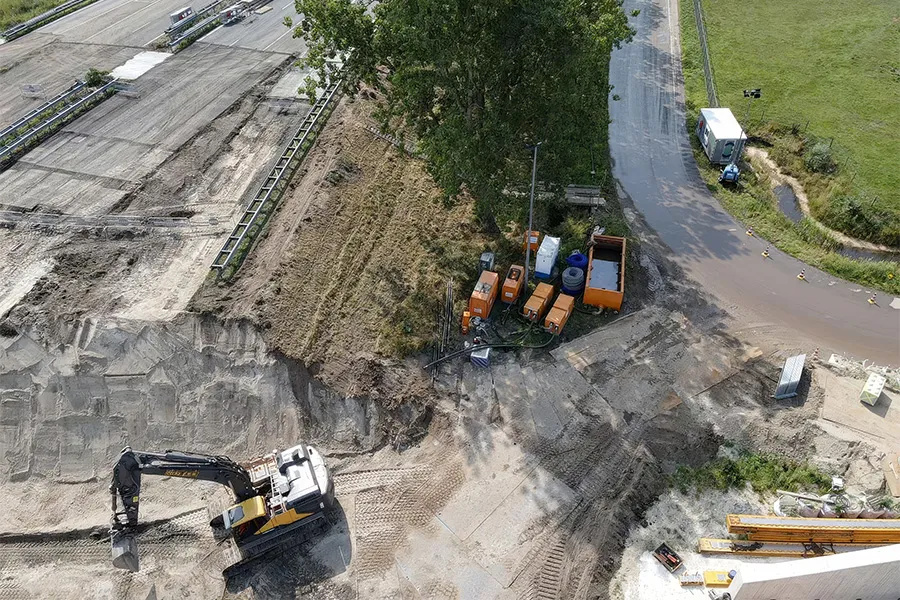
In the run-up to Hooipolder’s 100-hour operation, Raaijmakers en Zn. Bronbemaling was able to put its expertise to work again. “Ground improvement was also needed beneath the A27 to provide a foundation for the future underpass,” Raaijmakers explains. “Our task was to ensure, before the start of the major works, that the sand layer across the worksite, including beneath the A27, was dry to a depth of 2.5 metres. To achieve this, we drilled four deep wells in advance, each to a depth of 15 metres, positioning them at the corners just outside the worksite. They were about 100 metres apart along the longer sides and around 40 metres apart along the shorter sides. The aim was to lower the groundwater level by more than 1.5 metres across an area the size of a football pitch, to 2.5 metres below ground level. The wells had a capacity of 65 m3 per hour, allowing us to abstract a total of 260 m3 per hour.”
Straw containers
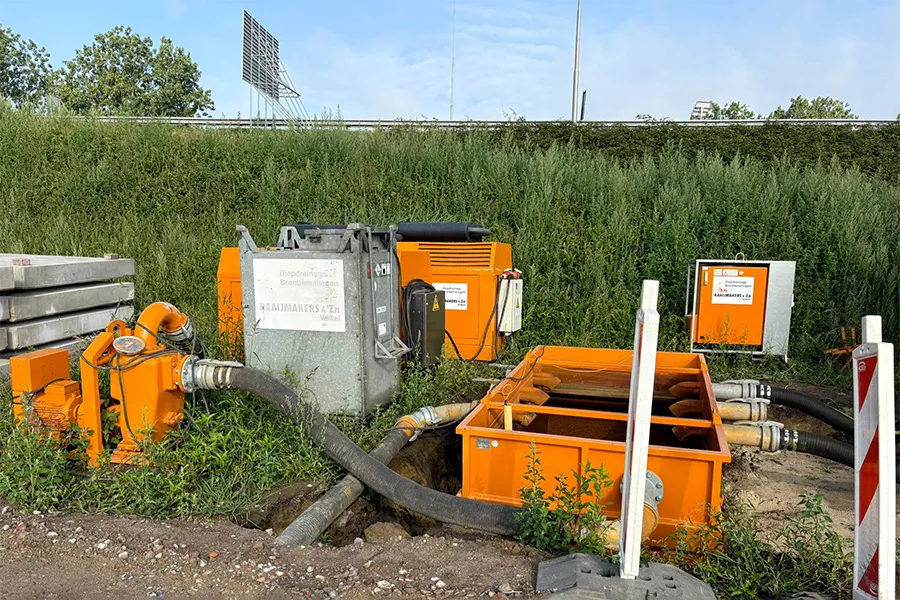
About five weeks before the sliding operation, Raaijmakers en Zn. Bronbemaling carried out a pumping test in collaboration with the construction consortium. “The main aim was to check whether what we had planned together could actually be achieved. We reached the required drawdown within 24 hours,” says Raaijmakers. Even so, they decided to start dewatering five days before Hooipolder’s 100-hour operation. This gave the ground time to dry out and helped speed up the earthworks. “The system ran for about eight days and was shut down once the underpass was in position and had been backfilled. The abstracted water was discharged into surface water via four straw containers. This brought the iron content down from 10 mg/l to less than 1 mg/l.”
Because the deep wells were located just outside the worksite, with all the equipment also set up outside it, the construction consortium experienced no disruption during the sliding operation. “So Hooipolder’s 100-hour operation wasn’t particularly challenging for us. That’s not always the case on other projects,” says Raaijmakers, who looks back with pride on another successful dewatering project. Brief, but effective.
Een zakelijke vraag aan Henk van Tongeren Water & Techniek? Get in touch
Companies in this story


Keep following this
Get an email when a new story is published. No account needed.
- ThemeUnderground construction
- SubjectRoad construction
- CompanyHenk van Tongeren Water & Techniek
- CompanyVan Tongeren Watertechniek
- CompanyBronbemaling.com







