









De Bruin Ermelo sets out 80 kilometres of lines on the A10
Text Suzanne van Gaale Beeld De Bruin Ermelo
Last summer, Rijkswaterstaat carried out major maintenance on the Zeeburgerbruggen on the A10. A major project that had to be completed in a short timeframe and involved a large number of people. Exactly the kind of work Johan de Bruin thrives on. Working for main contractor BAM Infra Nederland, he shared responsibility for setting out, transport coordination and monitoring the schedule. He is also working hard with his company to develop a sustainable method for milling off road markings. Johan sees considerable potential in this niche market.
Johan has been in the business for many years. He puts his knowledge and experience to work as an independent site manager and work planner under the name De Bruin Ermelo, working for BAM and other civil engineering contractors. His work on the major maintenance project at the Zeeburgerbruggen has been varied, ranging from setting out to overseeing day-to-day operations and monitoring the schedule. “In this case, there was already a comprehensive plan in place,” Johan explains. “It was my job to make sure that every subcontractor could do their work in the right place at the right time. This included coordinating transport and aligning the schedule with the various subcontractors. This work is not for everyone. You need to be able to handle stress, because it’s a real high-performance sport when you consider that you’re constantly working to make sure everything runs smoothly.”
Road markings and guidance lines
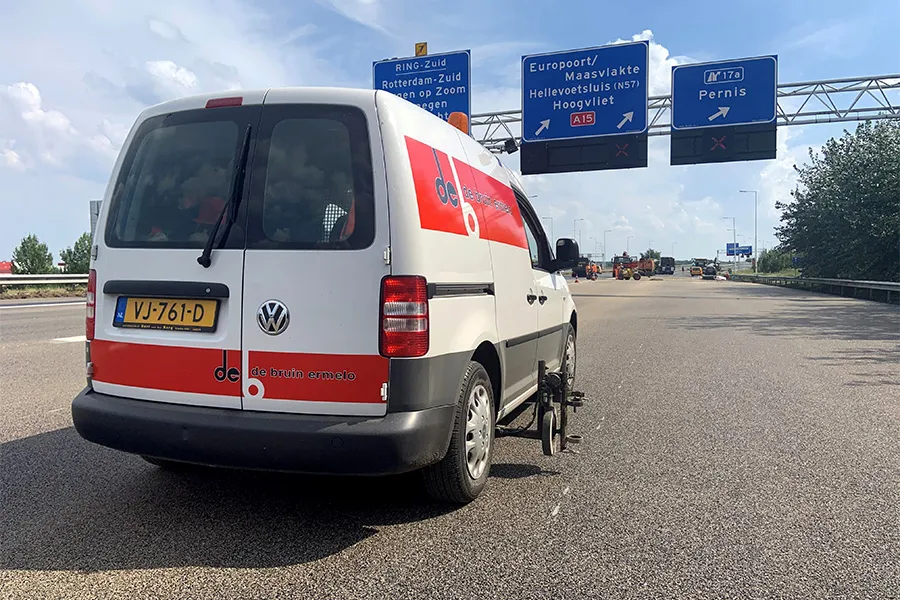
Alongside his work as a site manager, Johan has also handled the setting out. He has a regular pool of people he works with for this. Setting out includes drawing up level plans for the various structures and setting out the positions for installing the new finger joints. “We measure everything where height, width and length are a factor. We mark out guidance lines on the asphalt so the milling machines and asphalt pavers know exactly where to go.” The road markings and guidance lines are set out using specially built vehicles, which mark out the lines at a speed of 5 to 6 kilometres per hour. “We have three vehicles of this type, one of which will soon be electric. The vehicles make us highly visible and help us work safely, as we often work at night. The section of the A10 where we carried out the setting out was more than 2 kilometres long. In total, we set out 80 kilometres of lines there.”
Sustainable removal and reuse of road markings
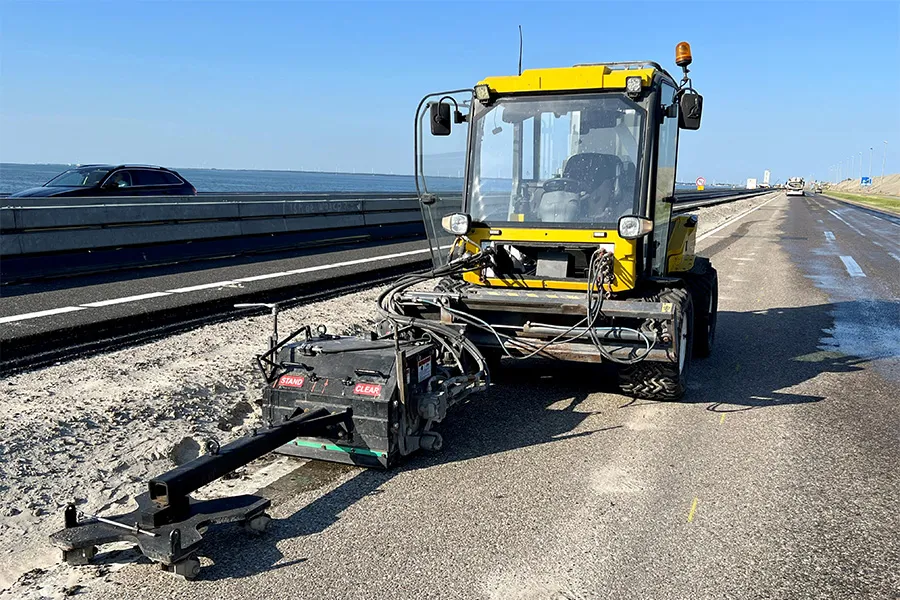
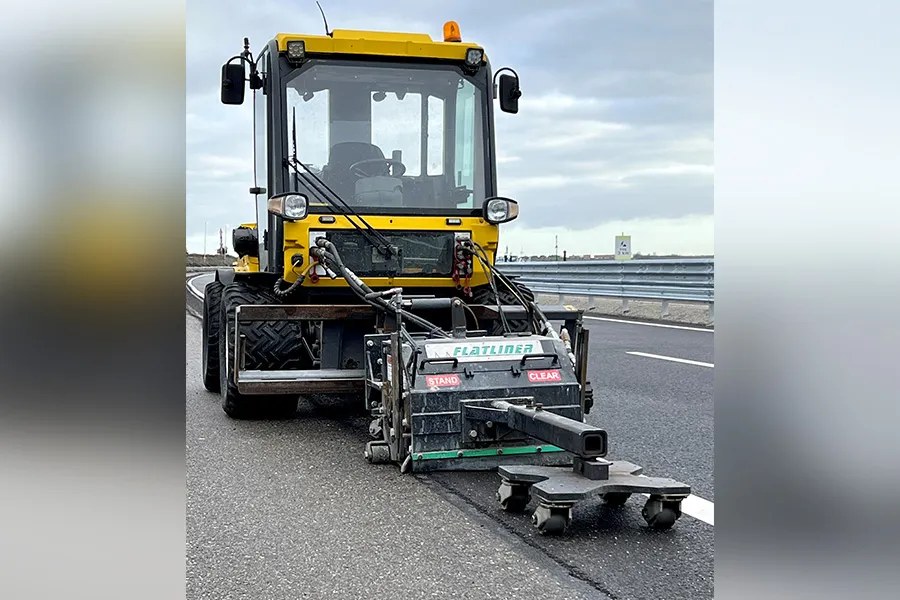
Alongside his work as a site manager and in setting out, Johan is focusing on removing road markings in a sustainable and responsible way. “Sustainability is playing an increasingly important role in the sector. When you consider that hundreds of tonnes of road markings are applied to roads on average, you can see that they also have to be removed. It’s a market with considerable potential, where we want to drive sustainability improvements. It’s becoming more and more of a specialism. This applies both to reusing the material and to the way it is removed.” Johan commissioned the development of a special machine in the United States for removing road markings. It uses a diamond grinder to mill asphalt to an accuracy of 0.2 millimetres without damaging the existing asphalt. This avoids generating large quantities of unnecessary asphalt rubble and reduces the need for transport. The same machine can also be used to mill through asphalt and concrete structures to create space for cables, pipes and fibre-optic cables. “The technology is still being developed, and the first tests for reuse are under way.”
Question about this story? Ask your question
Keep following this
Get an email when a new story is published. No account needed.
- ThemeDigitalisation from design to construction
- SubjectRoad construction







