









World first: wind turbines on a primary sea dike using Cutter Soilmix technology
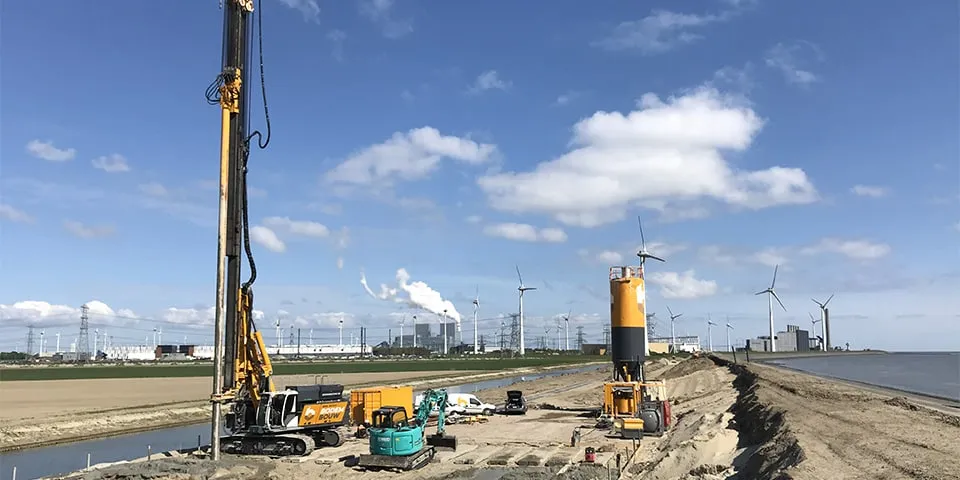
Wind energy plays a major role in the transition to a fully sustainable energy supply. Sea dikes in particular offer strong, consistent wind conditions, supporting renewable energy generation and the achievement of sustainability targets.
innogy, a developer, constructor and operator of renewable energy generation capacity in Europe and North America, best known in the Netherlands for the Essent and Energie Direct brands, has achieved a world first at its Oostpolderdijk wind farm in Eemshaven: the company is having three wind turbines built on a primary sea dike. Contractors Boskalis Nederland and KWS Infra are carrying out the civil engineering works under the name ‘Ommelanderdiek’.
A unique, innovative concept in the wind industry
This innovative concept has never been applied before. It was preceded by an extensive period of engineering. ABT has been involved as a consultancy from the very outset of the project and ensured that all the parties involved, including the water authority, the province and the municipality of Het Hogeland, were working towards the same goal. Vasco Veenbergen, geotechnical project manager at ABT: “People mainly know us for large, complex projects in non-residential construction, but we are also active in civil engineering, roads, water engineering and infrastructure. Around a third of our company works on wind turbines and dike improvement at a high level of complexity. These activities were recently brought together under WindBase, part of ABT.”
Production of the CSM panels by BodemBouw at the Oostpolderdijk site in Eemshaven.
Water safety comes first
Veenbergen: “Our dikes literally separate land from sea, so water safety must never be compromised. Wind turbines are usually installed on agricultural land, but placing them on a dike requires different preparation.” Waterschap Noorderzijlvest made the sea dike available for the wind turbines. As well as owning the dike, it is also responsible for supervising water safety. “We carefully assessed and calculated what kind of foundation was needed and which techniques could be used,” Veenbergen continues. “The aim was not to weaken the dike in the permanent situation, or while the work itself was being carried out.” A Mixed-In-Place technique was the solution.
CSM technology used on a primary flood defence
The specialist in underground construction using the revolutionary CSM system (Cutter Soilmix) is BodemBouw. Djordy van den Eijnde, project manager at BodemBouw: “Our technique, which involves adding a cement mix to the existing soil, usually works best on urban projects. It is therefore good to see its benefits, including being vibration-free and settlement-free, and adding cement mix to the existing ground, also coming into their own on a primary flood defence. Our experience using CSM in combination with clay is a major advantage on this project.” BodemBouw and ABT devised a work sequence and inspection plan that also ensured the dike’s safety during construction. Van den Eijnde: “Close coordination with the contractor and the consultancy adds significant value to the project. What has been designed must be built and meet all the requirements, and that calls for a solid foundation of mutual trust.”
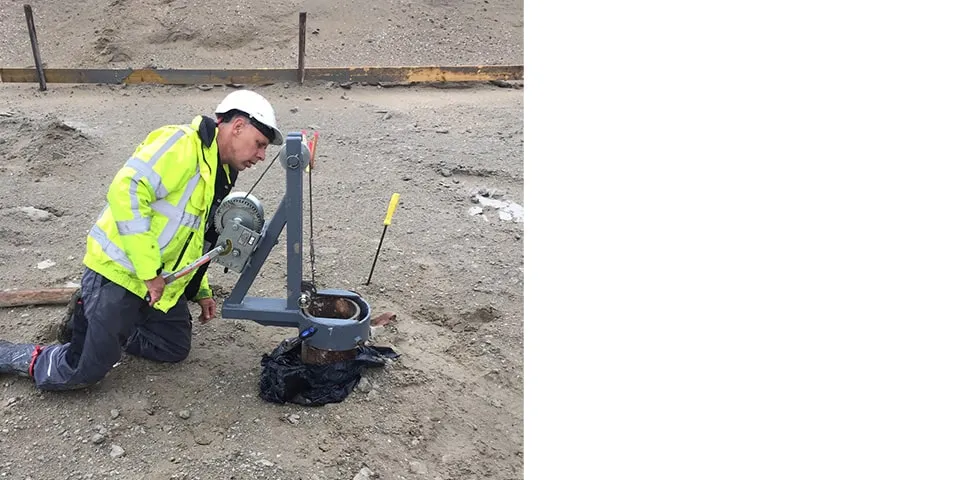
BodemBouw creates the liners to ensure quality. Samples are taken from the full panel using the liners and tested extensively in a laboratory.
A load-bearing subsoil
The turbine places static and dynamic loads on the ground, Veenbergen explains. “Turbine vibrations can cause the top layer to liquefy, which in turn can put the flood defence function at risk. Ground improvement is needed to prevent settlement. Individual CSM panels are milled into the clay in the dike to reinforce the ground beneath the wind turbine foundations. The turbines will have wide raft foundations resting on the CSM panels. This also addresses the risk of tilting towards the canal behind the dike under the turbines’ immense loads.”
Exceptional conditions
Exceptional conditions must also be taken into account, Veenbergen says. “Extremely high water levels often coincide with storms, which place the wind turbine under maximum load. CSM panels are therefore installed around and beneath the foundation, but they are not placed against one another, allowing groundwater to flow between them. In the event of an earthquake, which may pose a risk at this specific location, the turbine must be able to move with the dike. Here, we address that by positioning the CSM panels in the dike in a specific way. Thanks to this optimised design, the CSM panels can deform horizontally because they are not confined by the deep sand. I can say that this is the most complex calculation my colleagues Thomas Lankreijer and Arie-Jan van Renswoude and I have ever carried out.”
Quality assurance
These complex calculations must, of course, be verified. Van den Eijnde: “Quality is assured through an extensive monitoring plan under which BodemBouw takes wet grabs of the liquid mix. Liners have also been installed, allowing us to take samples from the full panel.” Veenbergen adds: “Manufacturing and installing the liners is a very important part of the process, as this determines the quality of the test results. BodemBouw is highly skilled in carefully installing liners to obtain reliable samples. They have also drawn up a thoroughly developed inspection plan, drawing on their many years of experience.” Both the wet grabs and the liners are tested and assessed by a concrete laboratory. Monitoring must continue during the final phase to check how vibrations compare with the calculations and make adjustments where necessary. The project’s complexity lies in combining various mechanisms in a single calculation: dike safety during high water, maximum loads on the wind turbines during storms, and the risk of settlement in the event of an earthquake. This makes the project unique. It is also a unique, innovative project for the water authority, adding value to the sea dike without compromising its flood defence function..
Question about this story? Ask your question
Companies in this story

Keep following this
Get an email when a new story is published. No account needed.
- SubjectWater infrastructure
- CompanyBoskalis Nederland
- CompanyKWS







