









Work on the Nieuwe Sluis in Terneuzen making steady progress
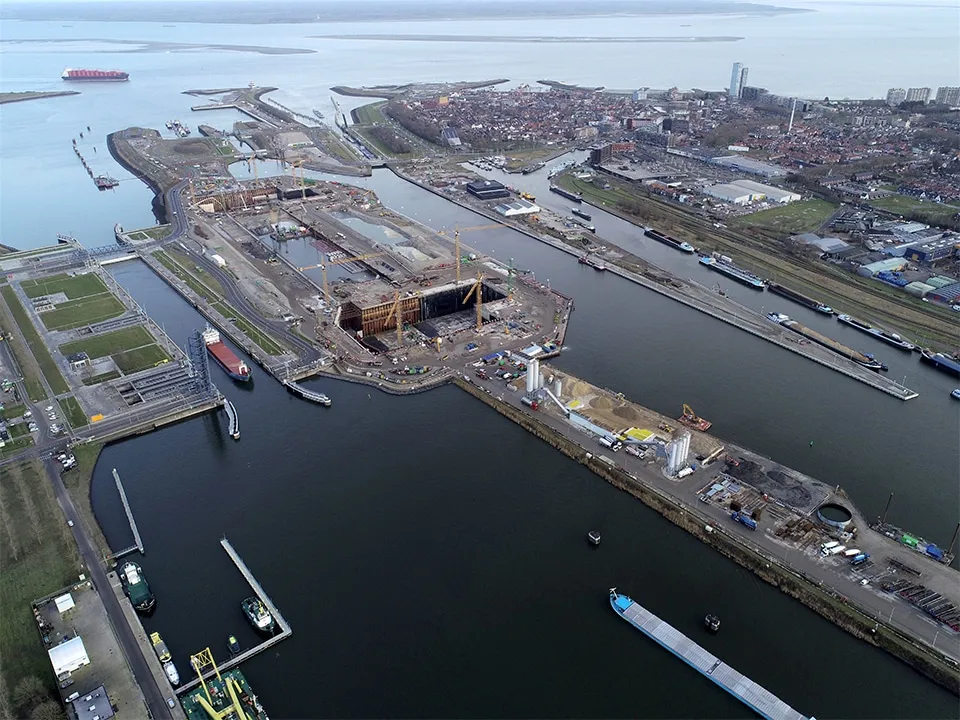
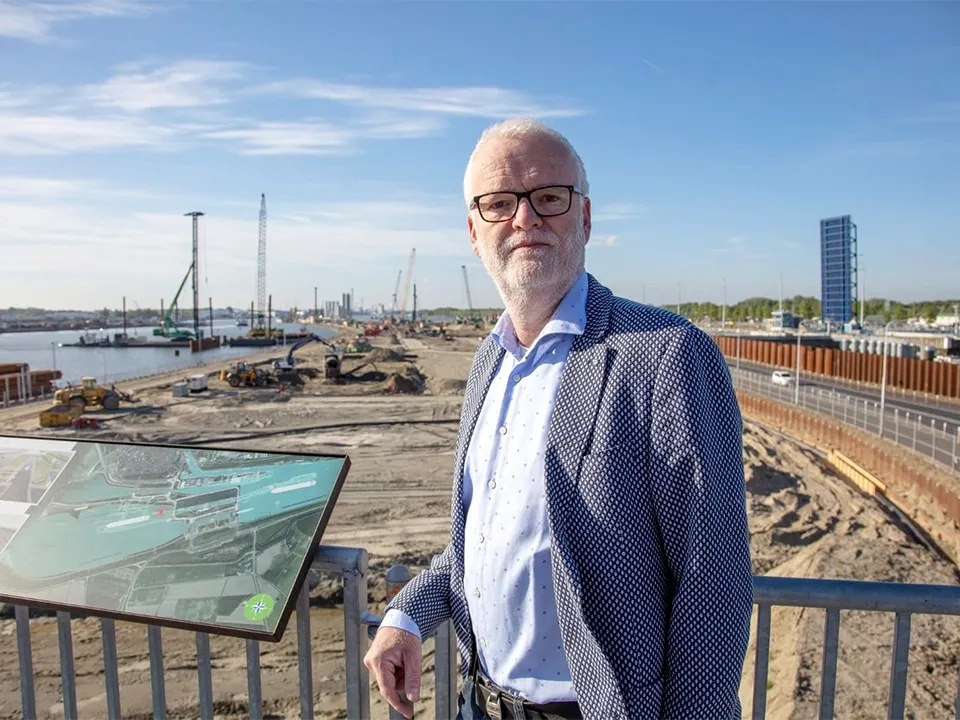
While Terneuzen is a hive of activity, work is also progressing apace elsewhere in the world, in China to be precise. The lock gates that will form the beating heart of the lock are being built there. We speak to environmental manager Harm Verbeek, looking back with him at what has been achieved and ahead to what lies in store.
“In 2019, the outline of the Nieuwe Sluis in Terneuzen was marked out in the ground, and the diaphragm walls and combi-walls were installed,” Verbeek explains. “Excavation of the outer lock head, on the Western Scheldt side, began in 2020. The ground was excavated dry to 11 metres below NAP, with some of the soil taken to a storage site and the rest transported by ship to the Western Scheldt.”
Outer lock head cofferdam flooded
In May 2020, the outer lock head cofferdam was flooded. “The excavation work was then carried out underwater, from a pontoon. The excavated material was removed by hopper barge. The underwater excavation went down to 22 metres below NAP. With ground level at 3 metres above NAP, the cofferdam was 25 metres deep at that point. The work was completed at the end of June 2020, when a layer of gravel was placed on the bottom of the cofferdam.”
Underwater concrete and dewatering
“In August 2020, the underwater concrete for the outer lock head was poured in a continuous operation lasting 75 hours. It was a major undertaking: a full 1 metre of concrete over an area measuring approximately 85 metres by 140 metres. The cofferdam was dewatered in stages a week after the pour. Groundwater levels were monitored closely. Once we reached the bottom, we celebrated reaching the lowest point, while of course observing COVID safety measures,” says Verbeek.
Dry excavation of the inner lock head
While the outer lock head was being excavated underwater, dry excavation began at the inner lock head. “The same procedure was followed there. Once the dry excavation was complete, the crane was put to work from the pontoon to begin the underwater excavation. The underwater concrete was then poured there in mid-November 2020, followed by dewatering the cofferdam at the end of November. By mid-December, the bottom had also come into view at the inner lock head.”
Tower cranes installed and concrete work gets under way
The first tower cranes were installed at the outer lock head in September 2020, followed by those for the inner lock head in December 2020. “That work was completed in early January 2021 with three more cranes,” says Verbeek. “January also saw the start of the remaining concrete work at both the inner and outer lock heads. This includes the gate recesses, the bridge pit alongside them, 3-metre-thick concrete sills into which the gate rails will later be installed, and the inlet structure for the bypass culvert on the west side. Taken as a whole, this is a complex set of concrete structures that will all need to be connected to one another. 2021 will be a year full of concrete work. The lock chamber will also continue to be excavated underwater and will receive underwater concrete later this year.”
Manufacture of the lock gates
The lock gates are being manufactured in China. “The latest update is that work has begun on welding the various sections together. The four gates are expected to be completed this spring. The same factory is also building the two steel bridges at the same time. There is also a series of smaller components, such as the sewer gates. The Chinese manufacturer is a highly experienced steel construction company, but the process is nevertheless being closely supervised by our own inspectors. Quality and safety standards are very high. The entire shipment from China will be made by sea, arriving in Vlissingen. After being stored in the Canal Zone, the gates will be installed in the lock in 2022,” Verbeek concludes.
Question about this story? Ask your question
Keep following this
Get an email when a new story is published. No account needed.
- SubjectWater infrastructure







