









Widening the busy Kiel Canal (D)
Text Susan Peek Beeld René Meijer / Van den Herik, WNA NOK
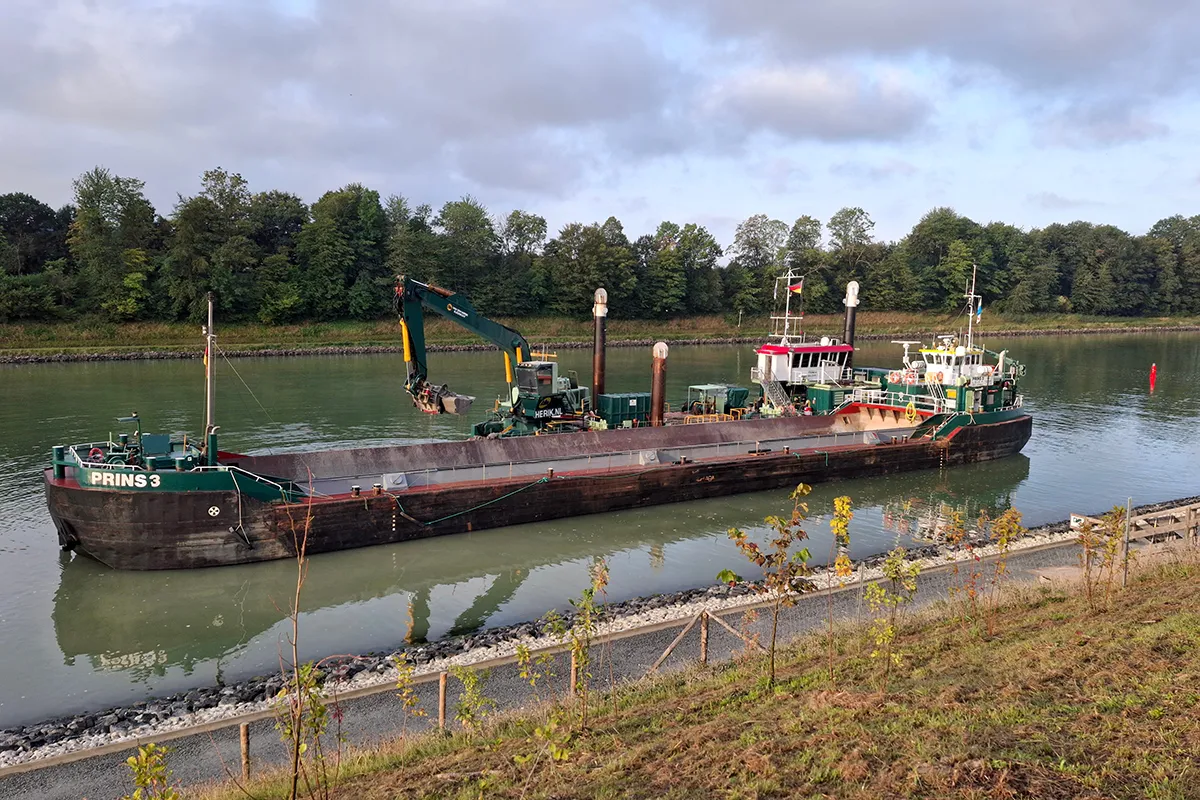
Water engineering in complex conditions
The eastern section of the Kiel Canal in Germany has been a bottleneck for shipping for years. The canal section was built more than a century ago under Kaiser Wilhelm. As shipping traffic increased and vessels grew larger, the load and pressure on the banks rose, while parts of the route still had the dimensions set in 1914. As a result, large vessels could not pass one another and had to go through one at a time. A major widening project has been launched to future-proof the canal. Van den Herik-Sliedrecht worked as part of a joint venture on a 4.5-kilometre section between Großkönigsförde and Groß-Nordsee.
The project was carried out for WNA Nord-Ostsee-Kanal, with the canal bed being widened in stages from 44 to at least 70 metres and sharp bends being eased.
Large volumes
This section comprised various fill layers with substantial differences in elevation and highly heterogeneous ground conditions, which affected stability. Shipping also continued throughout the works. “These factors made the widening technically and logistically complex,” says Teo Huisman, international regional manager at Van den Herik. “In some places, we had to excavate 20 metres in the dry before reaching the waterline.” In total, 1.5 million cubic metres of dry material was excavated, followed by around 1.1 million cubic metres removed by water during the dredging phase.
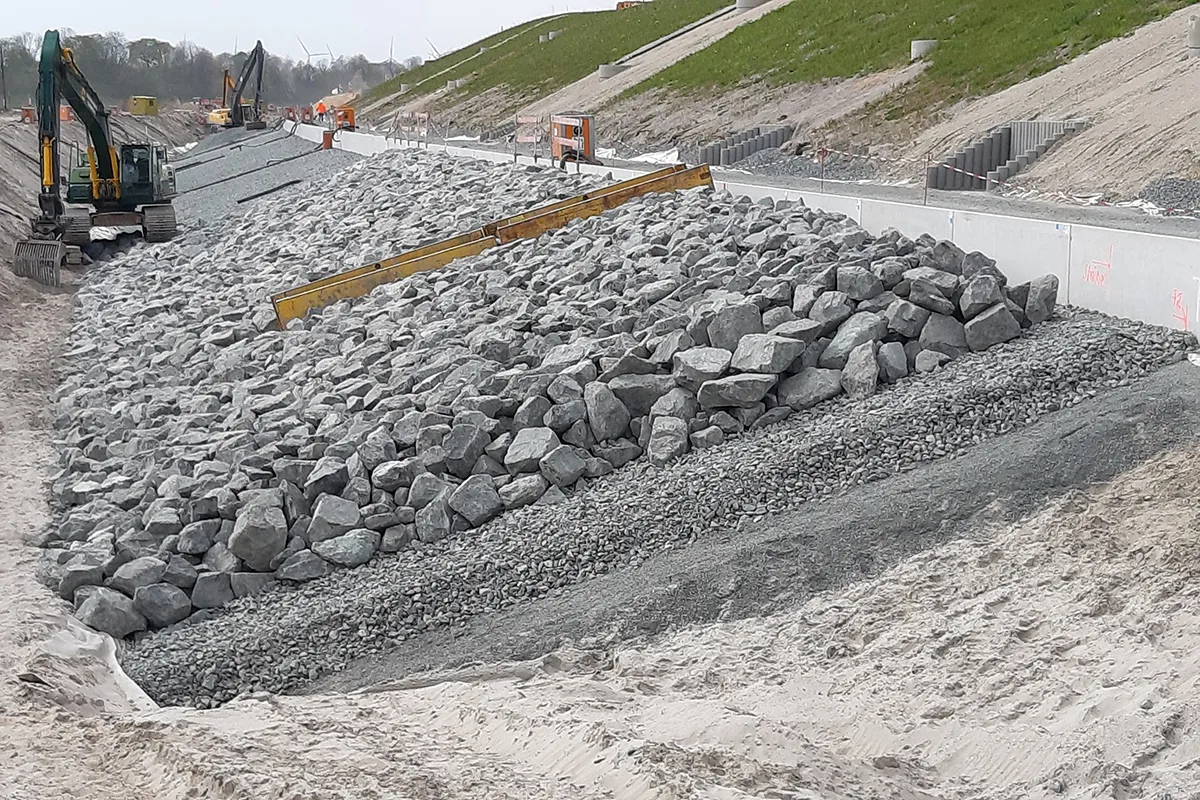
Joint venture
Van den Herik worked in a joint venture with Depenbrock and DEME. Depenbrock excavated the route to the required depth down to the waterline, while Van den Herik installed the new bank protection, around 180,000 tonnes, in some locations down to the canal bed at a depth of about 11 metres. Once most of this work had been carried out in the dry, the wet phase was undertaken in collaboration with DEME. “Because you cut through several water-bearing layers, there was a substantial influx of water, so we had to use a closed dewatering system with drains instead of open dewatering,” says René Meijer, who is responsible for projects in Germany. “That requires a lot of coordination and makes this kind of work considerably more intensive.”
Huisman and Meijer say it is crucial for a joint venture to operate as one team. “Be open with the client, think along with them and offer solutions,” says Huisman. Meijer adds: “We don’t sit back, we keep digging. We focus on solutions, progress and deadlines. It always works out, however difficult things may get.”
After the old bank line was removed, the canal was widened to its final dimensions. The section has now been technically completed and was officially opened earlier this autumn by the Federal Minister.
Looking ahead to Hamburg
Next year, Van den Herik will start work in the Port of Hamburg. Two historic harbour arms will be shortened, and the material removed will be used to fill in a harbour basin. “Another major project,” says Meijer. “It involves moving 1.7 million cubic metres of earth, controlled demolition, munitions surveys and staged construction because of settlement. It’s a challenge we’re keen to take on.”
Question about this story? Ask your question
Keep following this
Get an email when a new story is published. No account needed.
- SubjectWater infrastructure







