









‘We always try to raise the weakest link in a chain to a higher level’
We have written before about ‘predictive maintenance’, carrying out and planning maintenance based on techniques that determine condition. It is a new term for a process underpinned by today’s technology, including sensor technology and data processing using algorithms. Very much of the moment. Yet assessing condition and tailoring maintenance accordingly are nothing new. At least, not at Croonwolter&dros.
We discuss this with Guido Koopmans, Manager Maintenance, and Eric Schuurman, Project Manager at Croonwolter&dros. “If you look at what the term ‘predictive maintenance’ means and unpack the concept, you can see that Croonwolter&dros has been applying this approach for a very long time. It is only the ways of measuring, recording and processing data that have changed, thanks to advances in technology,” Koopmans begins.
The reliability of a component is linked to the operational reliability of the whole
Schuurman continues: “In the past, things were apparently built more robustly, with greater tolerance for failure. Today, or rather over the past 20 years, systems have become increasingly complex. They are also more reliable, but with more and more added features. The reliability of a component is linked to the operational reliability of the whole. That is why we also factor in ‘replaceability’ when selecting components.”
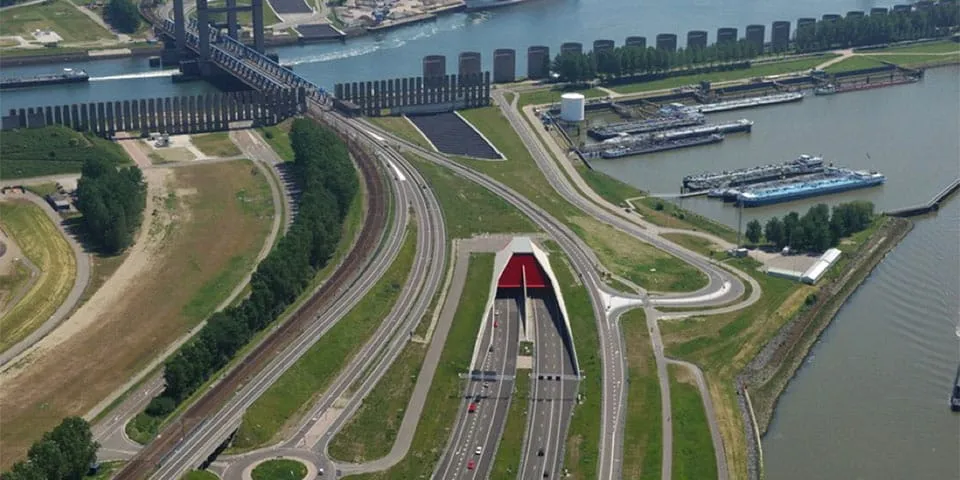
Thomassentunnel, nicknamed “The Ferrari Tunnel”.
The balancing act between innovation and the use of ‘proven technology’
Koopmans notes that there is sometimes a dilemma: “On the one hand, the government asks for innovative solutions, but when it comes to reliability, it prefers ‘proven technology’. The pace of development in electrical engineering is enormous at the moment, with very short cycles. It is up to us to assess how reliable a newly developed component is and how to incorporate it into the overall maintenance plan.” Schuurman adds: “Knowing that product turnover is continuing to accelerate, we try to select suppliers for projects that offer a 15-year supply guarantee. We pass this requirement on to our partners through our contractual obligations, based on technical requirements. The ideal, however, is also utopian: it would be great if, under a 20-year maintenance contract, we could count on the availability of suitable, working parts for 20 years. Often, though, a replacement product has changed so much that documents have to be revised and the system re-engineered and tested. But that is something we are good at.”
Making everything that can be more efficient more efficient
Maintenance is certainly not a static process at Croonwolter&dros. As an innovation leader, the company is always looking for ways to optimise. Koopmans gives a good example: “Take cybersecurity. With increasing digitalisation and communication via the Cloud, this is a very important topic, including in maintenance. We offer comprehensive cybersecurity scans. After a scan, we work with the client to identify areas for improvement and propose ways to improve security quickly and effectively. This is good first and foremost for the client, but also for Croonwolter&dros and the Netherlands as a whole.” Schuurman adds: “Information security must become second nature. Care is needed when you entrust the operation of systems to the Internet of Things.”
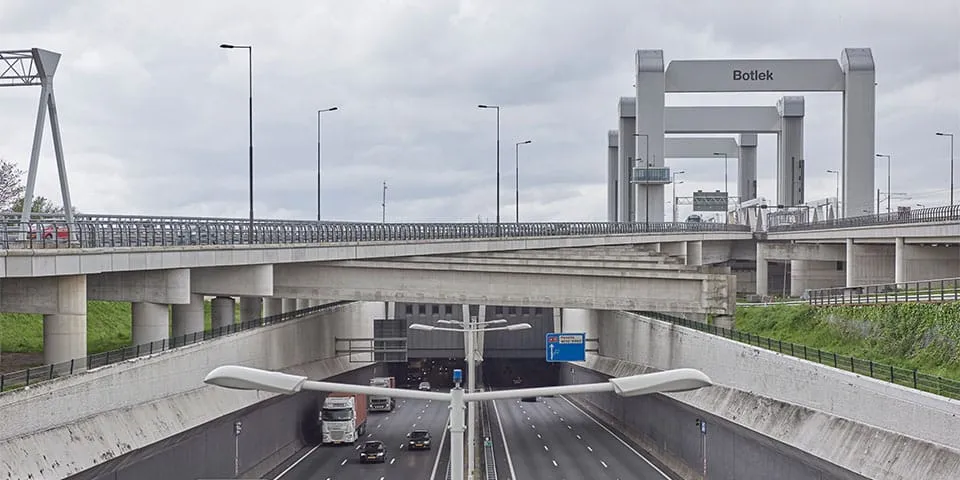
The Botlektunnel and the Botlekbrug.
‘Groot Rotterdam’, more a nickname than a working title
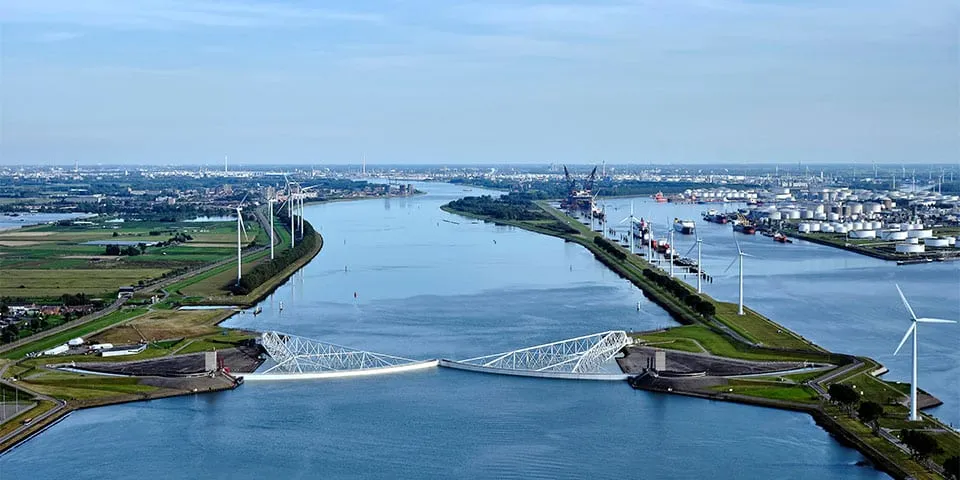
Croonwolter&dros has four major maintenance contracts in and around Rotterdam. The team working on them internally calls the work ‘Groot Rotterdam’. “That is not an official name, but more a nickname,” Schuurman explains. “These are four excellent projects with maintenance as a major component. My own department provides services to the projects. We grew out of the A15 renovation project south of Rotterdam. It is called ‘MAVA’, from Maasvlakte to Vaanplein. The project is managed by RWS, with A-lanes A15 as our client. We are responsible for maintaining our own scope at our own risk. The project includes the Botlektunnel, the Botlekbrug and the Thomassentunnel.” In addition, Croonwolter&dros owns a 50% share in Sherpa Mos, a joint venture between Hollandia Services and Croonwolter&dros, which carries out multi-year maintenance on the Maeslant- and Hartelkering together.
Schuurman names the iconic Maastunnel as the third project. It was recently restored. “Croonwolter&dros, Mobilis and Nico de Bont, as the CAM joint venture, carried out the full renovation and restoration of ‘De Oude Dame’. We are now in the maintenance phase,” Schuurman explains. “And do you know what’s great? When I started at the then Croon Elektrotechniek 31 years ago, I was already assigned to renovation work on the Maastunnel. Now, 30 years later, I am responsible for its maintenance on behalf of the CAM joint venture. I could never have imagined that, or even dared to hope for it!” The A13-A16 Rotterdam Connection is the fourth project in ‘Groot Rotterdam’, on behalf of the ‘De Groene Boog’ joint venture. Schuurman: “The maintenance contract is already in our portfolio. We hope to take on maintenance of the entire route in 2024, once everything is complete, just as we have for the A15 and the Maastunnel. All four clients we serve through ‘Groot Rotterdam’ are equally important. That is necessary, too, because it is the only way we can put together the right mix of projects and risk profiles to staff everything.”
Minimising safety risks is paramount
“Our highest priority is to minimise safety risks on all fronts,” Schuurman continues. “Safety cannot be taken for granted. Everyone must be able to rely on safe traffic conditions: the client, road users, road workers and our own people. That is our number one priority.” Koopmans adds: “We make full use of the experience we gain on projects and share information with one another. Our people need to keep their knowledge of a project and its assets up to date. That means they have to visit a project frequently. That is why we rotate our people, so the work does not become a ‘trip around the church’. This teaches us to take a broader view and innovate on a much wider scale.”
Koopmans names human error as one of the biggest risk factors affecting availability. “We build in safety protocols. At the Maeslantkering, for example, we have different teams maintain different pumps to prevent errors from being copied. That takes careful planning. It is a form of ‘redundancy’ at the human level. The Maeslantkering is essentially a large robot. That is good in one respect, because it eliminates human error. But it makes maintenance complex. That is why we invest in our people, in their knowledge and skills. Human capital… it is, and always will be, work done by people. We always try to raise the weakest link in a chain to a higher level.”
A business enquiry for Croonwolter&dros? Get in touch
Companies in this story

Keep following this
Get an email when a new story is published. No account needed.
- SubjectWater infrastructure
- CompanyCroonwolter&dros
- CompanyMobilis







