









Waterbouwprijs 2024 awarded to Lian Schout of Hogeschool Rotterdam and Anne-May Alkemade of TU Delft
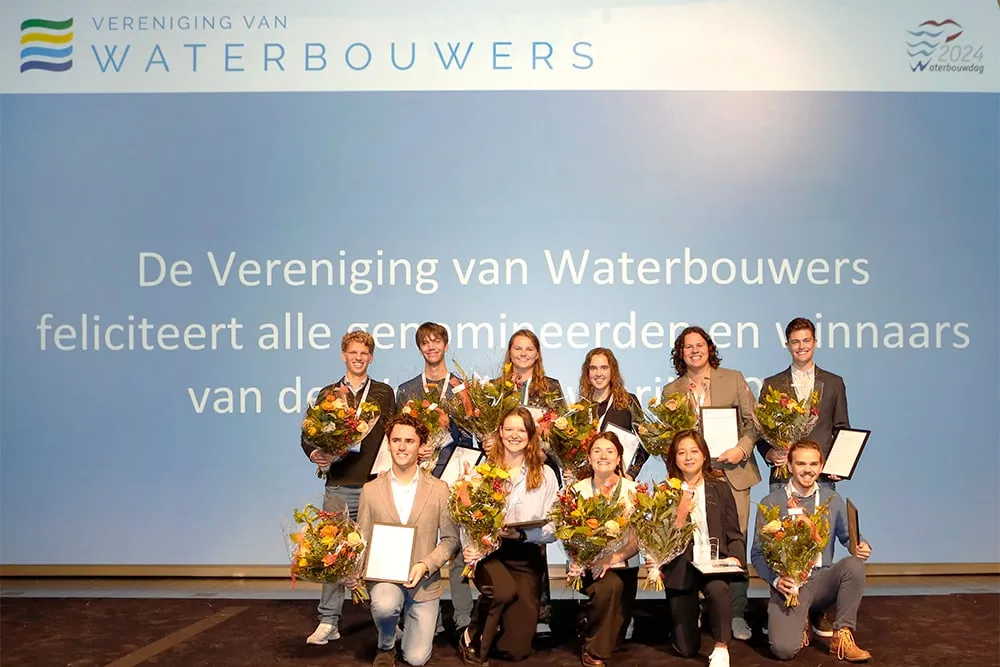
Lian Schout of Hogeschool Rotterdam has won the Waterbouwprijs 2024 in the HBO category with her graduation project. The first prize in the WO category went to Anne-May Alkemade of TU Delft. The prizes were presented during Waterbouwdag, held once again this year at Beatrix Theater Utrecht, by the 2023 Waterbouwprijs winner in the WO category, Maria Montijn.
The winners
Lian Schout, a graduate of Hogeschool Rotterdam, won with her graduation project, “The erodibility of Trisoplast and clay”. Large quantities of clay are used in the Netherlands to reinforce flood defences. This clay layer must prevent the dike from failing due to erosion. Sufficient clay of the right quality is becoming increasingly scarce, and the use of Trisoplast offers an alternative. Trisoplast is a mineral sealing material made from sand, bentonite and a polymer, currently used for base and top liners at waste disposal sites. Through a series of laboratory tests, Lian demonstrated in her graduation project that Trisoplast has greater resistance to erosion than erosion class 1 and 2 clay under both parallel flow and wave loading. This demonstrates the potential of the material as a replacement for clay in dike reinforcement. The jury considers Lian’s research to be of an excellent standard. The research is well scoped, carrying out a series of tests in such a short time is an impressive achievement, and the report is clear, with well-defined conclusions. The research is innovative because it has advanced the use of Trisoplast in dike reinforcement.
Anne-May Alkemade, a graduate of TU Delft, won with her graduation project, “Seed-sediment Dynamics: An experimental study into the behavior of seagrass seeds in a sand mixture informing a novel approach for large scale seagrass restoration”. Restoring seagrass in shallow waters is essential because it stores large quantities of CO2 and helps prevent erosion. At present, however, there is no suitable, low-cost technique for carrying this out on a large scale. The new idea is to lay a thin layer of around 10 centimetres using a mixture of sand, water and seeds. The seeds need to be 1-5 centimetres below the top of this new sand layer to develop properly. In her research, Anne-May examined the dynamics of such a mixture to determine whether, and if so how, this technique could work, using a series of different types of experiments. The experiments show that low sand concentrations and smaller sand grain diameters help the seeds reach the right position in the soil. At higher concentrations or with larger grain diameters, considerable or even complete separation occurs during sedimentation, leaving the seeds on top of the sand despite their higher settling velocity. The jury is impressed by the detailed research and systematic answers to the research questions, combining ecological and physical knowledge. The jury considers the report to be excellently written, with many attractive photographs and illustrations and compelling writing from beginning to end. The jury sees this research as an excellent example of how fundamental research into mixtures can bring the scaling-up of a nature restoration solution one step closer, and hopes this promising result will be tested further in practice.
Jury assessment
The Waterbouwprijs jury assessed the graduation projects on criteria including innovation. The jury defines this as the extent to which new elements are added to existing knowledge, the practical applicability of the results and the multidisciplinary approach. The extent to which the project contributes to the sustainability of the sector also plays an important role.
Purpose of the Waterbouwprijs
The purpose of the Waterbouwprijs is to bring water engineering to the attention of young people with renewed energy. The sector needs well-trained employees at all levels. They are needed to carry out water engineering projects both in the Netherlands and elsewhere in the world. Each year, Vereniging van Waterbouwers gives students graduating from HBO or a technical university in water engineering (or a related field) the opportunity to enter their graduation project for the annual Waterbouwprijs.
Vereniging van Waterbouwers
Vereniging van Waterbouwers is the employers’ and business organisation for contractors and service providers in the water engineering sector. It represents around 90 member companies in the Netherlands, which account for approximately 80% of the water engineering market. Its member companies operate in the Netherlands and abroad in fields including land reclamation, dredging, coastal and riverbank works, structural water engineering, port development, soil remediation and area development. The water engineering sector is distinguished by its sustainable, capital-intensive, innovative and international character. www.waterbouwers.nl
Question about this story? Ask your question
Keep following this
Get an email when a new story is published. No account needed.
- SubjectWater infrastructure







