









Verdygo-Nereda plant in Weert now operational
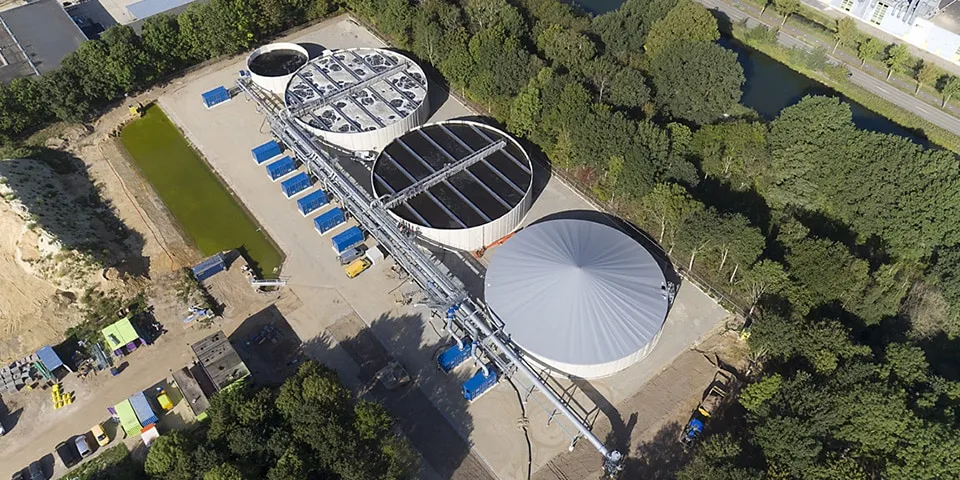
The new wastewater treatment plant (WWTP) in Weert, built using the Verdygo concept and equipped with Nereda technology, is ready. It was delivered on time and within budget to meet the strictest discharge requirements under the Water Framework Directive (WFD). Verdygo, an innovation developed by Waterschapsbedrijf Limburg, is a revolutionary, sustainable and modular construction and design technique for WWTPs. Thanks to the more energy-efficient Nereda technology, a product of Royal HaskoningDHV, the more stringent WFD requirements can be met more energy-efficiently than with conventional treatment methods.
The Verdygo concept had already been partially introduced at several WWTP sites in Limburg, including Roermond, Simpelveld, Wijlre and Hoensbroek. With the introduction of Verdygo in Weert, an almost complete WWTP in the ‘Verdygo style’ has been delivered. The concept will be introduced at the Panheel and Stein WWTPs in 2021.
Fast construction
While construction of a conventional wastewater treatment plant of this size takes around 2 years, the brand-new Verdygo plant was built in just 11 months. This was the result of intensive and successful collaboration between Waterschapsbedrijf Limburg and its construction partners, the Mobilis and Croonwolter&Dros joint venture, partner Tauw, RWB and Royal HaskoningDHV. “We started earthworks in Weert at the end of November 2018 for the new biological treatment plant using the Nereda process,” says Arnold Jansen, who oversees Verdygo as a member of the executive board of Waterschapsbedrijf Limburg. “After months of hard work, we now have a new treatment plant to be proud of.” The new biological Nereda treatment plant was commissioned a few weeks ago in the presence of Royal Haskoning DHV. Initially, water from the Nereda plant underwent further treatment at the old plant. The treatment process is now well established and performance is satisfactory. The new plant has therefore been disconnected from the old one and now discharges directly into the Zuid Willemsvaart.
Modular concept
With the introduction of Verdygo, Waterschapsbedrijf Limburg has effectively reinvented wastewater treatment. Unlike conventional construction methods, which use buried basins, Verdygo consists of above-ground tanks and separate modules the size of standard shipping containers, connected to one another. The modules can easily be replaced using a ‘plug-and-play’ approach, and capacity can be scaled up or down as needed. This modular design enables Verdygo to respond flexibly to climate change, demographic trends and innovations in water treatment. As a result, Verdygo can also offer significant added value in developing countries facing either rapid population growth or local wastewater treatment challenges. Verdygo’s potential is boundless, both literally and figuratively.
Circularity: reusing modules
The modular design also fits seamlessly with Waterschapsbedrijf Limburg’s ambition to become circular by 2030. Unlike in conventional plants, pumps and compressors are not embedded in concrete, but are flexible components of the plant. If a component breaks down, needs maintenance or can be replaced by a better alternative, it can be changed quickly. Modules can easily be transported by lorry and plugged in elsewhere or put into storage, following maintenance or repair if necessary. While old plants embedded in concrete are demolished, Verdygo modules can simply be given a new lease of life. As well as contributing to Waterschapsbedrijf Limburg’s sustainability goals, the organisation sees this circular approach as an opportunity to make its operations cost-neutral in the longer term, after 2030, thereby limiting costs for residents and businesses. In the coming years, WBL aims to evolve from an ‘organisation with the lowest wastewater treatment levy’ into a ‘circular frontrunner’.
Saving and generating energy
Thanks to the energy-efficient Nereda treatment technology, the more stringent requirements of the European Water Framework Directive (WFD) can be met more energy-efficiently. To make the Weert WWTP even more sustainable, a new combined heat and power (CHP) unit has been installed to convert the biogas produced into electricity and heat at a higher efficiency.
Lower total cost of ownership
A key advantage of above-ground, modular and standardised construction is that the annual net costs of construction, maintenance and operation (total cost of ownership) are more than 20% lower than for conventionally built WWTPs. Design and construction time has been reduced by around 60% compared with conventional construction.
Have a business enquiry for Mobilis? Get in touch
Companies in this story


Keep following this
Get an email when a new story is published. No account needed.
- SubjectWater infrastructure
- CompanyMobilis
- CompanyCroonwolter&dros
- CompanyTAUW | Consultancy and engineering firm
- CompanyHaskoning







