









Underwater work carried out by specialists
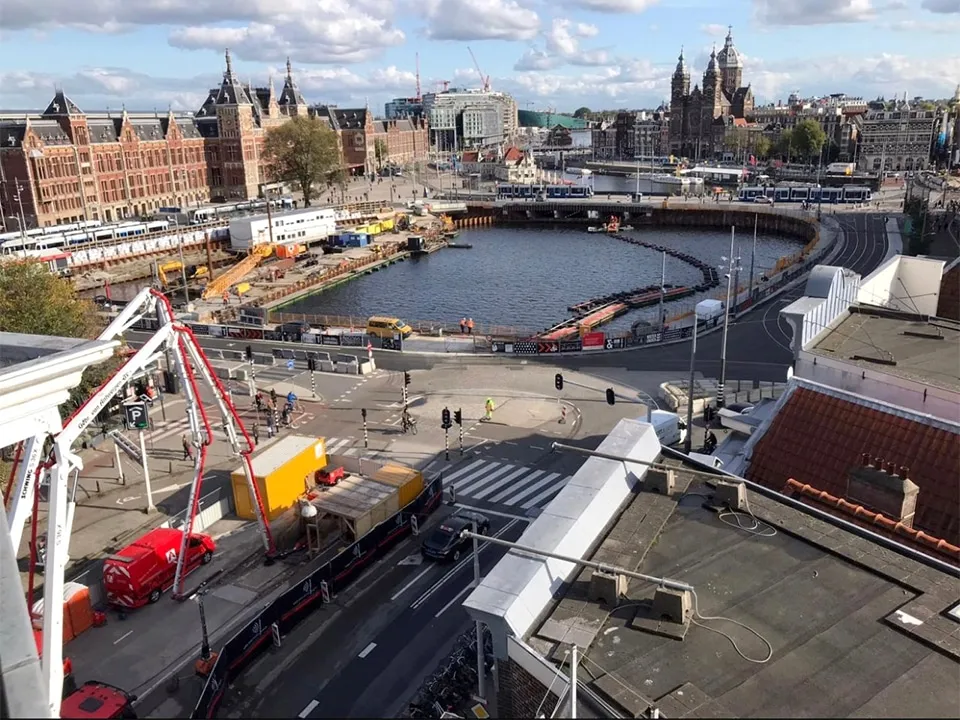
Sometimes it suddenly becomes clear just how important a strong network is. Ramon Wijgmans, General Manager at Qceas, realised this when he found out that a good contact of his worked at Max Bögl.
With the De Entree project in Amsterdam in mind, he got in touch to explain what Qceas does. The result: Qceas was invited to submit a tender to Max Bögl & Partners.
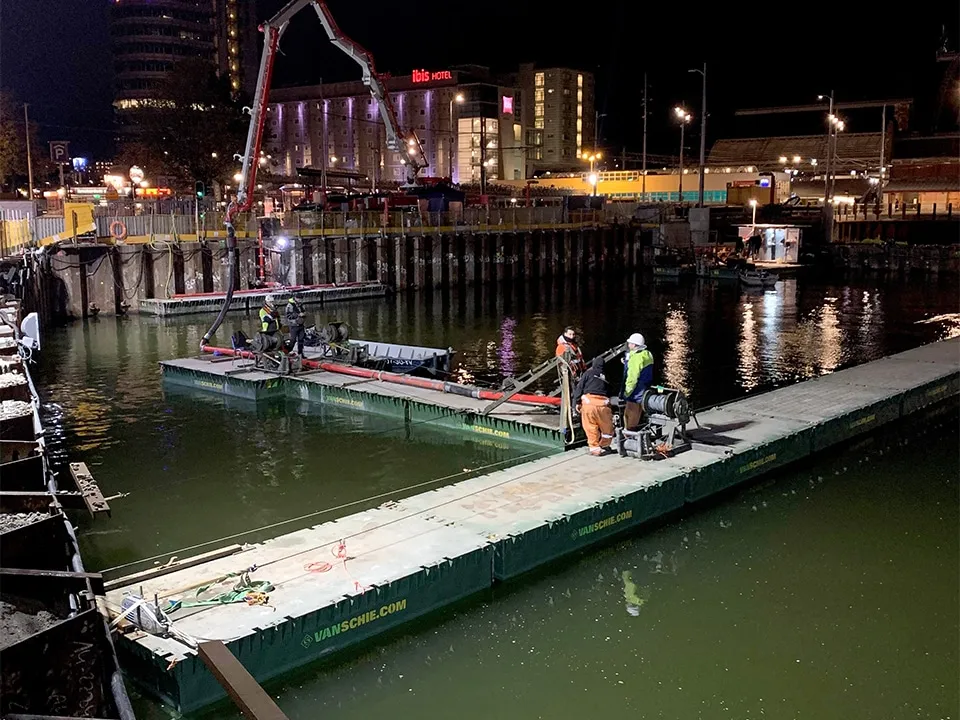
In a presentation, Wijgmans showcased Qceas’s expertise in underwater work in the broadest sense. “The presentation focused on placing underwater concrete via long, floating pipelines,” says Wijgmans.
A comprehensive underwater scope
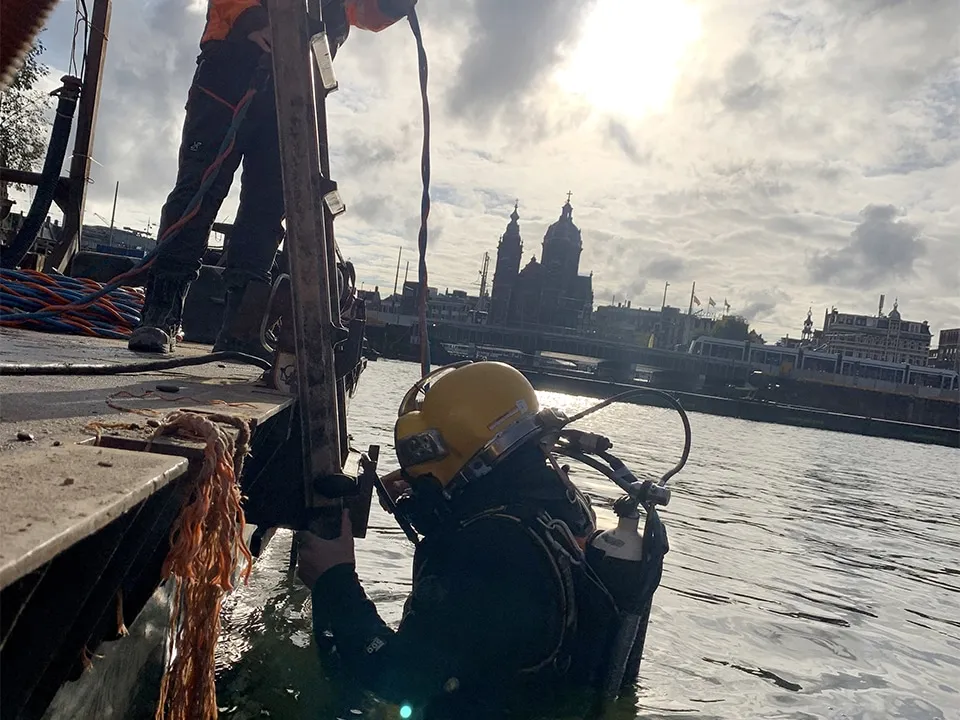
Qceas specialises in managing and carrying out projects in the maritime and civil engineering sectors, with a particular focus on underwater work. The company was awarded the work: “The scope included preparatory work for the underwater concrete pour, inspections, preparing the sheet piles, checking for contamination, welding work on the compartmentalisation, welding work on the cofferdam within the main cofferdam, installing anchors on the compartmentalisation screens and the underwater concrete pour itself. All in all, a substantial job.”
Scope for optimisation
Wijgmans continues: “De Entree is a complex project. We submitted our tender with one proviso: we needed the opportunity to optimise the work. With our knowledge and experience, we always look for the best way to carry out a task, which sometimes means deviating from the usual approach. Our focus, however, is always on efficiency and quality.” One task involved welding a plate to a sheet pile, fitted with two bars of around 25 mm in diameter. “However, the welding detail called for a cumbersome and labour-intensive procedure. We therefore proposed an alternative: an anchor bar through the sheet pile, secured with a coupling nut. This cut down on a lot of welding and was significantly quicker,” says Wijgmans.
Pumping and placing the underwater concrete floor
The underwater concrete then had to be pumped and the floor placed. Qceas selected Gebr. Van Antwerpen for the pumping work. “We used a floating pipeline. Four casing pipes ran under the tram line, passing through the sheet pile. At one end, these pipes were connected to Gebr. Van Antwerpen’s pumping equipment; beyond the sheet pile, they floated on large and small pontoons. We had spare pipe sections ready in case of a blockage.”
Additional work was also required to secure 34 drainage pipes beneath the underwater concrete. A layer of gravel was placed over them, followed by the underwater concrete pour. Qceas worked continuously with 8 people per 12-hour shift during the pour. “The pour took place late last year, with a total of 6.400 m3 of underwater concrete pumped. We started at 9.00 am on Monday and finished at 12.00 pm on Friday. Looking back, all we can say is that it was a great collaboration, built on mutual trust,” concludes Wijgmans.
Question about this story? Ask your question
Keep following this
Get an email when a new story is published. No account needed.
- SubjectWater infrastructure







