









Surface water pumping stations for Limburg’s first polder
Text Roel van GilsImage VOPO
The village of Griendtsveen lies between the Deurnsche Peel nature reserve in North Brabant and the Mariapeel nature reserve in Limburg. For 20 years, work has been under way to retain as much rainwater as possible in the area, helping to maintain and strengthen these raised bogs (Natura 2000). However, this could potentially have caused water problems in Griendtsveen. To prevent this, the water management system around the village was adapted. Contracting company Vissers Ploegmakers approached VOPO to develop the design for two surface water pumping stations as part of a construction team, for this first polder in Limburg.
Adapting the water management system around Griendtsveen is one of several projects in and around the village, alongside the extensive ‘Optimisation of water supply to the Peel canals’ programme, which involves bringing more water into the higher-lying sandy areas of south-east Brabant and north-west Limburg.
One-stop shop
VOPO offers clients such as government bodies, water authorities, regional water authorities, provincial authorities, municipalities, engineering consultancies and water engineering contractors a one-stop shop for surface water technology. Its services range from advice, design and engineering to construction and aftercare for fish-friendly pumps and pumping stations, inlets, weed-screen cleaners, fish passes, weirs, electrical installations and pipework. This covers new construction, overhauls and refurbishment.
Protected village conservation area
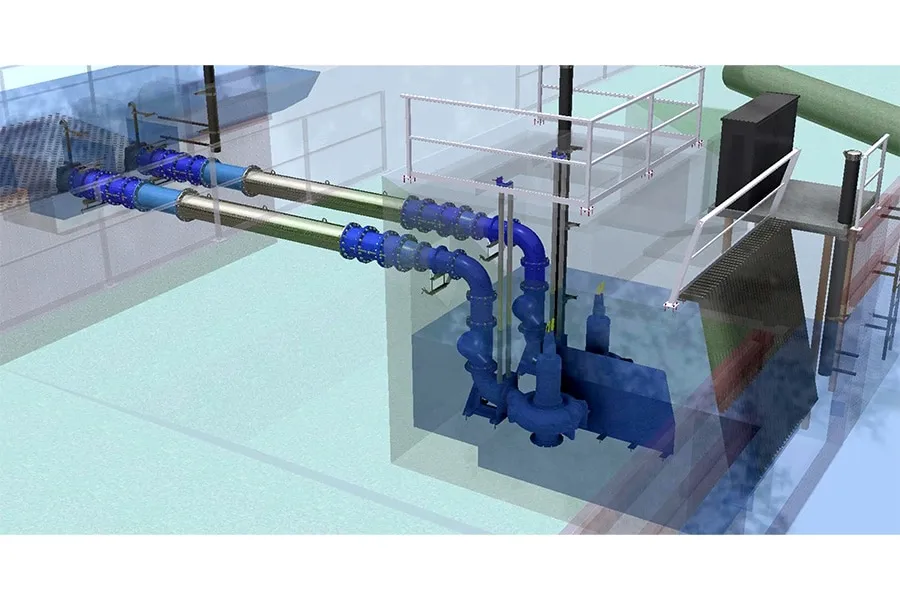
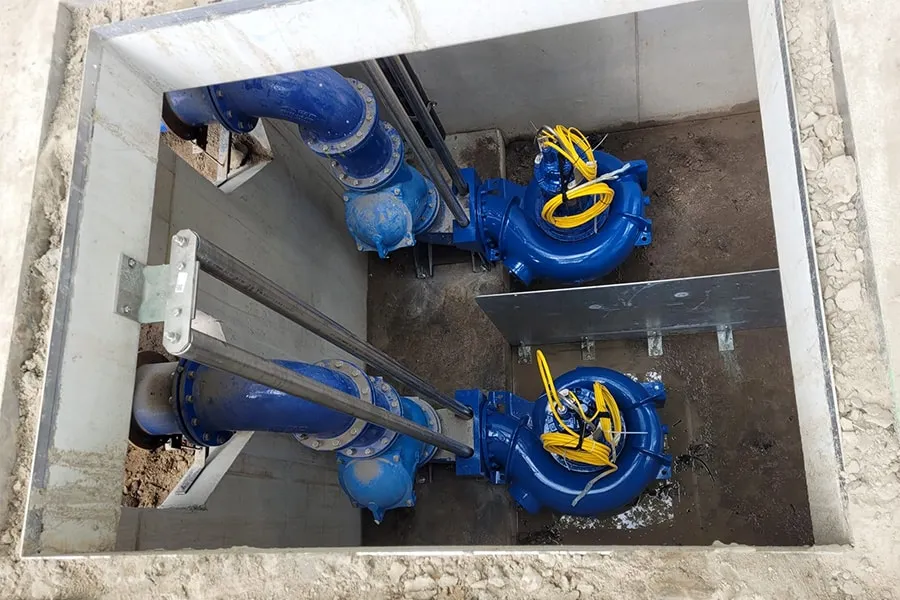
Two surface water pumping stations have been built to control water levels in the area and limit flooding in Griendtsveen, one on Lavendellaan and one on Kanaalweg. “Vissers Ploegmakers brought us on board as part of the construction team, where we worked together with the hydrologists from Waterschap Limburg to select the pump design for both locations using a decision matrix,” says Arjan Schilder, project manager at VOPO. “A site-specific solution was needed because space was limited. And since Griendtsveen is a protected village conservation area, the design had to meet aesthetic requirements, so most of the pumping stations were built below ground level.”
Two pumping stations, four pumps
Each of the two surface water pumping stations has two VOPO pumps. “They are submersible pumps fitted with a screw-centrifugal impeller,” explains Arjan. “A key advantage of pumps like these, with their large free passage, is that they are both fish-friendly and capable of handling large amounts of debris. Having two pumps at each pumping station also gives the water authority a wide operating range. During heavy rainfall, they can now discharge excess water more quickly to prevent flooding in Griendtsveen. During dry spells, they can pump water into the area to prevent the ground from shrinking and avoid other drought damage.”
Both surface water pumping stations have now been completed, much to the client’s satisfaction. “We have had good experiences with VOPO and have enjoyed working together for more than 25 years,” says Johan Stultiens of Waterschap Limburg. Arjan concludes: “We at OPO also look back on a smoothly completed
project, with open communication and close collaboration with Vissers Ploegmakers and Modderkolk, which was responsible for the electrical engineering and control systems for the pumping stations.” In the coming years, residents of Griendtsveen will at least no longer have to worry about wet feet.
Een zakelijke vraag aan Vopo pompen- en Machinefabriek B.V.? Get in touch
Companies in this story
Keep following this
Get an email when a new story is published. No account needed.
- SubjectWater infrastructure
- CompanyVopo pompen- en Machinefabriek B.V.







