









Specialist loading and unloading pontoons
Text Roel van Gils Beeld Aannemingsbedrijf J. den Boer
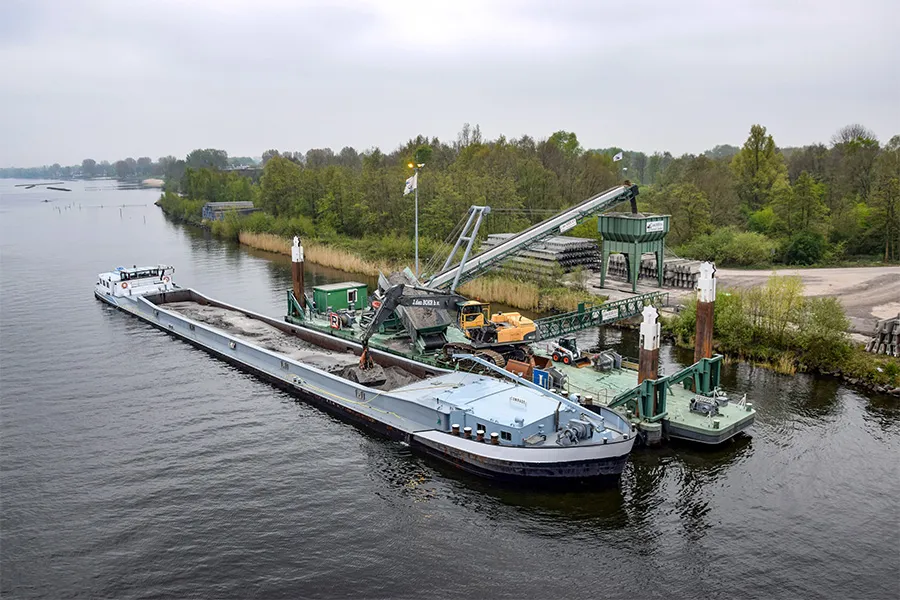
The specialist loading and unloading pontoons operated by Aannemingsbedrijf J. den Boer make a strong impression on many civil engineering projects. They were the unsung force behind the widening and deepening of the Julianakanaal, and are proving their worth on various dike reinforcement projects at home and abroad. Ton Kuijs, director of Aannemingsbedrijf J. den Boer, takes us ‘up to the bridge’.
The Julianakanaal was widened and deepened in record time. After barely six months of ‘renovation’, the waterway reopened to shipping in mid-April. An enormous amount of soil and silt was moved during this period. J. den Boer’s loading pontoon De Buffel played a key role. “More than 300,000 cubic metres of contaminated silt had to be transported to two Rijksdepots, one in the Hollandsch Diep and the other near the Slufter,” Kuijs explains. “De Buffel is ideally suited to this kind of work because it is fitted with a special extendable discharge chute. The chute prevents contaminated silt from splashing or spilling. It can be operated remotely and moves to match the height of the vessel being loaded. As the vessel fills up, the chute moves down with it, and the skipper can also operate it remotely from the wheelhouse. Finally, rubber flaps at the bottom prevent the contaminated silt from splashing.”
Loading and unloading without spills
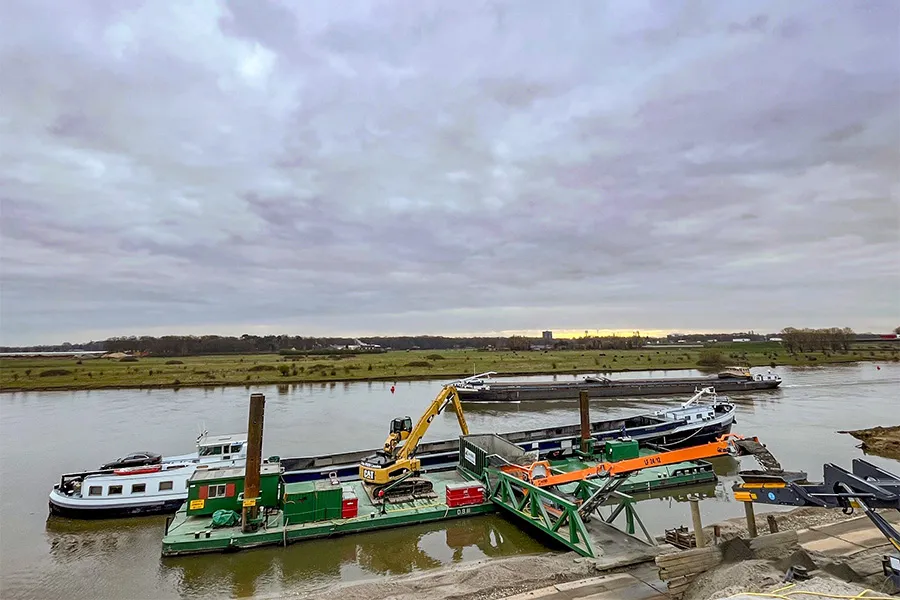
Loading was one thing, but the contaminated silt also had to be unloaded. “At the Hollandsch Diep, the pontoons were unloaded using a grab dredger. However, the contaminated silt also contained coarse material, including Limburg stones, which the grab dredger could not pick up,” Kuijs explains. “To remove the remaining cargo and clean out the pontoons, we provided assistance with our floating unloading pontoon BJI. This pontoon is fitted with a vehicle access ramp, a transfer crane and a hydraulic spill flap on deck. Trucks can be loaded quickly and efficiently. The spill flap prevents contaminated material from ending up in the water. Its hydraulic operation means there is no time lost when changing vessels.”
In-house plant department
The BJI was also used after shipping had resumed on the Julianakanaal. “For another four weeks or so, we removed all the remaining materials, such as riprap, soil and fascines. We were not allowed to use our spud legs for this, so our in-house plant department came up with an anchoring system using winches on the bank to hold the pontoon in place.”
Both our loading pontoons, De Buffel and Huibert, are still active on the Julianakanaal and, according to Kuijs, will remain in use for the rest of the year. “We are assisting with the transfer of 700,000 cubic metres of soil, which is being transported by vessel to the Grensmaas project.”
Aannemingsbedrijf J. den Boer’s loading and unloading pontoons are also proving their worth on other projects. “For example, we used our DBIII to unload a substantial volume of sand in Grubbenvorst, fitting the pontoon with an additional Telestack as a bespoke solution. The DBIII is now being prepared and converted for the Meanderende Maas project. The BJI has meanwhile moved to the dike reinforcement project between Tiel and Waardenburg, and our Antonia Johanna will shortly be deployed on a project in Germany for around twelve weeks. This is how we, as a small contractor, contribute to outstanding civil engineering projects in the water sector, at home and abroad.”
Question about this story? Ask your question
Keep following this
Get an email when a new story is published. No account needed.
- SubjectWater infrastructure







