









Specialist concrete and brickwork for a green urban river
Text Armand Landman Image Gebr. Van de Ven
How a Brabant family business provided the technical backbone for nature-friendly quays
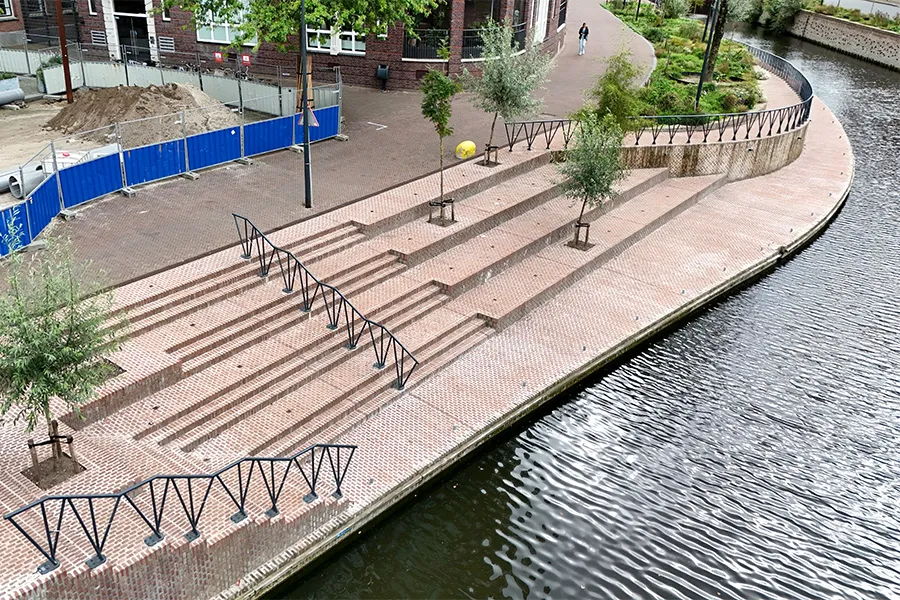
When the Mark returned to Breda city centre, Gebr. Van de Ven played a crucial role. As a specialist in civil engineering concrete work and complex brickwork, it provided the structural foundation and visible finish for the new quays, where trees, plants and mosses will soon grow. “We rarely do anything simple,” says director Dirk van de Ven with a smile. “The more complicated, the better.”
The original plan was for some of the quay walls to be made from precast elements, but the complex curves and changes in height led the main contractor to decide that the work should be carried out on site. “In the end, we cast the entire concrete structure behind the wall in situ,” says Van de Ven. “The brickwork you can now see by the water was built on top of it.”
This was no standard bricklaying job. Between the concrete wall and the facing layer is a 5-centimetre cavity filled with substrate. This retains moisture, allowing the wall to become vegetated. For the bricklayers, this meant working with a special mortar developed at TU Delft and inspired by historic lime and trass mixes. “It contains no cement, so there are no substances that are harmful to plants,” explains Van de Ven. “But you have to work with it differently: use 2-centimetre joints, don’t apply it too firmly, and allow for future plant growth.”
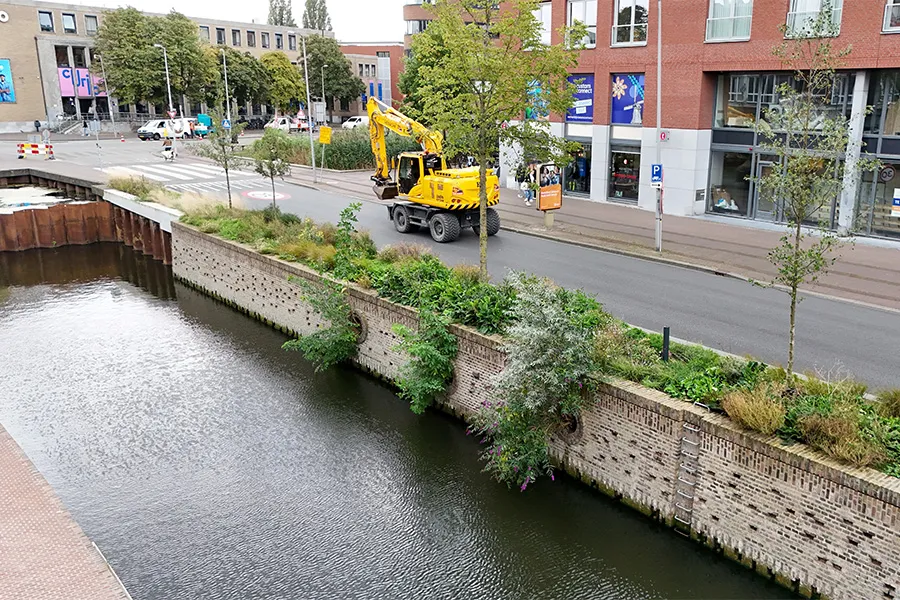
Greenery in the brickwork
Although Van de Ven did not install the greenery itself, the contractor had to take the provisions for it into account at every stage. “The damp conditions in the wall affect the joints. There are even planting sockets for trees that have been specially selected to stay small,” says Van de Ven. “It’s surface vegetation, not root systems that will force the wall apart.”
The specialist nature of the work lay not only in the details, but also in the materials used. Reclaimed bricks, for example, were used at the new Tolbrug. “They came in different thicknesses and sizes, and looked less uniform than new materials,” says Van de Ven. “That calls for craftsmanship. Fortunately, we had a bricklaying team that also works for the Efteling: people who relish this kind of challenge.”
Working together in a trusted network
Gebr. Van de Ven has been working with main contractor FL BV for around 25 years. “You know how each other works and what you can expect from one another. On projects like this, it helps enormously when you don’t pick apart every problem in legal terms, but work together to find a solution.”
That was important, as many drawings were revised during the preparation phase. “Sometimes we received changes while we were already working. You have to respond quickly. As a small family business, we have short lines of communication. I still occasionally put up formwork myself, which makes us flexible.”
Learning for the future
Although Van de Ven says there were no major problems, the project did provide technical insights for the future. “You see how other parties approach the details, and you learn from that. We’d also like to work more often with combinations of concrete, brickwork and nature-inclusive elements.”
Looking back, Van de Ven describes the project as a success. “It’s turned out beautifully. We may have been a little sceptical at the start, but it went well, thanks in part to the collaboration. This is exactly the kind of work we enjoy: technically challenging, with a visible end result that the city can enjoy for decades to come.”
Question about this story? Ask your question
Keep following this
Get an email when a new story is published. No account needed.
- ThemeMaterials and techniques for infrastructure
- SubjectWater infrastructure







