









Quay Wall Innovation Partnership: cheaper, faster and less disruption
Text Tony VosImage G-Kracht
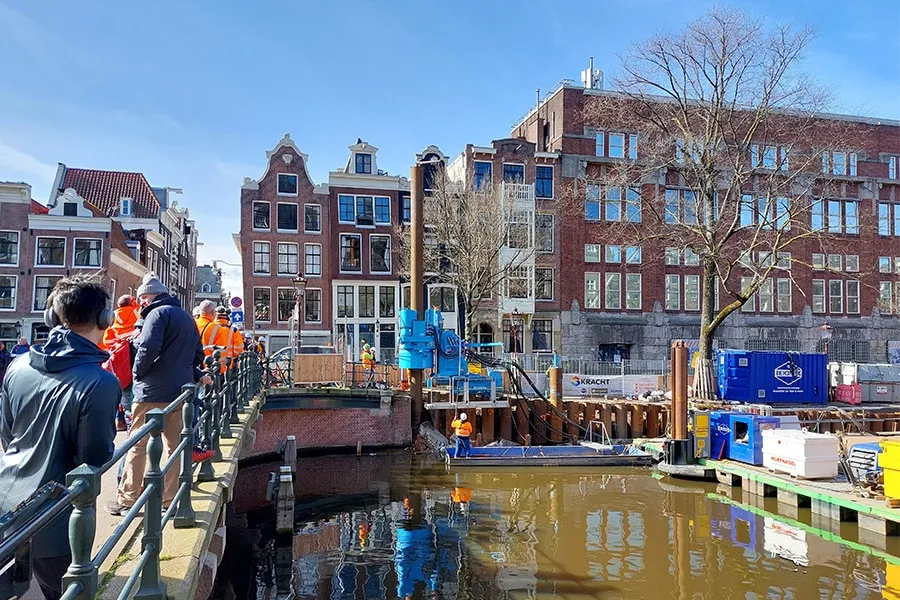
One of the three consortia selected by the City of Amsterdam to replace urban quay walls is G-Kracht. Gebroeders de Koning, Van Gelder and Giken Europe have joined forces to pool their innovative expertise. The consortium has now successfully completed the so-called Research and Development Phase, including the pilot project.
Edwin Boonstoppel, project manager at Gebroeders de Koning, explains: “Through its Bridges and Quay Walls programme, the City of Amsterdam is aiming to accelerate the work considerably compared with the situation in the preceding decades, when quay walls were replaced only sporadically. The tendering procedure began in 2018. From 2020, as one of the selected parties, we further developed our innovative idea into a construction-ready design, which we then demonstrated in a pilot project on the Singel.”
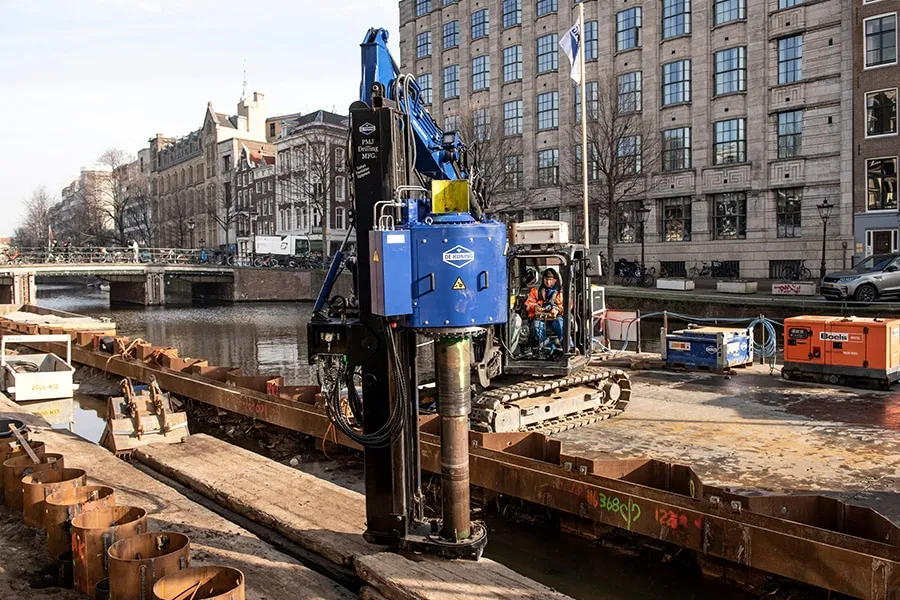
The three G-Kracht partners worked with a number of suppliers and subcontractors on the pilot project within the framework set by the municipality. ArcelorMittal supplied the steel tubular piles; De Vries-Titan installed the grout anchors; the Rutte Groep carried out demolition work on the upper section of the existing quay, provided electric water transport and manufactured concrete elements with brickwork; and Lommers Welding carried out the welding.
Over the next eight years, G-Kracht will build at least 3,300 metres of quay, including the 204 metres completed during the pilot.
Technical expertise
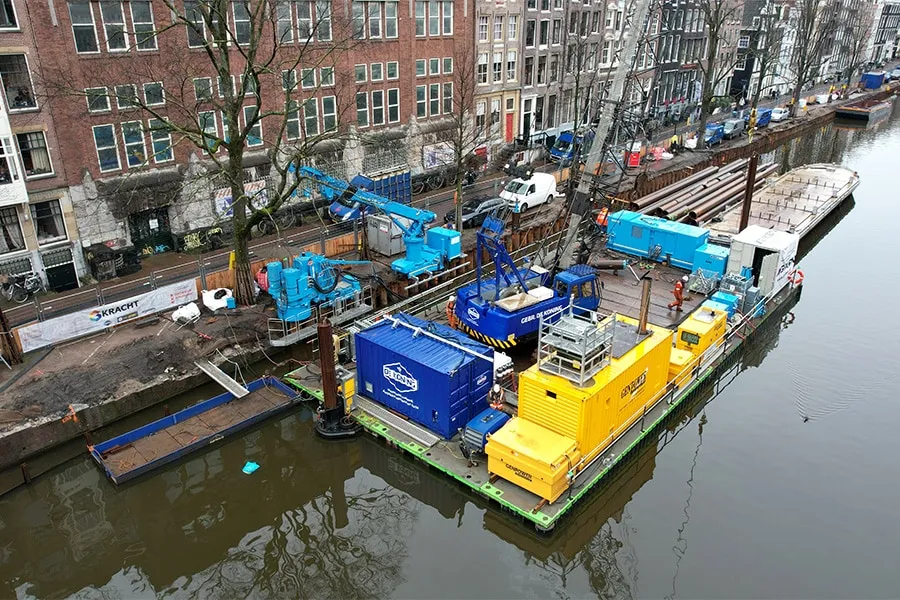
Edwin: “As a contractor, Gebroeders de Koning builds quay walls, bridges, tunnels and viaducts where land meets water. To quickly explain how the work is divided within G-Kracht: we build the quay wall itself, while Van Gelder handles all the work around it.”
Mark Geertman, environment manager at Aannemingsmaatschappij Van Gelder, explains: “We specialise in both above-ground and underground infrastructure, namely road surfacing and sewerage, cables and pipelines. We have extensive experience in long-term maintenance for the City of Amsterdam. One of the things that sets us apart is our stakeholder management.”
Job Vaessen, business development manager at Giken Europe BV: “We specialise in pressing steel tubular piles and sheet piles into the ground. We have also developed what is known as gyro technology, which rotates tubular piles as they are pressed into the ground. A toothed ring bit is welded to the bottom of the tubes and drills through all existing obstructions. No soil is displaced in the process; it remains inside the tube. Gebroeders de Koning has been a customer of ours for a long time. They asked us how we could help with this project.”
Giken Europe hires out the machinery and provides the technical expertise. The company developed a scaled-down version of the GRB system specifically for Amsterdam. The system was already used for large-scale applications elsewhere in the world. The innovation is that we have made this equipment as compact as possible so it can be used in an urban setting with limited working and construction space. Specifically, the system consists of three pieces of equipment, all electric: a gyropiler, a clampcrane and a pilerunner. The ring bit was also developed and patented by Giken.
The challenge
G-Kracht was tasked with renewing quay walls in half the time, at half the cost and with half the disruption of traditional techniques. This was a challenge, as it effectively meant an eightfold improvement on the traditional construction method. The pilot has since shown that G-Kracht has succeeded on all three counts. It represents radical innovation.
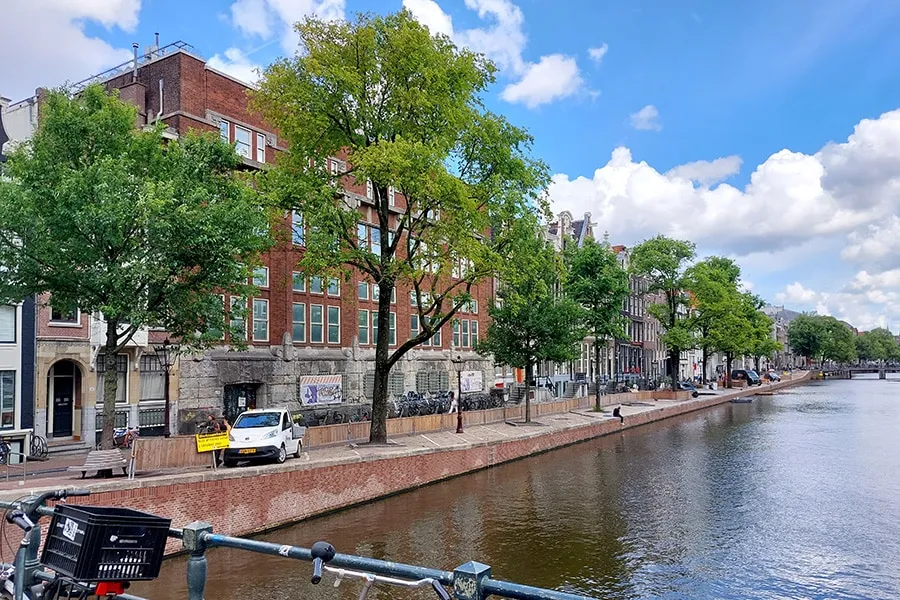
The reduced disruption is evident from the fact that both the road and the waterway remain open throughout. Boats can pass the worksites, and the road along the quay remains open to cars, cyclists and pedestrians.
The process begins by filling the cavities beneath the floor of the existing quay wall. Over the years, the propellers of tour boats wash sand out from beneath the wall, creating cavities in many places. Filling these cavities prevents subsidence in the future.
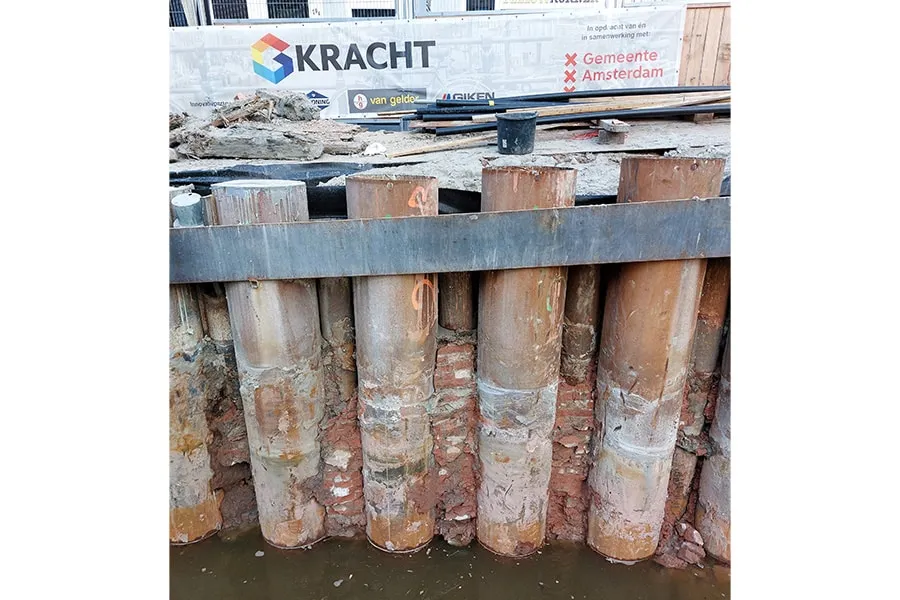
The upper section of the quay wall is removed down to just above the waterline. The coping stones are reused and will be put back later. Next, Giken’s Gyropress drives steel tubular piles into the ground by rotating and pressing them. The tubes have a diameter of 500 mm and are installed at 750 mm centres, leaving a gap of 250 mm between them. A clampcrane feeds the tubes to the Gyropress. Both pieces of equipment travel over the piles already installed and therefore do not stand in the water. The system is highly flexible and can be used whatever the shape of the quay. The tubular piles are 14 or 22 metres long and are installed in a sequence of two long piles reaching the second sand layer, followed by four short piles reaching the first sand layer. Once the piles are installed, the walls are stable under unloaded conditions, that is, without traffic.
Innovating as the work progresses
The next step is to install short, small piles in the gaps on the landward side. Ground pressure pushes these small tubular piles against the larger ones, creating a complete seal. Holes are drilled in one in every five piles, after which a filter system is installed inside the tube to keep the groundwater level at the same height as the water in the canal. This makes the wall impermeable to soil but permeable to water.
During the pilot, Lommers Welding then began installing the anchor waling. This is welded on site as a horizontal H-section, which accommodates the heads of the tubular piles. The waling therefore follows the alignment of the quay, both horizontally and vertically. The anchors installed behind the structure are then connected to it. De Vries-Titan drilled these into the ground at a steep angle, ensuring that the anchors remain in front of the building line. This is a client requirement.
A good example of continuous innovation during the process: low quay walls will almost certainly no longer need anchors in the future.
The final section of the old quay wall is then removed. In just two days, the Rutte Groep completed the entire facing of the new quay using precast elements with the brickwork already in place. Only the connecting strips were bricked up on site. Van Gelder then installed the reused coping stones and reinstated the paving, after which the parking spaces were reopened to traffic.
Mark: “Local residents compliment us on how quietly and with so little vibration we work. And the trees along the canals remain standing throughout the process, a form of climate-adaptive construction.”
Job adds: “All the equipment has been developed to operate with zero emissions. The Netherlands is extremely far ahead in electrification, by as much as ten to fifteen years compared with other countries. If there is enough power available on site, we can renew our quays with zero emissions.” If it can be done in Amsterdam, it can be done anywhere.
Een zakelijke vraag aan ArcelorMittal Projects Europe B.V.? Get in touch
Companies in this story

Keep following this
Get an email when a new story is published. No account needed.
- SubjectWater infrastructure
- CompanyDe Vries Titan B.V.
- CompanyArcelorMittal Projects Europe B.V.







