









Processing 350,000 cubic metres of concrete for the Nieuwe Sluis in Terneuzen
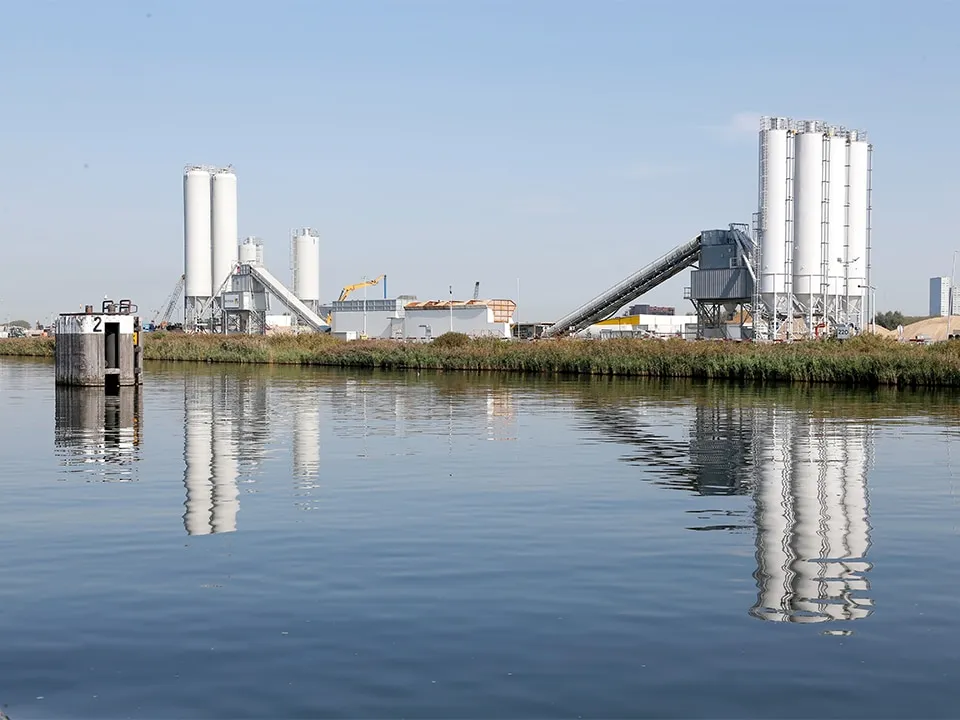
The mobile batching plants were assembled in Terneuzen as early as July 2018, with deliveries starting in November that year. De Rycke Beton BV, a concrete construction specialist, is responsible for supplying all the concrete for the Nieuwe Sluis in Terneuzen. Rudy De Baets, De Rycke’s project manager for the Nieuwe Sluis, takes us through the process.
“Sassevaart has us supply concrete to the construction site using mobile batching plants,” De Baets begins. “This saves a huge amount in transport costs and is more sustainable: we only have to travel 500 metres. The raw materials are delivered by ship. We made our first concrete deliveries in November 2018, and deliveries for the diaphragm walls began in March 2019.”
Diaphragm wall mix put to the test
“We tested various mixes for the diaphragm walls. The ‘winning’ mix was used to cast 125 diaphragm walls, with around 550 m3 of each wall completed per evening. In total, the lock has around 1 km of diaphragm wall, and this work was completed at the end of January 2020,” De Baets explains. “The results speak for themselves. That is not just our view; it has also been confirmed by various parties.”
The next challenge: lightweight concrete for the floor grilles
The next challenge soon followed: supplying special lightweight concrete for the construction of the floor grilles. De Baets explains: “These were built in a temporary dry dock in the lock chamber. The concrete has a density of 2,080 kg/m3, compared with the usual density of 2,300 kg/m3. This was necessary to make the floor grilles float, so they could be towed precisely into position before being lowered into place.” De Baets says that extensive laboratory and production testing was also carried out for the lightweight concrete.
Underwater concrete
The third specialist concrete application supplied by De Rycke was underwater concrete. “In August 2020, construction of the outer head began with 11,000 m3 of underwater concrete. At the end of November 2020, it was the inner head’s turn, with 12,500 m3 of underwater concrete produced continuously over 72 hours.” Sassevaart had specified that the concrete should reach its final strength of 37 N/mm2 after just six days. “Normally, that takes 28 days,” De Baets explains. “So this required another area of specialist expertise. Another challenge was keeping the concrete fluid enough to ‘survive’ a 125-metre pipe and remain workable at a depth of 22 metres.”
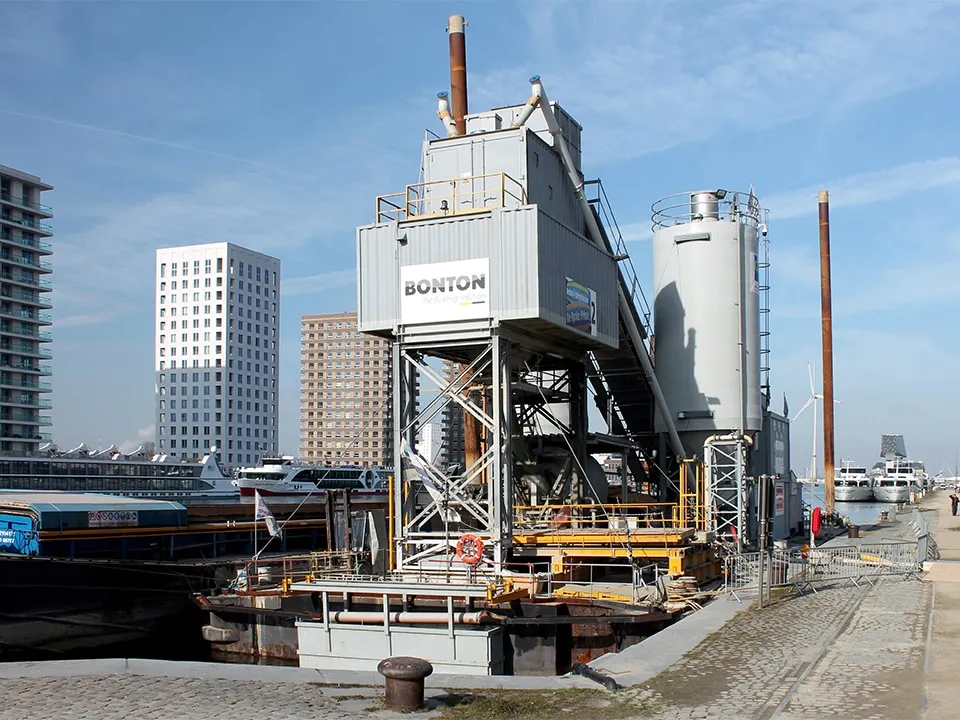
We hear that De Rycke often works on site, close to the customer. “Among other things, we have BONTON, a floating batching plant, which is ideal for construction sites close to a waterway. This saves a significant amount of road transport for concrete, helping us reduce CO2 emissions as much as possible. De Rycke also operates all its mobile batching plants under KOMO certification,” says De Baets.
Vraag over dit verhaal? Stel je vraag
Blijf dit volgen
Bij een nieuw verhaal krijg je een e-mail. Geen account nodig.
- ThemaMaterials and techniques for infrastructure
- OnderwerpWater infrastructure







