









Pipes for laying pipelines or as foundations
‘Only with a complete service offering can you deliver projects successfully’
Ordering steel pipes is ultimately the simplest part of a project. Those who go on to work with the pipes know that the real challenge starts afterwards. That is when it pays to have suppliers such as Van Leeuwen Buizen, whose additional services make laying and working with pipes easier.
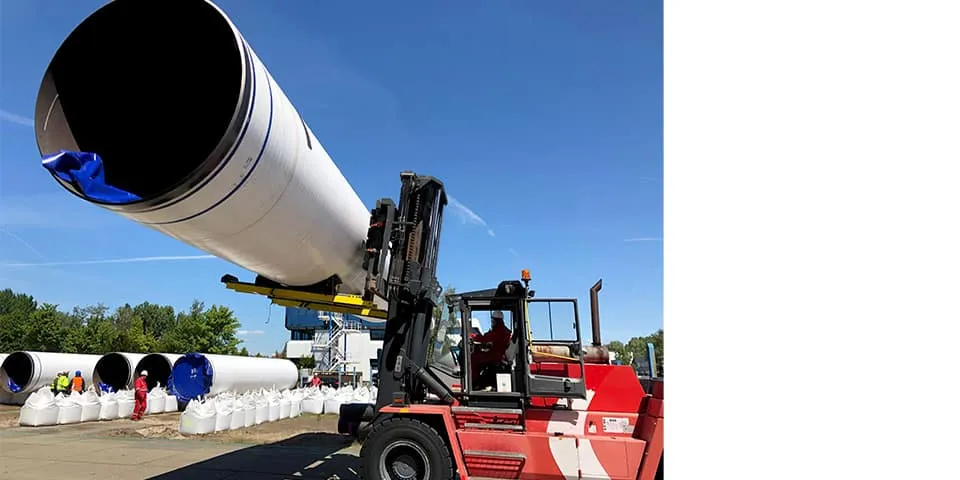
A good example of Van Leeuwen’s full-service approach is a project in the Brabantse Biesbosch, where a new water intake and pumping station were built for Evides Waterbedrijf. The project required substantial quantities of large pipes in an area that needed to be left as undisturbed as possible. “These were really big ones,” says Cees van Overloop, project manager at Van Leeuwen, “with a diameter of DN2100 (the usual maximum is DN1200), a length of 17 m and a weight of around 21 tonnes each. Together with the contractor, we worked out the logistics plan so that the heavy pipes were moved as little as possible and the impact on the environment was kept to a minimum.”
Complete service offering
Less than 400 m from where the ship unloaded, Van Leeuwen set up a temporary storage area for a large proportion of these huge steel pipes, with space for the welding line and the necessary cranes. After being double-jointed, the pipes, now weighing 42 tonnes and measuring 34 m in length, were loaded onto pontoons via the same quay and transported to the Biesbosch. Van Overloop says: “We provided a complete service here, including coating the pipes and supplying the certifications. By appointing an experienced project team, we were always able to respond quickly and accommodate changes, which are common on projects of this kind.”
Driven piles made from steel pipes
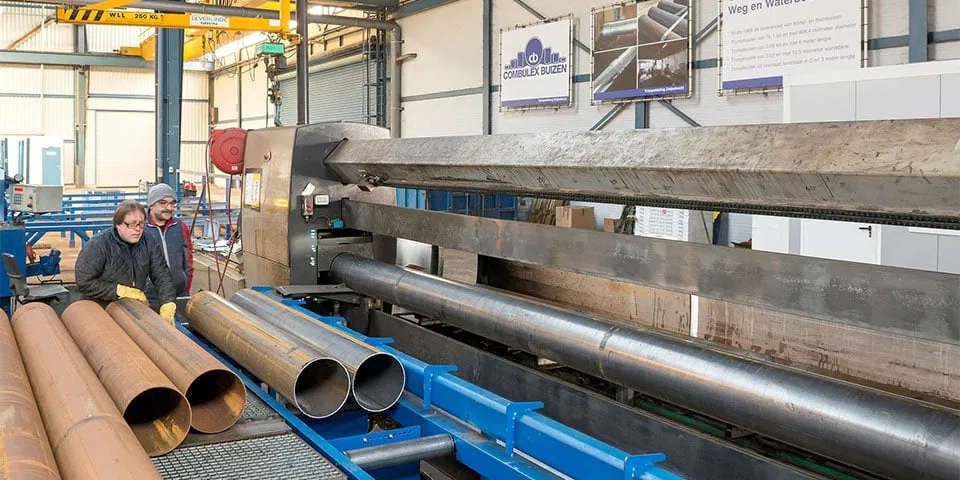
Another example of additional services for civil engineering projects is the swaged foundation pipe from Combulex, a subsidiary of the Van Leeuwen Buizen Groep. Swaging pipes is not new in itself. Swaged zinc and copper pipes, which could be joined by sliding one over the expanded end of another, were widely used before press fittings became common. Combulex now manufactures the swaged pipe in steel and fits it with a base plate, making it easy to drive into the ground.
Pipe as formwork
The swaged pipe sections are driven into the ground one by one and welded together until a load-bearing layer is reached. “That is often as deep as 30 m,” says Martijn ’t Hart, commercial director of Combulex. “Once it has reached the required length, the pipe acts as formwork for a cast-in-place foundation pile.”
Question about this story? Ask your question
Keep following this
Get an email when a new story is published. No account needed.
- SubjectWater infrastructure







