









New Terneuzen Lock: how 11.5 million cubic metres of soil found a new home
Text Suzanne van Gaale Beeld VNSC/Sassevaart
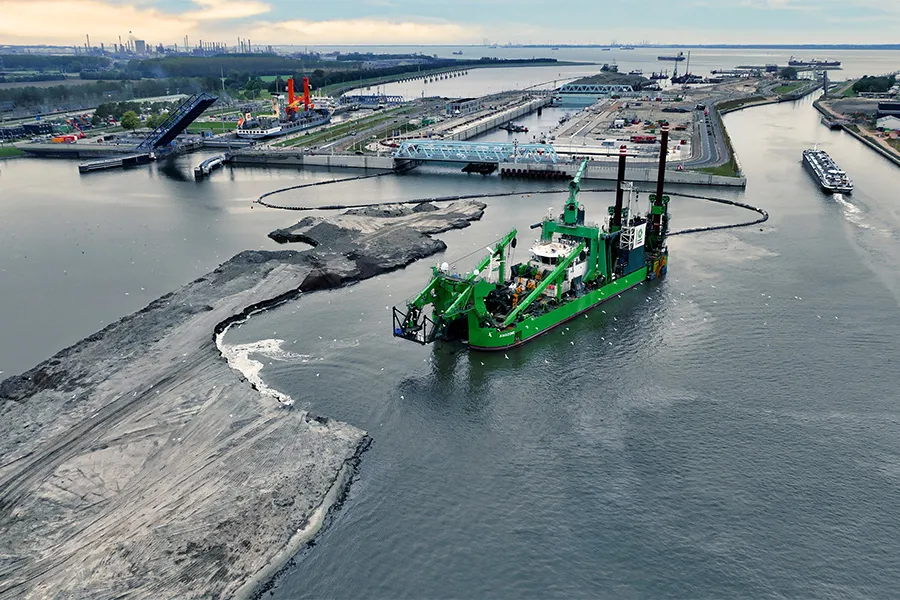
The New Terneuzen Lock will be opened on Friday 11 October 2024. The lock is 427 metres long, 55 metres wide and 16.44 metres deep. It will give access to the Ghent-Terneuzen Canal to ships that can also pass through the new locks in the Panama Canal. Work on this new access route has involved extensive excavation over the past six years, totalling around 11.5 million cubic metres. This article looks at all this earthmoving, as well as the bank and bed protection works.
Before work could literally and figuratively get underway at the New Terneuzen Lock, extensive investigations were carried out. After all, a great deal needs to be established before earth can be moved: what type of soil is involved, what soil layers are present, whether or not the soil is contaminated, and whether there are any (archaeological) objects in it. “We carried out a lot of investigations before the contract was awarded,” explains Joris de Maat, Soil and Permits Adviser for the client, the Flemish-Dutch Scheldt Commission (VNSC). “These included environmental investigations into soil quality, geotechnical investigations to identify the soil layers in the area, such as sand, clay and peat, and archaeological and palaeontological investigations. Among other finds, the latter uncovered tusks and molars from the woolly mammoth. Research at the University of Groningen has since established that these remains are 40,000 to 50,000 years old. The geotechnical investigation was used to create a geological model showing all the soil layers. This was particularly relevant when installing the lock walls and pumping out the construction pits for the landward and seaward lock heads. To pump them out, you need to know exactly how the ground is structured. Based on the model, the Sassevaart contractor consortium drew up a dewatering plan.” This preparatory investigation, carried out between the contract award and the start of construction, looked not only at soil quality but also at whether there were any old foundations or other remains in the ground. “And there were,” says Joris. “We came across an old inundation sluice, remains of an old bridge blown up by retreating French soldiers during the Second World War, and sections of a drainage sluice dating from the early 1900s. We were able to remove all of these.”
PFAS crisis
PFAS was also detected during the project, in 2019. This meant a great deal of additional investigation. Alarm bells rang, as in June 2019 the Dutch government had decided to introduce the Temporary PFAS Framework for Handling. This brought a large number of projects to a standstill. Amendments to the temporary framework created more scope for moving soil. “Fortunately, we were able to temporarily store some of the excavated soil, initially suspected of containing PFAS, in a polder near Terneuzen.
This meant we managed to prevent work on the New Terneuzen Lock from grinding to a halt, which would of course have had significant financial consequences. Once the standard was revised, we were able to store the PFAS-containing dredged material in Rijkswaterstaat’s depot in the Hollandsch Diep after all.”
Soil movement plan
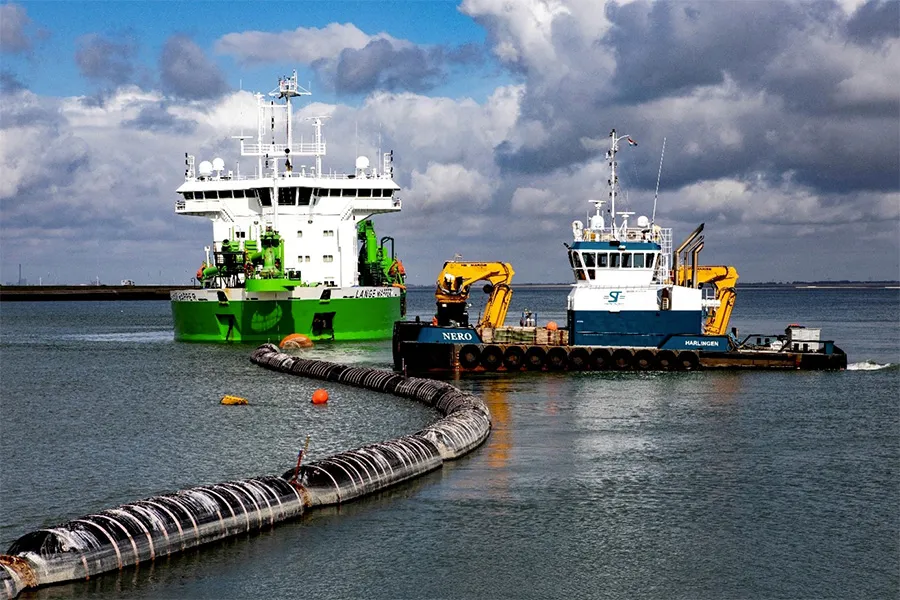
The soil excavated during all the dredging work also has to go somewhere. A soil movement plan was drawn up to determine where each type of soil could be taken. “Soil quality determines where it goes. The plan covers everything: soil type, soil quality, the permits required, the timing and the volumes involved,” explains Jori van der Hout, adviser at Sassevaart. “The entire New Terneuzen Lock project area was mapped and divided into four categories according to environmental quality: industrial, residential, agricultural/nature and unsuitable for reuse. In total, 11.5 million cubic metres of soil were moved. Of this, 5.2 million cubic metres are covered by BRL 9335-2 certification. This certifies clean soil. Kiwa audits us twice a year for this certification. Soil classified as residential and industrial was taken to Golfbaan Oostburg, clean soil classified as agricultural/nature to Biervliet, and soil unsuitable for reuse to approved processors such as ATM Moerdijk and Grondreinigingscombinatie Nauerna.” The remaining soil, just under 6 million cubic metres, was mainly material excavated during dredging in the harbour. It falls under BRL 9335-2 and was put to beneficial use in the Westerschelde as a foreshore nourishment, as well as at Knokke and on a number of projects in Zeeuws-Vlaanderen. On a project as large as the New Terneuzen Lock, it is not always possible to find an end destination immediately for all the excavated soil. Sand that could not be reused directly within the project was temporarily stockpiled at a site in a polder near Terneuzen.
Testing
Normally, soil is tested in batches of 6,000 cubic metres. In the case of the New Terneuzen Lock, the volume to be removed was so large, more than 5 million cubic metres, that testing every 6,000 cubic metres was impracticable. “We therefore started with five tests as part of the soil acceptance investigation for project-derived soil (BRL-9335). We used these to check for any differences or deviations. This allowed us to determine how many additional tests were needed for the 5 million cubic metres. In the end, in line with the BRL, we carried out around twenty tests in total.”
Bed protection essential
While extensive earthworks were underway, work was also progressing apace to protect the bed and banks of the area against potential erosion. The New Terneuzen Lock will allow larger seagoing ships to pass through. The lock can accommodate vessels up to 366 metres long, 49 metres wide and 14.5 metres deep. Larger ships also mean bigger waves and more flow from propeller jets, generated by a vessel’s propeller, which can place a heavy load on the banks and bed. Add the tide and the discharge flow through the lock, and it is clear that the bed and banks will be subject to considerable forces. Bed and bank protection was installed to prevent erosion and the resulting damage.
Protection type determined by loading
“The design load determines which type of protection is used where,” explains Vyasa Sewberath-Misser, Hydraulic Engineering Adviser at VNSC. “Because the New Terneuzen Lock’s outer and inner harbours cover a large area and the loads vary from place to place, the work area has been divided into sections. Sassevaart designs the bed protection based on the design load. The client, VNSC, specified the design requirements. For example, the bed protection must require little maintenance, and limits have been set for the maximum damage that may occur under the design loads (Damage Parameters for Granular Bed Protection).”
Work plan and on-site checks
Once the required type of bed protection has been determined, Sassevaart draws up a work plan describing how it will be installed. “We also keep a close eye on the work to make sure everything is going according to plan,” says Vyasa. “My colleagues and I inspect the rock armour to check that it meets the requirements for mass distribution and length-to-width ratio. We sometimes have the rock tested by an external party as well. Most of the stone comes from quarries in Belgium. Sassevaart carries out bathymetric surveys before, during and after placing the different layers of bed protection. Once installation is complete, we receive the survey data and use ArcGIS to create difference maps and check the thickness of the various layers. I also check whether the top of the bed protection is at or below the depth specified in the contract.”
Willow-brushwood mattresses
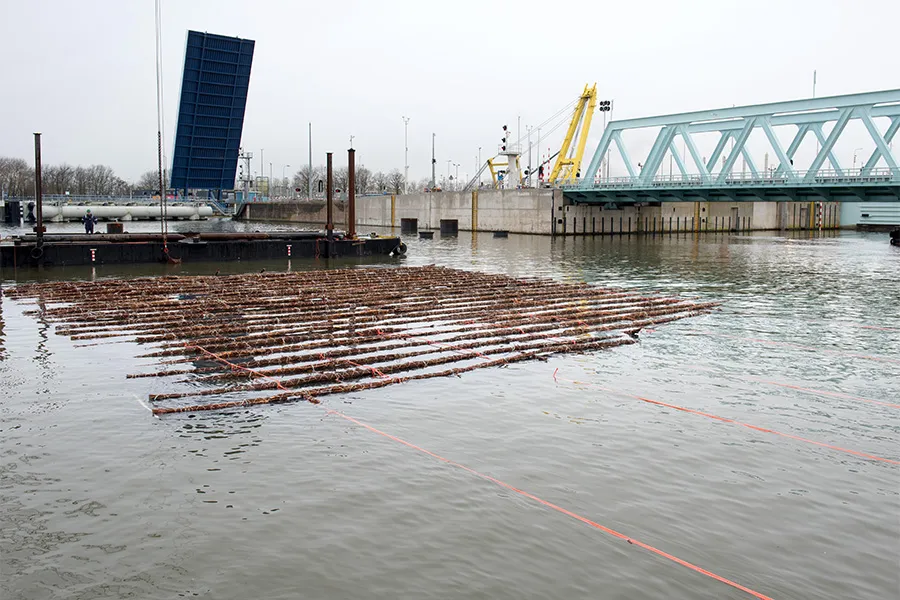
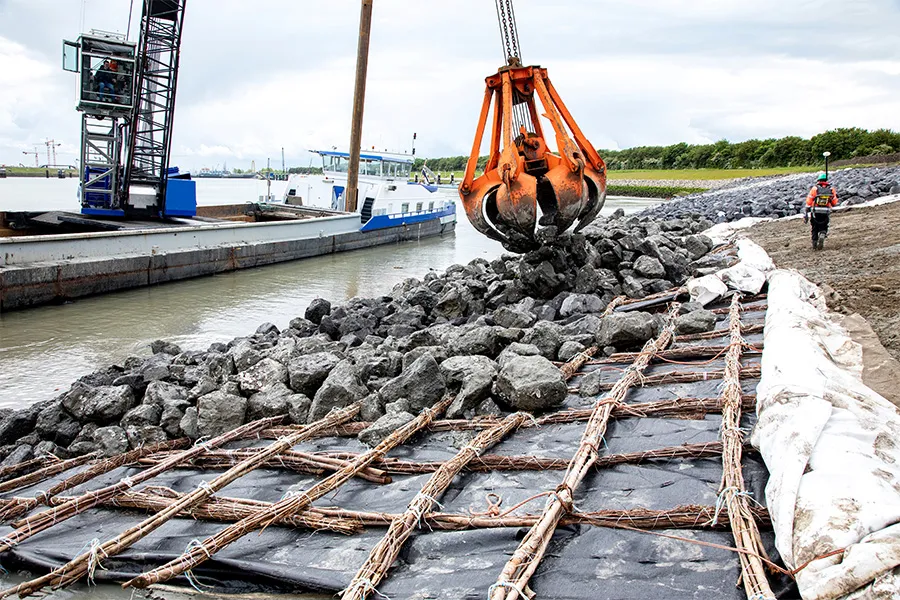
Evelyn de Clerq is part of Sassevaart’s Soil and Dredging team and is responsible for all bed and bank protection. Making the mattresses on the construction platform is largely manual work and takes a great deal of time. “For protection, we use mattresses with geotextile. The fabric is supplied to size. The geotextile is tied to a willow framework on the construction platform. You can think of it as a kind of grid made from geotextile and willow rods. The mattresses vary in size, with the largest measuring about 60 by 20 metres. They are laid side by side with an overlap of about one metre. The mattress layout is drawn up based on the detailed design.”
Lowered into place one by one
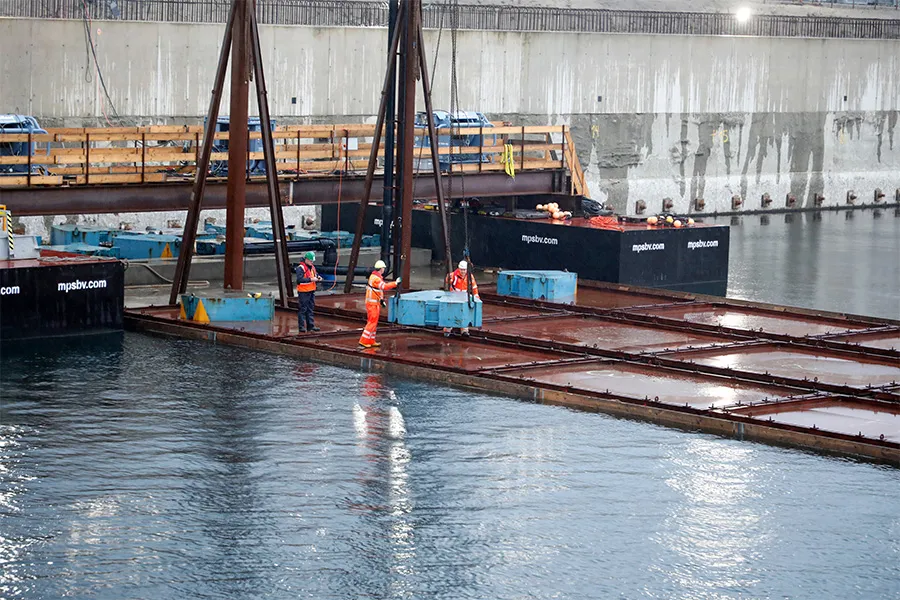
Installing the bed protection is a major undertaking. A crane vessel lays the mats afloat in the water, using GPS to determine their precise position. They are then partially sunk using rock armour. A survey is carried out to check that each mat is in the correct position. If it is, the next mat is lowered, with a one-metre overlap. The mats are then covered with the remaining broken rock. To give the structure sufficient strength, it is usually grouted with colloidal concrete. This creates a layer of broken rock with the voids between the stones filled with concrete. The concrete is specially formulated with additives so it can be placed underwater. “In the tidal zones, we use cast asphalt because it is less susceptible to washout by waves. The rock armour also varies in size. We mainly use two grades on the project: 5-40 kilos and 40-200 kilos. The latter is used mainly in areas subject to greater wave and current loads.”
Opening of the New Terneuzen Lock
The New Terneuzen Lock will be opened on Friday 11 October. After a long construction period that began in late 2017, larger and more numerous ships will finally be able to travel along the canal to the port of Ghent. The capacity and reliability of the locks will also increase, reducing waiting times for inland vessels. The New Terneuzen Lock is now ready for the next hundred years. This is a milestone that everyone involved is eagerly anticipating. The final works and opening can be followed at www.nieuwesluisterneuzen.eu.
Question about this story? Ask your question
Keep following this
Get an email when a new story is published. No account needed.
- SubjectWater infrastructure







