









Large quantities of steel for Nieuwpoort storm surge barrier
Text Roel van Gils Beeld ArcelorMittal, THV Herbosch-Kiere – Jan De Nul
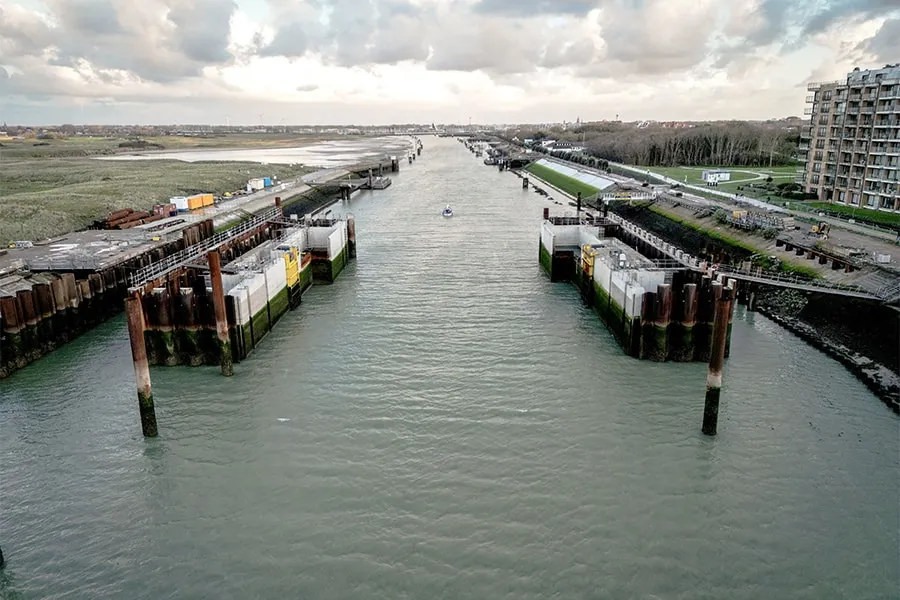
Storm surges are one of the greatest natural threats in the North Sea region. To protect the coast and hinterland from severe storms, the Flemish Government approved the Masterplan Kustveiligheid in 2011. The plan includes the construction of a storm surge barrier at the mouth of the IJzer in Nieuwpoort. After extensive studies, a horizontal sector gate with a navigation opening 38 metres wide was selected. ArcelorMittal was brought in to supply approximately 7,300 tonnes of tubular piles and 2,900 tonnes of sheet piles. The project also saw the first use of the newly developed AM-SIS proximity switches.
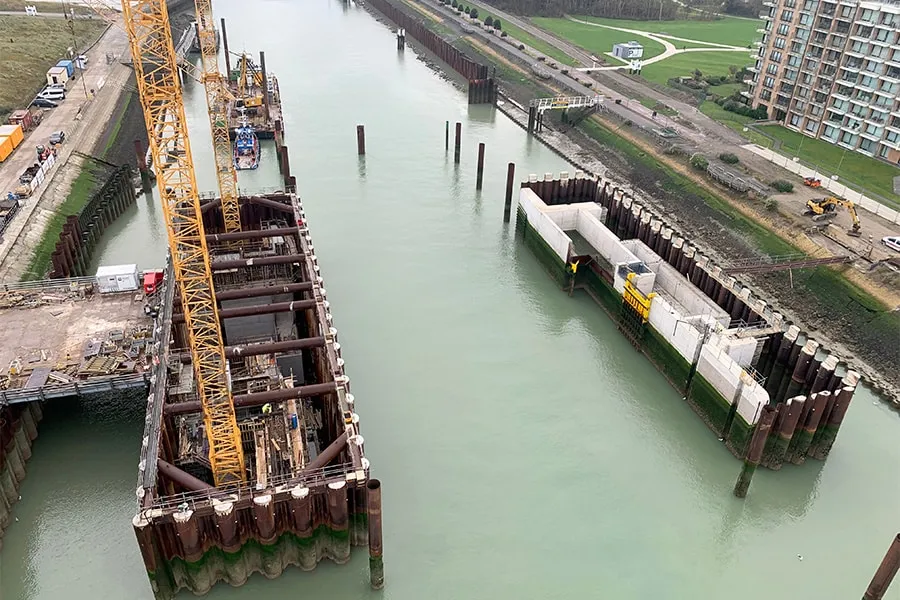
The movable steel barrier rotates between two cast-iron shafts anchored in concrete abutments connected to the banks of the IJzer. “Think of it as a half-cylinder that can be raised into a vertical position to hold back seawater. When parked, the barrier is recessed into a concrete sill on the bed of the IJzer,” explains Johan Branders, Technical Sales Engineer at ArcelorMittal. “Since work on the project began in 2018, a great deal of steel has gone into it. We supplied the steel to contractor THV Herbosch-Kiere, Jan De Nul for the concrete abutments, quay walls, flow-guiding walls, bypass culverts and seepage cut-off wall.”
Proximity switches
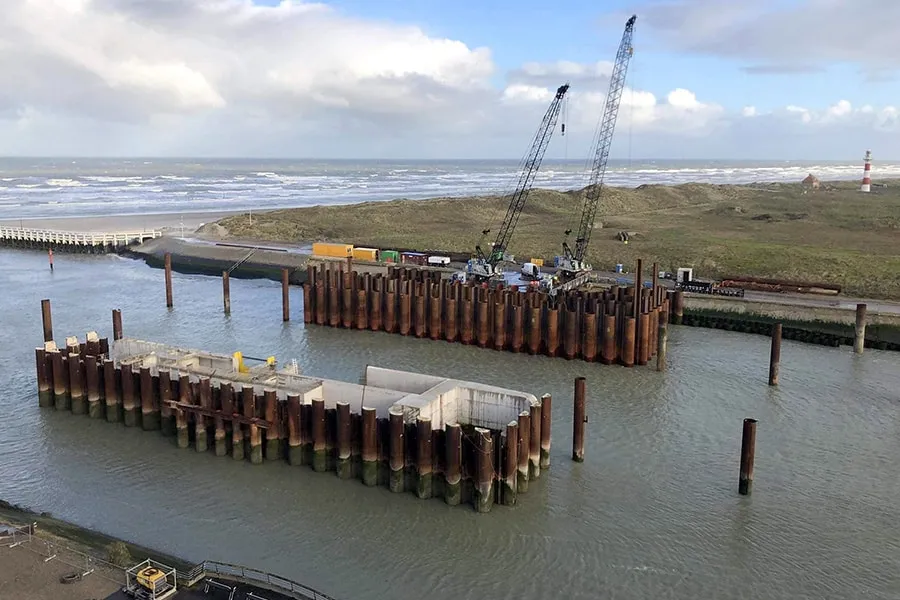
The two cofferdams for the abutments were constructed using combi-walls. “Each cofferdam comprised 53 tubular piles, Ø1420 x 21.6 mm in S460MH, 31.5 metres long, with AZ28-700 infill sheet piles measuring 26.5 metres,” Johan explains. “Because of the high water pressure on the combi-walls, the C6 interlocks of the tubular piles and the centre interlocks of the sheet piles were filled with Beltan Plus waterstop.” The AM-SIS proximity switches were tested for the first time on this project during sheet-pile driving. “The test was successful: the eight sensors installed gave a reliable, consistent signal confirming that the sheet piles remained in the interlocks during installation. This was also verified using Dixeran™ sensors attached to the combi-piles for monitoring.”
Strutting frame
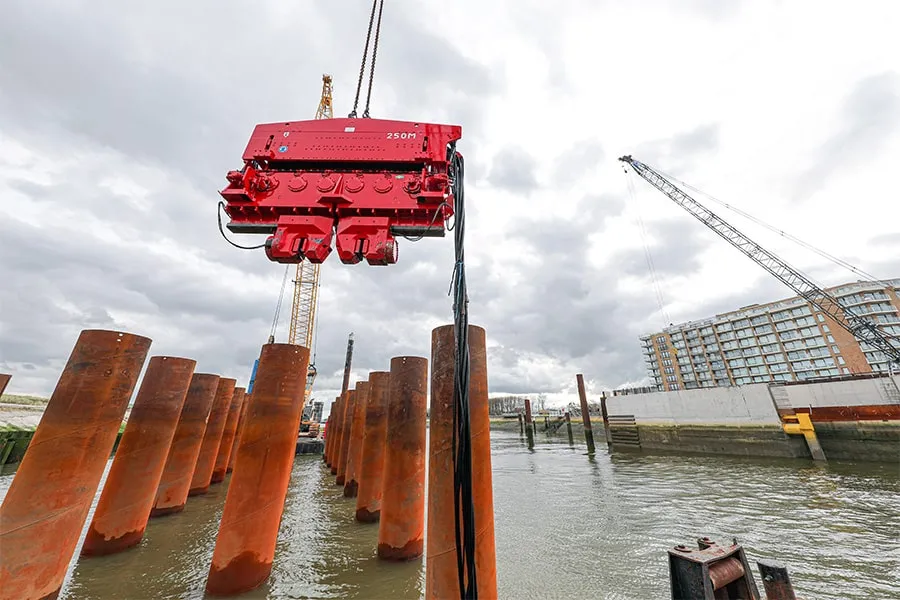
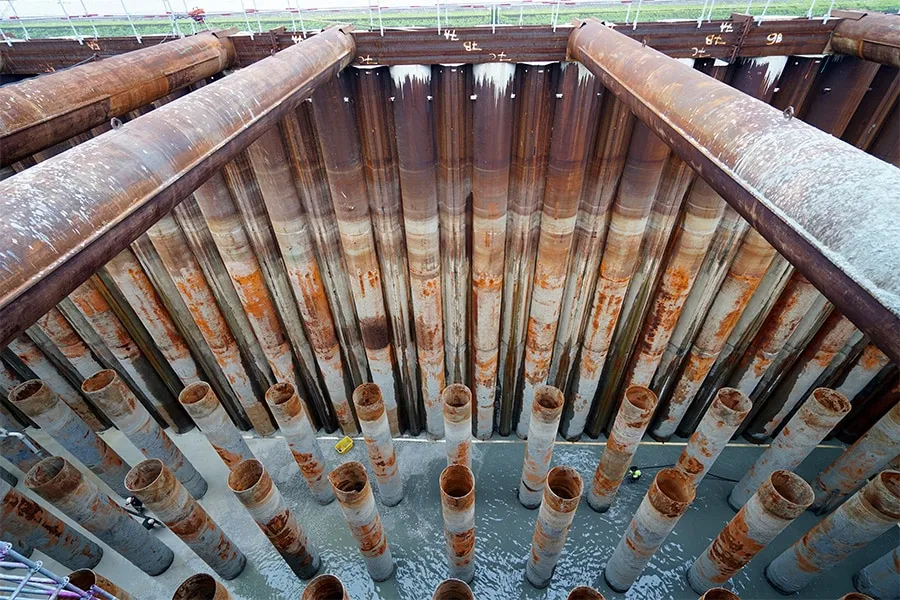
A further 42 tubular foundation piles, Ø1270 x 16 mm in S355J0 and 12.9 metres long, were installed in each cofferdam, with an extra length of 8.6 metres so they could be installed using a vibratory hammer kept above water level. A strutting frame was fitted on top of the combi-walls, using Ø1067 x 14 mm tubes as struts and HEM700 walings to distribute the high water pressure on the cofferdam across the combi-wall after dredging. “At high tide, we had a water column of 17.9 metres against the cofferdam. That is quite substantial,” says Johan.
Reuse and buy-back
After the cofferdam was dredged, a 2-metre-thick layer of underwater concrete was poured first. The cofferdam could then be dewatered to level -12.6 metres TAW (the reference elevation used for height measurements in Belgium, ed.). Johan: “The foundation piles were then cut off at level -12.6 metres TAW, and a 3-metre-thick concrete floor slab was poured. The cut-off piles were reused to make the foundation piles for the second cofferdam. As ArcelorMittal, we bought back the extra length from the second cofferdam. The 4,500-tonne concrete sill could then be installed between the two abutments in April 2022.”
All in all, this is a substantial project for ArcelorMittal. “The first bulk delivery dates back to 2018 and comprised foundation piles and combi-walls. We have since made a number of additional deliveries for the quay walls, flow-guiding walls, a cofferdam for the bypass culverts, a seepage cut-off wall and dolphin piles. The project will continue until 2025.”
Een zakelijke vraag aan ArcelorMittal Projects Europe B.V.? Get in touch
Who worked on it
Nieuwpoort storm surge barrier in Molenlanden
- contractorTHV Herbosch-Kiere: Jan De Nul
Keep following this
Get an email when a new story is published. No account needed.
- ProjectNieuwpoort storm surge barrier
- ThemeMaterials and techniques for infrastructure
- SubjectWater infrastructure
- CompanyTHV Herbosch-Kiere – Jan De Nul
- CompanyArcelorMittal Projects Europe B.V.







