









Lapinus stone wool, part of Rockwool Group, filters more than 50% of contaminated particles from road runoff
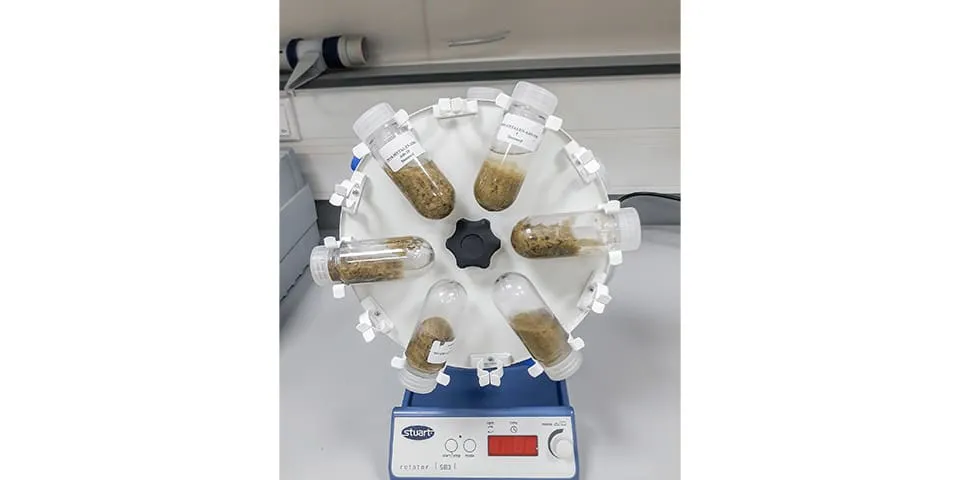
Heavier downpours and more severe drought in areas of the Netherlands are having a major impact on the condition of surface water and groundwater. Rainwater running off main roads and local roads into verges contains concentrations of pollutants from vehicles. Lapinus, part of Rockwool Group, has discovered that stone wool is an excellent material for filtering these substances from rainwater, helping to prevent them from entering the environment. Wageningen University & Research (WUR) tested the stone wool in its laboratory, finding that it captures more than 50% of these substances.
Stone wool is used, among other applications, in water management systems (Rockflow) to store water and prevent flooding during heavy downpours. During peak flows, excess water is captured quickly and efficiently and then slowly infiltrates into the groundwater. Lapinus has discovered that the stone wool in these water management systems is also suitable for filtering rainwater. Daan de Kubber, marketing & business development manager at Lapinus, explains that stone wool can even remove dissolved pollutants from rainwater, such as PAHs and heavy metals including zinc and copper. “During rainfall, these environmentally harmful substances run off the asphalt of main roads and local roads and seep into the soil. This has far-reaching consequences for water management in the Netherlands, and could also allow these substances to enter the food chain,” says De Kubber. PAHs (polycyclic aromatic hydrocarbons) are molecules formed by thermal decomposition caused by vehicle exhaust fumes, tyres and brakes, and are extremely harmful to health. “Very little grows in verges alongside main roads, where you find a lot of black sludge. This is heavily polluted waste from vehicles,” says De Kubber. Stone wool installed in water management systems alongside main roads and local roads can effectively filter road runoff. As well as capturing solid particles, the stone wool can adsorb dissolved molecules of PAHs, copper and zinc (sorption). This prevents these environmentally harmful particles from entering the environment directly. “Stone wool is a durable material that can capture pollution accumulated over many years in this way,” says De Kubber.

Wageningen University & Research (WUR) began researching the filtration of rainwater and the retention of pollutants by Lapinus stone wool in 2018. Wim Beltman is an environmental chemistry researcher at Wageningen Environmental Research, part of WUR. Together with his research team, he studies organic contaminants such as pharmaceuticals and pesticides in the environment, and the risks they pose to ecosystems. “This study focused on the adsorption of PAHs, copper and zinc onto stone wool. The research, commissioned by Lapinus, will be published this autumn,” says Beltman. Stone wool is already being used to store peak rainfall. “We investigated whether PAHs, zinc and copper adhere to the stone wool.” Tests using artificial wastewater in a laboratory setup showed that acenaphthene and phenanthrene (both PAHs), zinc and copper adsorb onto the stone wool. The stone wool, or Rockflow WM2005 water absorption system, proved effective at retaining substances in the test: 62% of acenaphthene, 91% of phenanthrene, 88% of copper and 51% of zinc.
“We tested rainwater under optimal conditions,” says Beltman. “A next step could be to adapt our tests to reflect the dynamics of rainwater, such as how fast it flows, and better replicate water from real-world settings, which has a different composition from the test water, including particles and dissolved organic matter.” Beltman explains that the condition of rainwater depends heavily on the dynamics of rainfall. It is
best to test rainwater regularly at outdoor locations. “Metals such as copper and zinc can occur in different forms, depending on the acidity and the presence of dissolved substances in the water. This affects how much of the PAHs, copper and zinc adsorb onto the stone wool,” says Beltman.
Ronald Wentink is a senior water and climate adviser at Syntraal, part of consultancy and engineering firm Tauw. He explains how important the condition of rainwater, surface water and groundwater is for the Netherlands. “If pollution enters groundwater via rainwater, it can then also reach surface water,” says Wentink. Groundwater flows beneath the Netherlands towards the sea, carrying pollutants with it. “This damages the ecosystem and could result in pollution entering our drinking water and food.” According to Wentink, filtering polluted rainwater can have far-reaching positive effects on the water balance. For many years, the trend has been to infiltrate rainwater into the soil rather than discharge it via the sewer to a treatment plant. One issue is that polluted rainwater is often still sent to treatment plants through the sewer. “Road runoff can sometimes contain high concentrations of PAHs and heavy metals, and ideally you don’t want this going directly into the soil.” If it can be filtered effectively, more water can be infiltrated into the soil. This reduces the load on the sewer system and builds up a water reserve in the soil for drier periods. This is a timely issue, given the periods of drought and heavy downpours that the Netherlands is experiencing increasingly often. “Regulations on rainwater filtration in the Netherlands are limited. Denmark has now introduced a law prohibiting the infiltration of untreated water from roads. Drinking water there is extracted from groundwater, which must therefore remain clean. “There is no general law in the Netherlands prohibiting untreated rainwater contaminated with PAHs and heavy metals from seeping into the soil. There are, however, requirements for groundwater protection areas,” says Wentink. Not only the authorities, but also road managers and infrastructure companies have an important role to play in preventing polluted rainwater from infiltrating into the soil. “These are important issues that the Netherlands must not treat as optional,” concludes Wentink.
Een zakelijke vraag aan ROCKWOOL Rainwater Systems? Get in touch
Companies in this story

Keep following this
Get an email when a new story is published. No account needed.
- SubjectWater infrastructure
- CompanyROCKWOOL Rainwater Systems
- CompanyTAUW | Consultancy and engineering firm







