









Keeping ground pressure at bay even at a depth of 7.5 metres
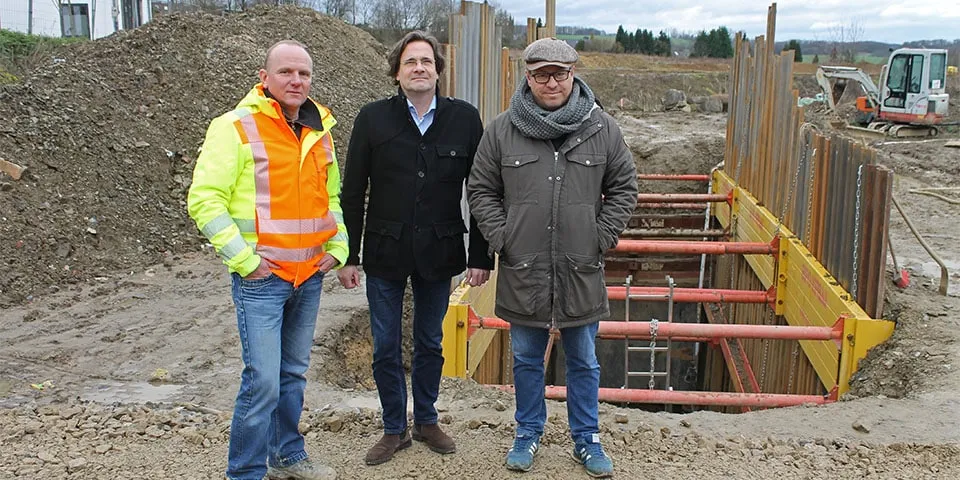
“You only realise how deep it really is when you’re standing down there,” says Andreas Iks. The site manager at construction and civil engineering company Müller & Bleckmann and his colleagues have excavated a 7.5-metre-deep shaft several times to lay huge concrete pipes with an internal diameter of 2 metres. The individual pipe sections are 2.5 metres long and weigh around 11.5 tonnes.
Extra-long sheet piles from Euro Verbau enable complex stream diversion
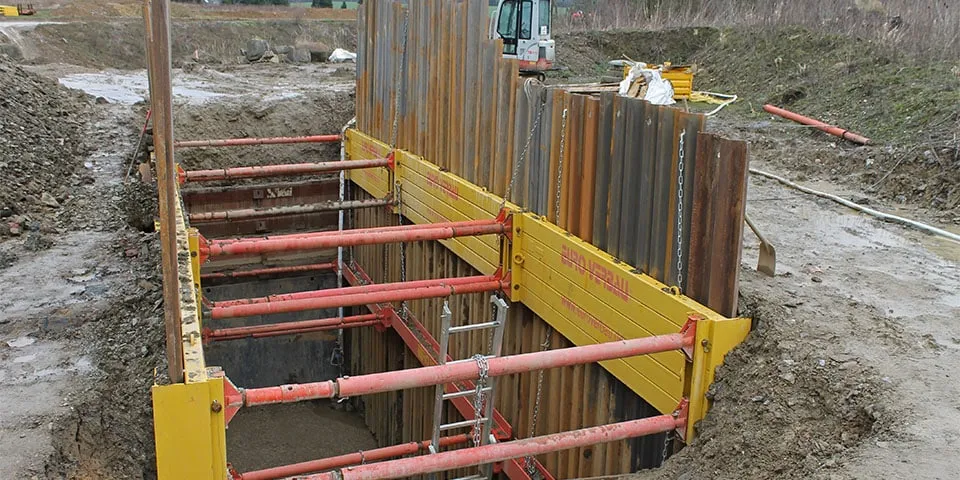
The sheet piles are installed in sheet pile chambers in the 10-metre-long excavation. The guides in the chambers ensure the profiles overlap correctly. Photo: ZIKOMM / Thomas Masuch
The concrete pipes are being laid in the Neviges district of the German city of Velbert, in the state of North Rhine-Westphalia. From the end of 2020, the Motschenbrucher stream will flow through these pipes and return to its original course. For years, the stream water was mixed with sewage and carried to a wastewater treatment plant in Essen. From the end of 2020, the stream will once again meander along its natural course at an elevation of 400 metres, slowed by natural rock and bordered by shrubs, ferns and trees. This idyllic vision is part of the renaturation plan, but is currently disrupted by a road, Am Rosenhügel, and several access roads that cross the stream’s former course. The stream will be diverted through new concrete pipes over a length of around 70 metres, laid up to 7 metres below the road. The total budget for this construction work is €1.25 million.
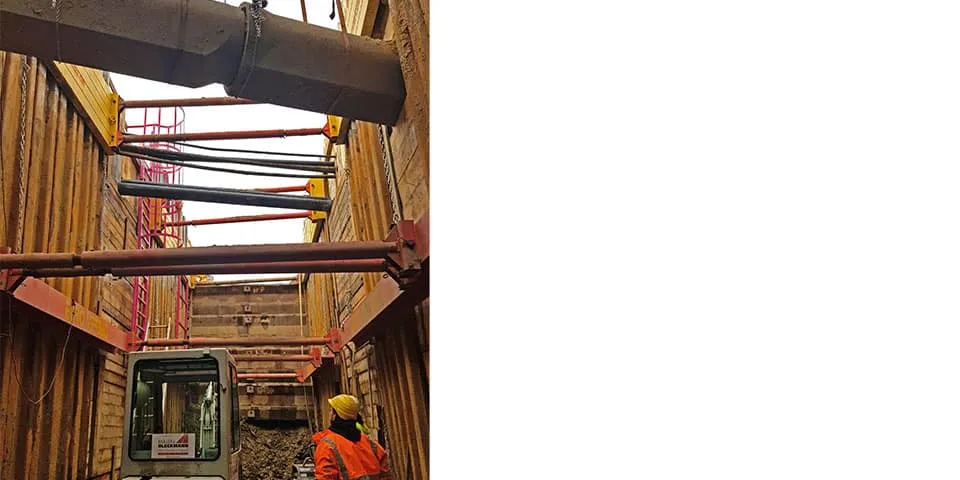
At 7.5 metres below ground level, the sheet piles withstand the pressure of tonnes of earth. Photo: Müller & Bleckmann
“An unusual challenge”
“And the depth presents an unusual challenge,” says Ingo Schachtschneider, managing director of Müller & Bleckmann in Heiligenhaus. This applies not only to placing the pipe sections, which weigh several tonnes and require a mobile crane each time. “Down there, you can feel the pressure of the ground, which weighs several tonnes.” To find a solution to these challenges in the ground at Neviges, Schachtschneider consulted Martin Echelmeyer, Sales Manager Rhineland at Euro Verbau GmbH, in advance. “We concluded that the deep shafts would be best supported by sheet piles 8.5 metres long and 60 centimetres wide,” says Echelmeyer.
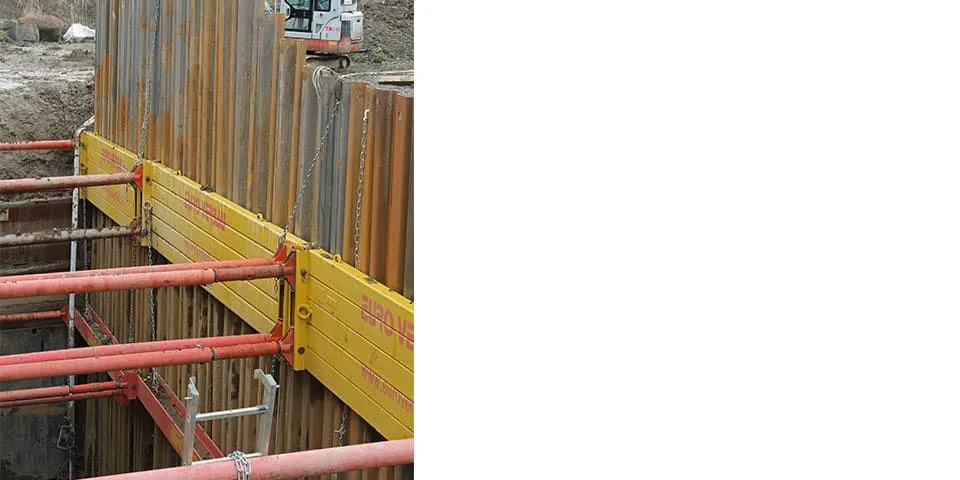
The sheet piles are installed in sheet pile chambers in the 10-metre-long excavation. The guides in the chambers ensure the profiles overlap correctly. Photo: ZIKOMM / Thomas Masuch
As sheet pile sections of this length are not a standard hire product, Euro Verbau made them to measure at its production facility in Mönchengladbach and delivered them as a suitable package, with complete sheet pile chamber elements including spindles, spacers and walings in widths of three, four and five metres. Before the elements and sheet piles were used, a stability calculation was carried out on the basis of a soil investigation. The structural calculations were also particularly important to Ingo Schachtschneider, whose company employs around 50 people, six to seven of whom are permanently on the Motschenbrucher stream site. “Because safety is our top priority.”
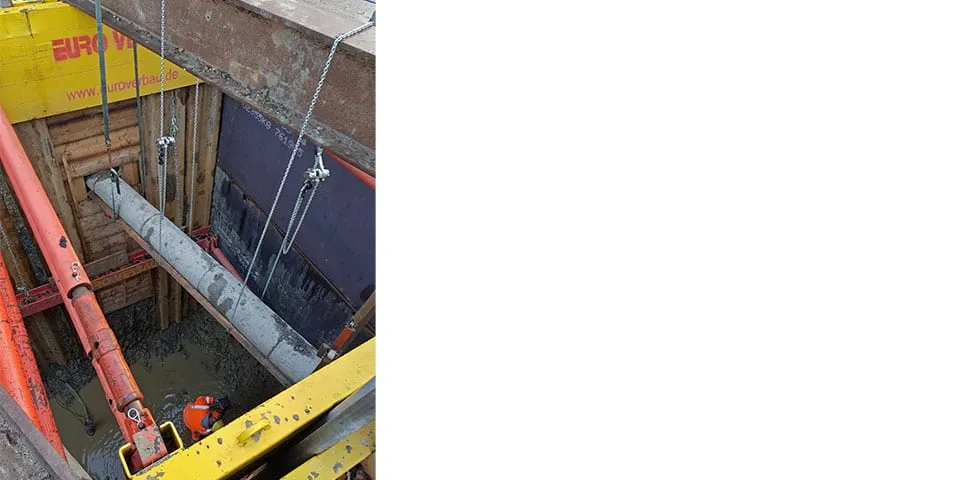
Working at depths of more than 7 metres requires highly reliable equipment. The system used is particularly suitable where cables and pipelines cross. Photo: Müller & Bleckmann
Wide range of solutions for highly specialised projects
Each section of the excavation is 10 metres long and 7 metres deep. The ground is first compacted with crushed stone and sand before the pipe sections are delivered and laid by crane. The sheet piles project above the sides of the excavation to varying heights, depending on how far they can be driven into the ground. Sometimes stones or rocks get in the way.
Once the pipes have been connected, Andreas Iks and his colleagues backfill that section of the excavation and start digging again 10 metres further on, supporting the sides with sheet piles once more. Ingo Schachtschneider says the flexible, bespoke solutions from Euro Verbau have helped make the whole process run so smoothly: “We have successfully completed several projects together. There are few companies that can provide the right solution for every application. With its wide range, Euro Verbau also offers solutions for highly specialised projects.”
Question about this story? Ask your question
Who worked on it
Motschenbrucherbeek in Velbert
- site managerMüller & Bleckmann
- sheet pilingEuro Verbau
Keep following this
Get an email when a new story is published. No account needed.
- ProjectMotschenbrucherbeek
- SubjectWater infrastructure
- CompanyMüller & Bleckmann
- CompanyEuro Verbau







