









Innovative quay wall anchored with strand anchors
Text Tony VosImage De Vries Titan
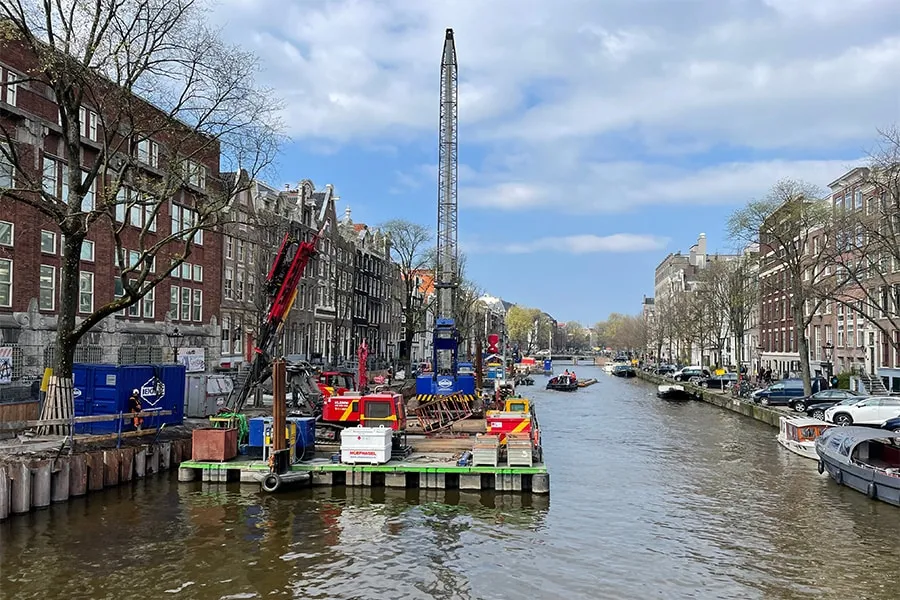
As a foundation specialist, De Vries Titan is involved in the Quay Walls Innovation Partnership in Amsterdam. The company manufactures anchors and anchor piles and has been operating in the Netherlands for almost 25 years, as well as in Belgium and Germany. Its good relationship with Gebr. de Koning B.V. led to its involvement in the project during the tender phase. It has been contracted as a regular subcontractor by G-Kracht.
A first pilot project was carried out on the Singel this year. De Vries Titan installed the anchors. Hendrik van de Woestijne, company manager: “The project’s key feature is the wall structure made of bored piles. That is unique in the Netherlands. One of the objectives was to minimise the time, disruption and impact by using innovative techniques, in short, to carry out the project in a way that minimised its impact on the surrounding area.”
Minimal impact
To work without vibrations, De Vries Titan opted for permanent strand anchors fitted with prestressing cables. The anchors were installed using a double casing. Once the drill casings reach the required depth, the inner casing is removed. The strand anchor is placed inside the larger outer casing, which can then also be withdrawn. De Vries Titan injects grout along the strand anchor, forming a bundle of strands surrounded by grout in the load-bearing sand layer.
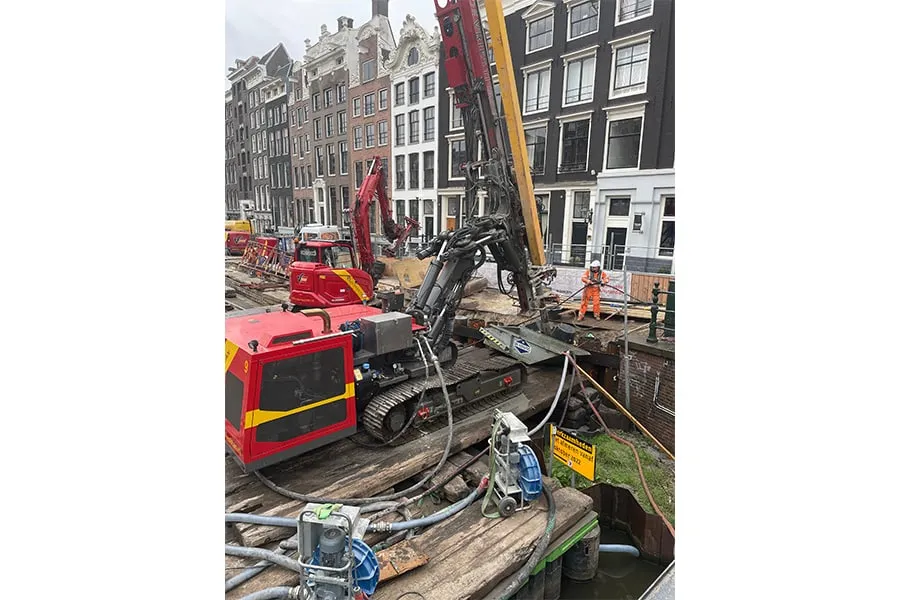
Hendrik: “Drilling is entirely vibration-free, which is a major benefit for the surrounding area. The drill casings pass through all existing structures, allowing the existing elements of the quay wall to remain in place. We also used this technique on the Singel. The existing structure consists of the old brick quay wall, a timber floor and timber piles.”
The double-casing drilling method has the least impact on the surrounding area. Drilling always has an impact, but this method produces the best results and carries the lowest risk of settlement. That is an important consideration in the city centre.
The anchors have a dual corrosion protection system, guaranteeing a service life of at least 100 years. Their design takes account of the adjoining buildings behind the quay wall, ruling out settlement of the listed buildings.
Logistical challenge
All De Vries Titan materials and machinery were transported from the construction hub by water, using fully electric vessels. This helped to reduce traffic on Amsterdam’s road network as much as possible.
Special pumping systems were used to prevent pollution of surface water. These pumped the wash water and surplus grout into containers.
De Vries Titan carried out the pilot using so-called Stage V machines, the most advanced diesel-powered machines currently available. Hendrik: “We are working on electrifying our equipment and hope to make good progress on this with G-Kracht’s follow-up projects.”
A business enquiry for De Vries Titan B.V.? Get in touch
Who worked on it
Innovatiepartnerschap Kademuren in Amsterdam
- subcontractorDe Vries Titan
Keep following this
Get an email when a new story is published. No account needed.
- ProjectInnovatiepartnerschap Kademuren
- SubjectWater infrastructure
- CompanyDe Vries Titan B.V.
- CompanyGebr. De Koning







