









High-tech beneath the Scheldt
Text Armand Landman Images Immontec
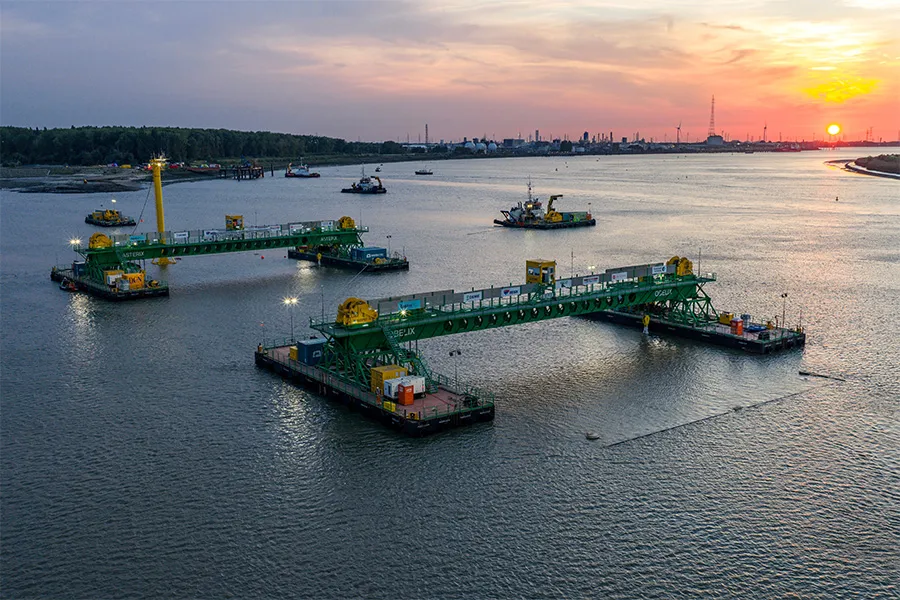
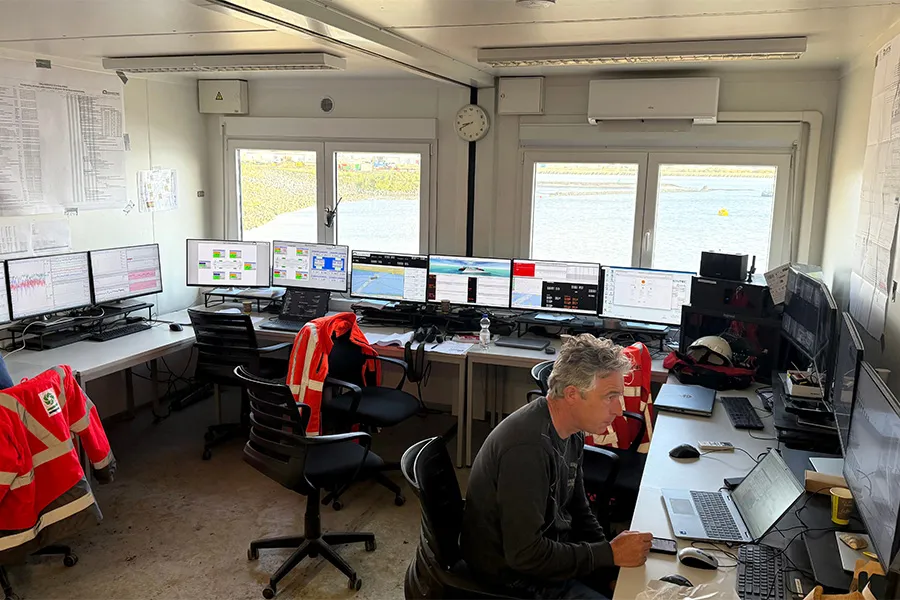
These days, immersing a tunnel no longer depends on the tugboat captain’s feel and the surveyor’s eye. Immersing the eight tunnel elements of the Scheldt Tunnel, part of the Oosterweel Link near Antwerp, is an elite sporting feat. Immontec’s control unit monitors the operation on sixteen screens. “It is high-tech work, where nothing is left to chance,” says Carlos Bosma, monitoring project manager at Immontec.
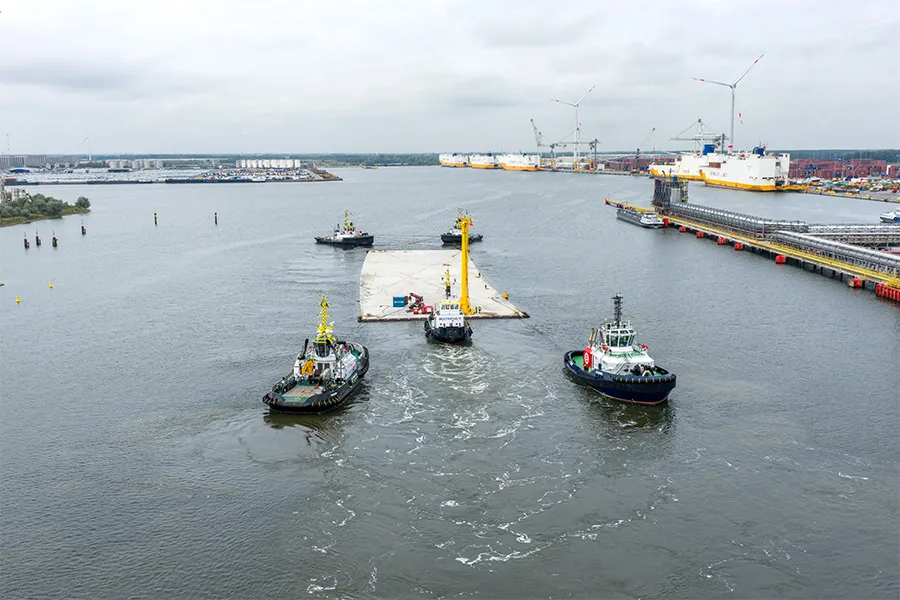
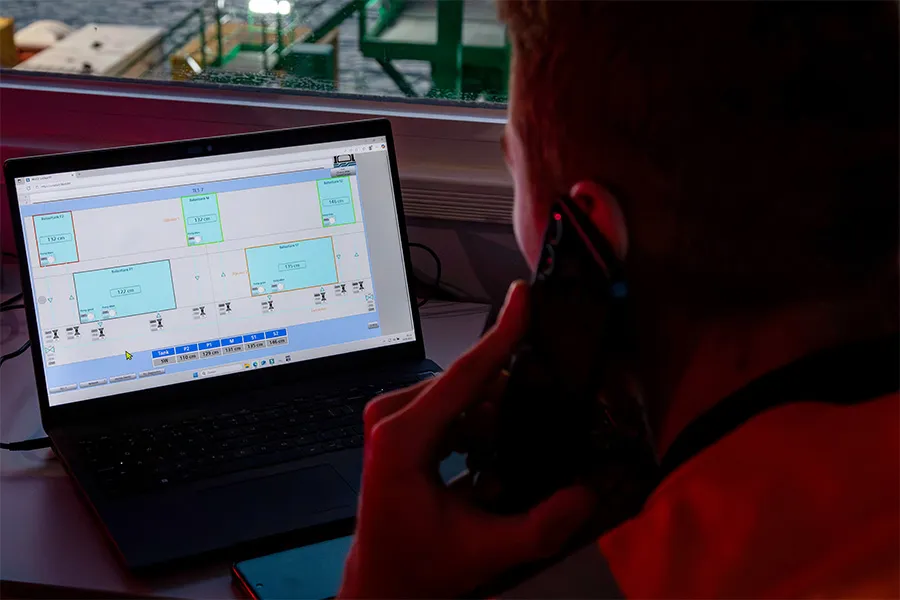
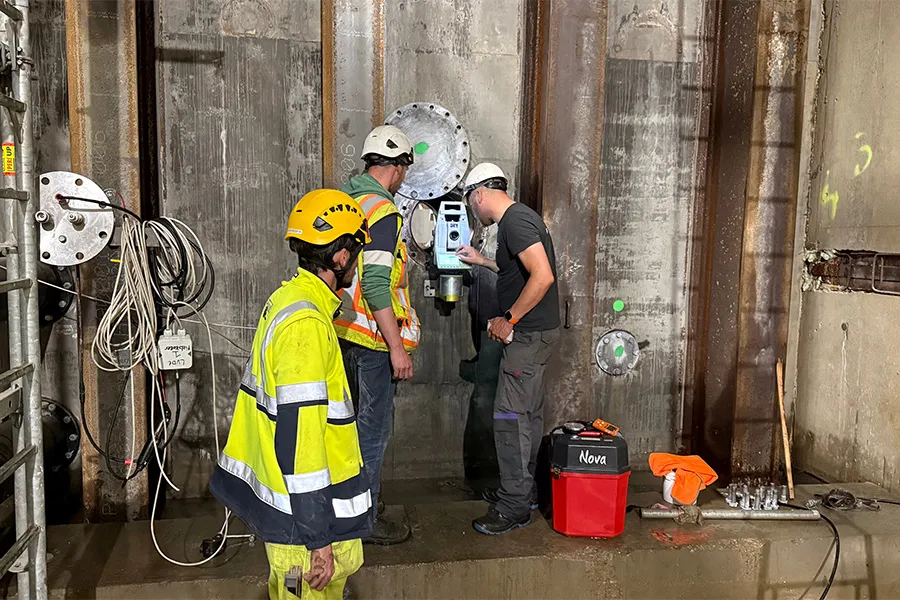
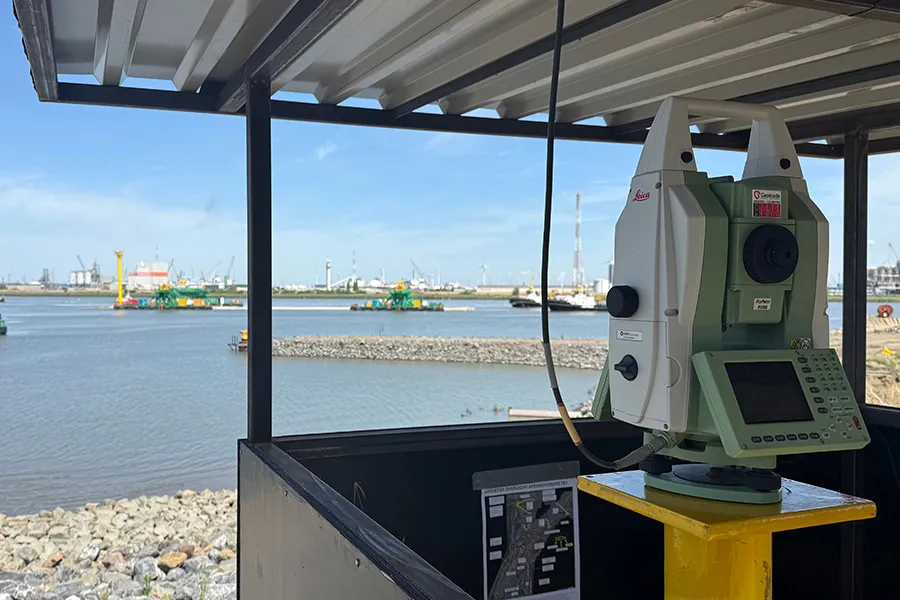
Bosma and his team are responsible for positioning and monitoring the tunnel elements as they float, are transported and are immersed, on behalf of TM Cotu and Bouwheer Lantis. Measurements are accurate to within 5 millimetres. “We measure everything: the element’s position using GPS and total stations, water levels in the ballast tanks, winch forces and cable lengths, salinity, currents. Everything is displayed live in our control unit,” he explains. “The data is transmitted simultaneously over Wi-Fi and mobile internet. If one connection fails, the other takes over. Redundancy is crucial.”
Immontec’s monitoring work begins in the construction dock in Zeebrugge, where sensors are installed in the elements. “From there, they are transported by sea to Antwerp and eventually immersed in the Scheldt,” says Bosma. “We provide the data our colleagues need for the immersion operation. For us, each of the eight tunnel elements is a separate project, with its own preparation and installation, and continuous monitoring of all the data.”
He says this intensive preparation is essential. “In the past, the surveyor on shore used prisms to determine the element’s position. Now we have internal sensors that measure its orientation relative to magnetic north, combined with GPS and total stations on shore. This lets us determine its position to millimetre accuracy, even 25 metres underwater.”
Eight immersion operations at record pace
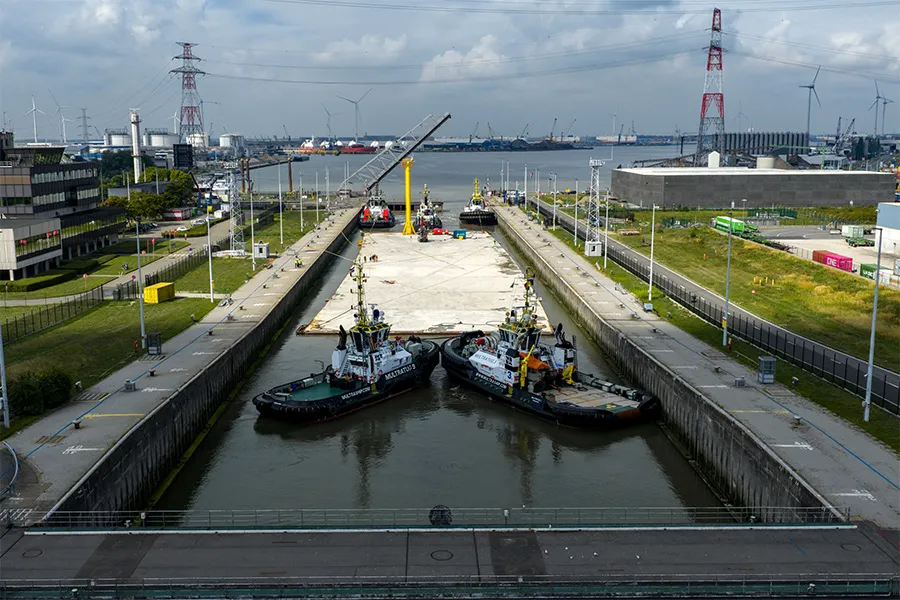
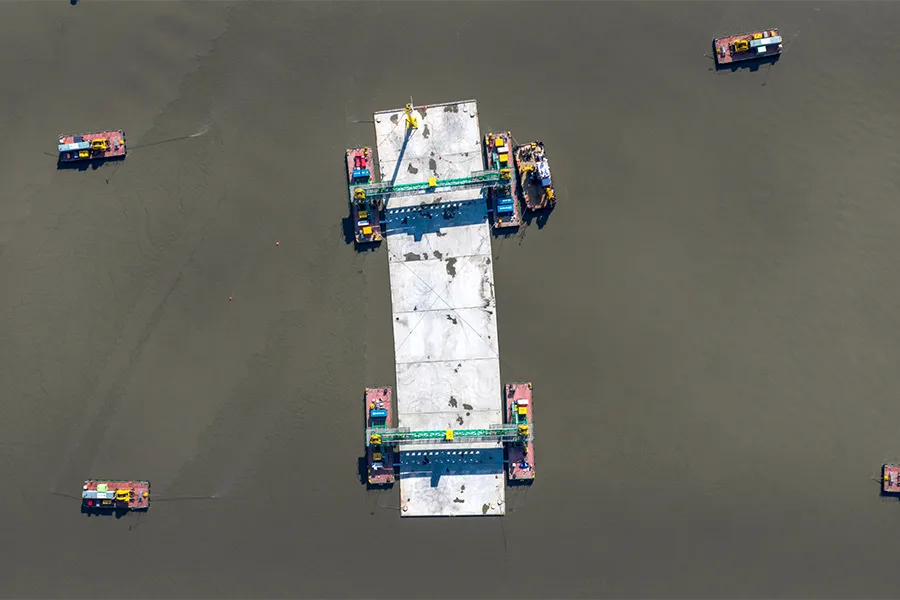
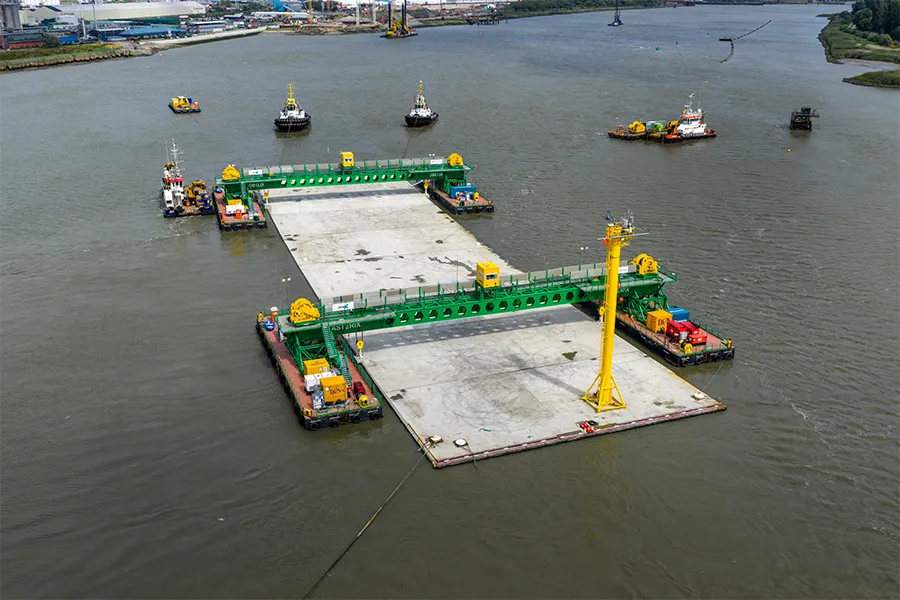
Auke Lubach, project manager at Immontec and responsible for the immersion operations themselves, says the project’s scale and pace are unique. “We immerse eight elements on a fortnightly cycle. The approach itself is not unique, but the large number of elements makes this project special,” he says. “That means that every fourteen days we have to position an element 160 metres long and 40 metres wide, 25 metres underwater. And on a river with strong currents, where we can work only during neap tides, for a few days each month.”
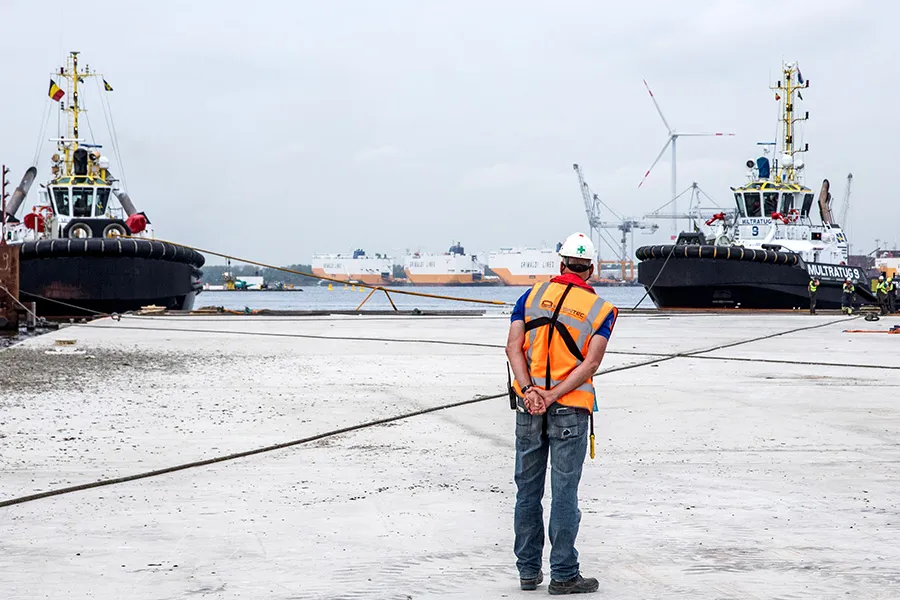
The operation requires millimetre precision. “A tunnel element weighing thousands of tonnes hangs from 70-millimetre winch cables. Unexpected movements can generate enormous forces,” Lubach explains. “That is why everything is simulated, tested and checked in advance. During immersion, we work with six tugboats, a tow master, an immersion supervisor, and a team on shore and on the pontoons operating the winches. Everyone needs to know exactly what they are doing.”
Logistics are also a challenge. “After each immersion operation, we move the heavy winches, each weighing around 50 tonnes, from the bank to a pontoon, which is anchored ready for the next operation,” says Lubach. “Each move is a mini-operation in itself, involving transport through the city and assembly on the water. In the weeks between immersions, we also have to retest the hydraulic systems and ballast installations. It is a continuous sequence of preparation, execution and reconfiguration.”
The technology behind immersion
A 10 to 15-metre-deep, 100-metre-wide, 1.5-kilometre-long immersion trench is dredged in the Scheldt for the tunnel. Lubach explains: “After immersion, the element does not rest directly on the riverbed, but on temporary supports. At the landward end, it rests on a so-called nose-and-chin support; at the other end, on two steel pins resting on bearing plates weighing 120 tonnes each. The space beneath the element is then filled with fluidised sand, which we monitor continuously to prevent the element from being pushed upwards.”
Fluidised sand is a crucial stage in the process, Bosma adds. “The sand must not flow too quickly beneath the element, or it will push the entire tunnel element back up. Our sensors monitor the pressure distribution and show us in real time whether the sand is spreading evenly. It is like surgery: you work blind, but the data shows you exactly what is happening.”
Temporary bulkheads keep the inside of the tunnel element dry, and the element has compartments for ballast water. After immersion, the ballast water is replaced with ballast concrete. Once all eight elements have been immersed, a 1.8-metre closure joint remains between the last two. “A steel formwork and base plate are installed there, after which we pump the water out of the space and finish it,” says Lubach.
Monitoring and immersion: one team
Both say that the close collaboration between Bosma’s monitoring team and Lubach’s immersion crew is one of the project’s success factors. “We literally sit next to each other,” says Bosma. “If Auke needs to know something about a measurement, he can find out straight away. Those short lines of communication make us flexible and reliable. There is no time to wait days for analyses from outside.” Lubach adds: “Thanks to our in-house expertise, we can respond quickly to what is happening in the field. If something deviates, we can immediately trace it to a sensor, a cable or a physical situation in the water.”
It also means the company can learn a great deal from its own projects. “We will use the Antwerp data to refine our systems further,” says Bosma. “For example, we are now continuously measuring the winch forces, something that was not yet standard on earlier projects. This gives us insight into the dynamics of the whole system and makes future operations safer and more predictable.”
World-class expertise
The Antwerp project is attracting international attention. Lubach says: “The immersed tunnel market is moving again. Projects in Bremen and Vancouver will follow Antwerp. This is specialist work: there are few companies around the world capable of doing it.”
Bosma nods in agreement. “It is special to work on infrastructure on this scale. You are literally building underwater, in conditions you cannot see but must nevertheless fully control. Everything has to be right. Flawless. That is our mindset: failure is not an option. Monitoring and immersion are now pure high-tech. And the best thing is that, before long, Antwerp will be driving into the future on the strength of our measurement data.”
* Commissioned by TM COTU and Bouwheer Lantis, Immontec is responsible for carrying out the immersion operation.
A business enquiry for IMMONTEC? Get in touch
Who worked on Scheldetunnel
- immersing the tunnel
 StruktonMentioned in Strukton Immersion Projects signs contract to immerse Scheldt Tunnel
- construction of the tunnelTijdelijke Maatschap COTUMentioned in Strukton Immersion Projects signs contract to immerse Scheldt Tunnel
Keep following this
Get an email when a new story is published. No account needed.
- ProjectScheldetunnel
- ThemeUnderground construction
- SubjectWater infrastructure
- CompanyIMMONTEC







