









Good advice is essential when disconnecting rainwater drains
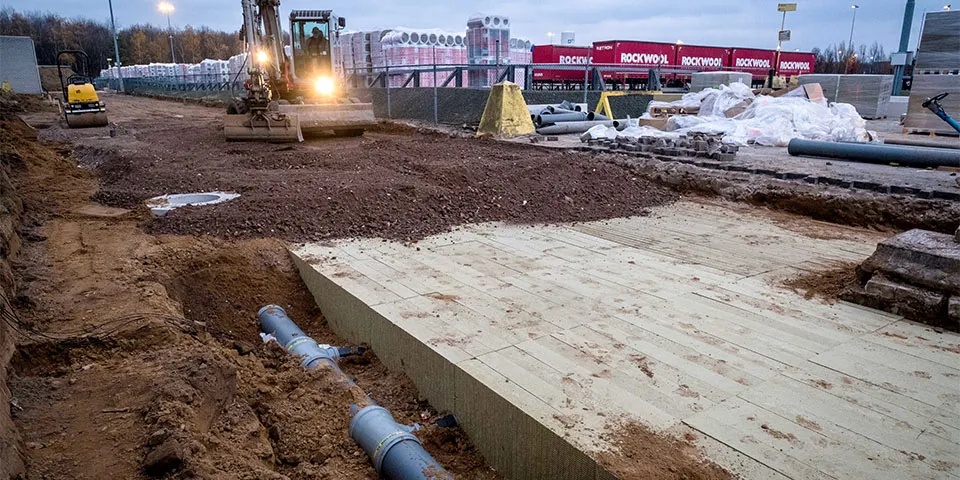
As extreme rainfall events become more frequent and intense, local authorities are encouraging property owners to disconnect rainwater drains from combined sewer systems. This is intended to prevent the capacity of the existing sewer network having to be increased. It also means that rainwater, which is already clean, no longer needs to be treated. A good, cost-effective solution. But both local authorities and residents would be wise to seek expert advice before cutting into a downpipe.
John Evers: “Rockflow always works”
CHECK THE VENTILATION
John Evers, senior consultant at engineering firm Kragten in Herten (L), is an authority on sewer engineering and solving problems caused by water and odour nuisance. The latter, in particular, is something he encounters regularly when rainwater drains are disconnected improperly at a property. “People don’t realise that, in a home connected to a combined sewer, the downpipes act as ventilation ducts for the public sewer. If you disconnect the downpipes, the only ventilation left is the vent pipe inside the house. For it to work properly, this vent pipe must extend through the roof and have the same diameter from end to end. If it doesn’t, you can expect odour nuisance.” His main advice to homeowners and businesses considering disconnecting the rainwater drains at their home or commercial premises is therefore always to consult an expert.
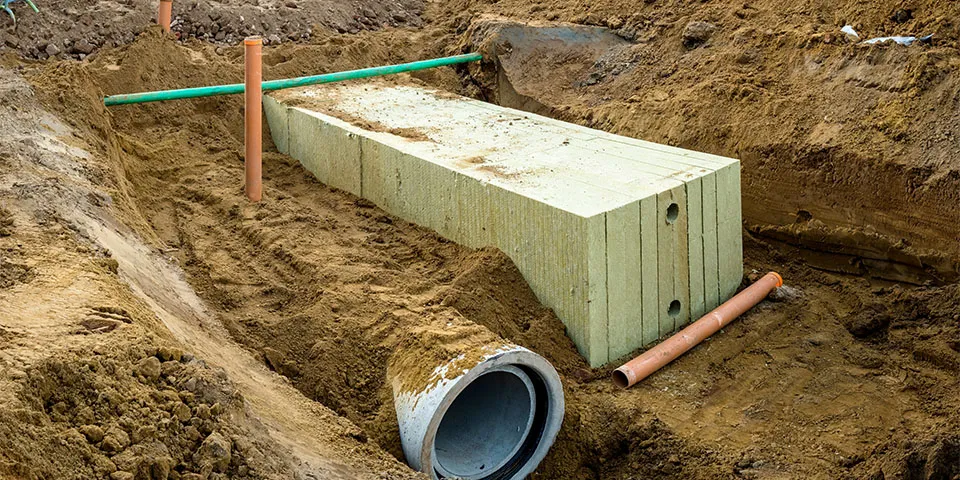
Example of a separate sewer system in Maasbracht (Limburg). Rockflow is installed alongside the foul sewer and allows rainwater to infiltrate without having to be conveyed.
LIMITATIONS
For new-build developments, separate drainage for foul water and rainwater is already taken into account at the design stage. For existing buildings, which still account for around 75% of the housing stock, solutions must be found to suit the site conditions. Evers: “The limitations you encounter when disconnecting rainwater drains generally have to do with a lack of space, low soil permeability or a high groundwater level.”
SAFE STORAGE
“Technically, disconnecting rainwater drains and combining this with infiltration is an excellent measure. The mistake people make is to assume that disconnection means they are protected against heavy downpours, but that’s not the case. Infiltration is, by definition, a slow way of draining water, whereas heavy downpours arrive very quickly, so the water cannot infiltrate fast enough. You therefore need to create storage areas and buffers to hold the water temporarily.”
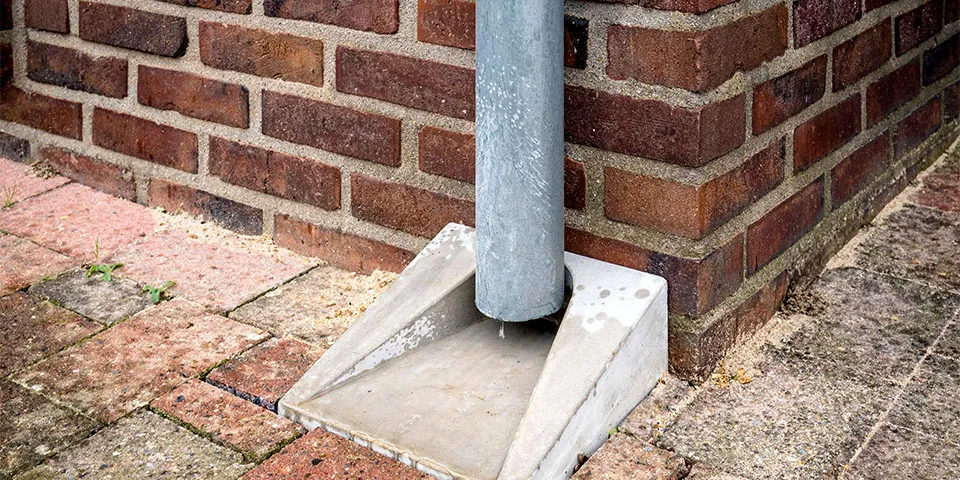
Rainwater disconnection tile at a project in Maasbracht (Limburg).
THE BEST SOLUTION
So what is the best solution for storing and infiltrating the water? Evers: “In principle, any solution can work, but the conditions will determine which product is preferable. Rockflow* is ideal where groundwater levels are high, because it can be installed directly beneath the foundations. That isn’t possible with crates, which need at least 80 cm of cover. Lava is another option, but it has far less storage capacity than Rockflow, with its 95% void space. I think many engineering firms still mainly opt for crates for infiltration because they aren’t familiar with this relatively new product. At our firm, we always consider all the options, and Rockflow often comes out as the best solution. That’s not just because it offers extra capacity where groundwater levels are high: the fact that it doesn’t need to be wrapped in geotextile, unlike infiltration crates, is also a major advantage. Geotextile can clog and cannot be cleaned, with all the consequences that has for infiltration capacity.” Another advantage Rockflow has over crates is its ‘infiltration angle’. “When you install crates underground, an infiltration cone spreads out from the crate at a certain angle. With Rockflow, the water travels almost straight down alongside the Rockflow bed, so there is hardly any horizontal spread. This is a major advantage when the infiltration system is installed close to the foundations. If you do that with crates, you are guaranteed to get moisture in the crawl space.” Is there a situation in which you would advise against using Rockflow? “No, Rockflow can always be used and always works. And there are situations where it is even the only option. If you have a ‘bathtub’, a low-lying site with a clay subsoil and no possible outlet, using Rockflow is effectively the only way to solve the problem.”
*Rockflow is an innovative water management system made from stone wool. It quickly and effectively stores runoff from extremely heavy rainfall, before gradually allowing it to infiltrate into the ground or discharging it into the sewer system.
Question about this story? Ask your question
Keep following this
Get an email when a new story is published. No account needed.
- SubjectWater infrastructure







