









Floating nature island made from compressed willow matting
Text Roel van GilsImage Van Schaik
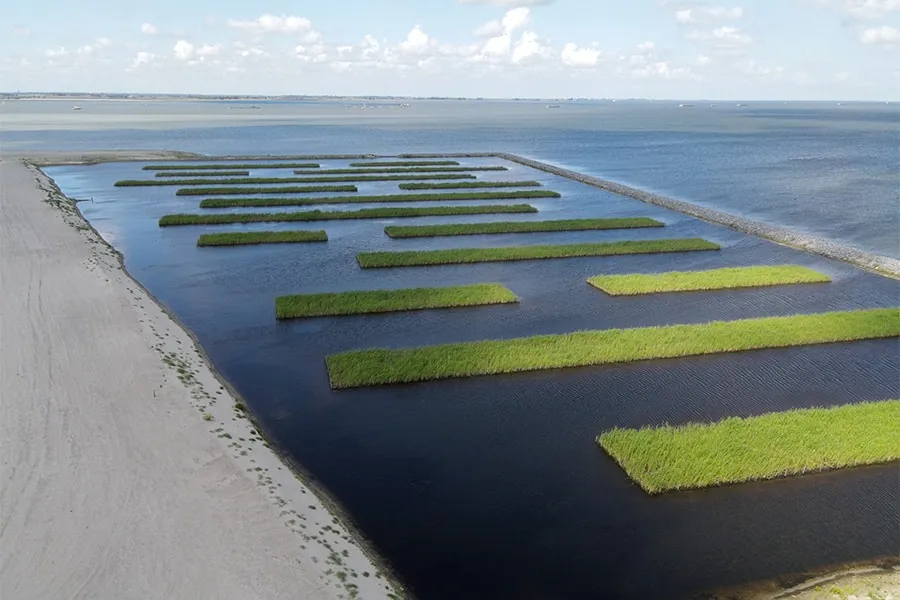
Amsterdam has gained another new piece of land. At 82 hectares, Strandeiland is the largest island in IJburg. Up to 6,200 new homes will be built here in the coming years. Alongside this new part of Amsterdam, a 3-hectare Nature Island has been created, with reed beds and a mussel bed. Its foundations were laid using the Schaikmat, which has been used on a large scale here for the first time. A unique and exceptionally sustainable product made in the Netherlands.
The Schaikmat was developed by Van Schaik, which has specialised in manufacturing products made from coppice wood for more than sixty years. “It is a sustainable, locally sourced alternative to coconut matting,” says director Teba Jongenotter. “The idea for the Schaikmat came about around eight years ago. Since then, we have continued to develop the willow matting and test it extensively on small-scale projects.” Natuureiland on IJburg is the first truly large project to use the Schaikmat. Van Schaik supplied and installed no less than 12,000 m2 of compressed willow matting.
A native product
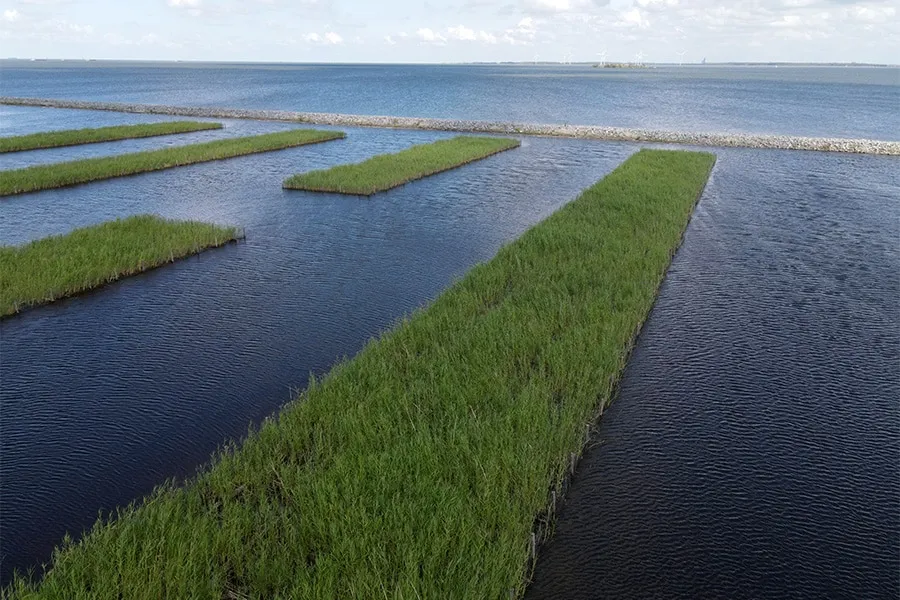
The Schaikmat is suitable for a range of applications, including robust bed and bank protection, and can also be used as a floating island. “The latter creates ecological value in waterways or simply improves their appearance,” explains Teba. “The plan to create a strip of reeds at Natuureiland was already part of the design. It was initially to be made using coconut matting, but the client, Gemeente Amsterdam, and contractor Combinatie IJburg were open to alternatives. So we put forward our Schaikmat. It is a native, sustainable product made from willow, which grows and is processed here in the Netherlands. Coconut, by contrast, has to be shipped from far away. The use of willow is also of interest to nature conservation organisations, because demand for the product helps preserve traditional coppice beds.”
A range of plant species
Van Schaik has developed a method for machine-producing the mats. “After pruning, the willow branches (rods) are left to dry for several months at our production site in Ingen. The loose branches are then compressed in a machine and woven into Schaikmat panels measuring around 2 by 2 metres and ranging from 10 to 20 cm in thickness,” explains Teba. “We bind the branches together using untreated 2 mm iron wire. The idea is that the entire mat, including the wire, will eventually decompose, allowing nature to take over its function. In the meantime, the plants have had a chance to take root. A range of plant species can be used in the mat, from helophytes to marsh plants. Here on Natuureiland, reeds were chosen.”
Van Schaik joined the mats for Natuureiland together on dry land, anchored them and planted them with reeds. Only then was the area flooded. “It has now been just over a year, and all you can see are neat lines of green reeds. The mats lie about 30 cm underwater and are mostly covered with roots. So, as far as we’re concerned, it’s already a success,” says Teba proudly. She adds that the Schaikmat is also highly suitable for greening banks, as required under the Water Framework Directive (WFD). “The sustainable mat can even withstand heavy wave action and strong currents.”
Een zakelijke vraag aan Van Schaik Grondverzet B.V.? Get in touch
Who worked on it
Natuureiland in Amsterdam
- clientGemeente Amsterdam
- contractorCombinatie IJburg
Keep following this
Get an email when a new story is published. No account needed.
- ProjectNatuureiland
- SubjectWater infrastructure
- CompanyGemeente Amsterdam
- CompanyCombinatie IJburg
- CompanyVan Schaik Grondverzet B.V.







