









Expert in building flood defences
Text Roel van GilsImage Hollandia Infra
It is no coincidence that Ploegam and Dura Vermeer, through the Dijkzone Alliantie, are working with Hollandia Infra to build the Vlotterkering® in Steyl-Maashoek. The company, based in Krimpen aan den IJssel and part of the Hollandiagroep, is regarded as the leading specialist in the design and construction of complex steel water-control and movable structures and bridges in the Netherlands and abroad.
Iconic flood defence structures such as the Maeslantkering, the Hollandsche IJsselkering and the Hartelkering, including its renovation, are all products of the Hollandiagroep. Since the floods on the east coast of Great Britain in 2013, the company has also been a regular partner of the Environment Agency (the British equivalent of Rijkswaterstaat, ed.) in building flood defences at the estuaries of the major rivers there. Without exception, these are all innovative structures. The Ipswich flood barrier was the first. “We did not have a leading role on that project, as the design was prepared by the civil engineering contractor,” says Rob Schippers, project manager at Hollandia Infra. “However, we had so many comments and suggestions for improvement that we were awarded the next project, the Boston Barrier, directly and were also given responsibility for the design.” Apparently, that whetted their appetite, because Hollandia Infra has since also supplied the flood gates for Tilbury Docks, which now protect thousands of homes and businesses in the surrounding area from high water.
Linked flaps
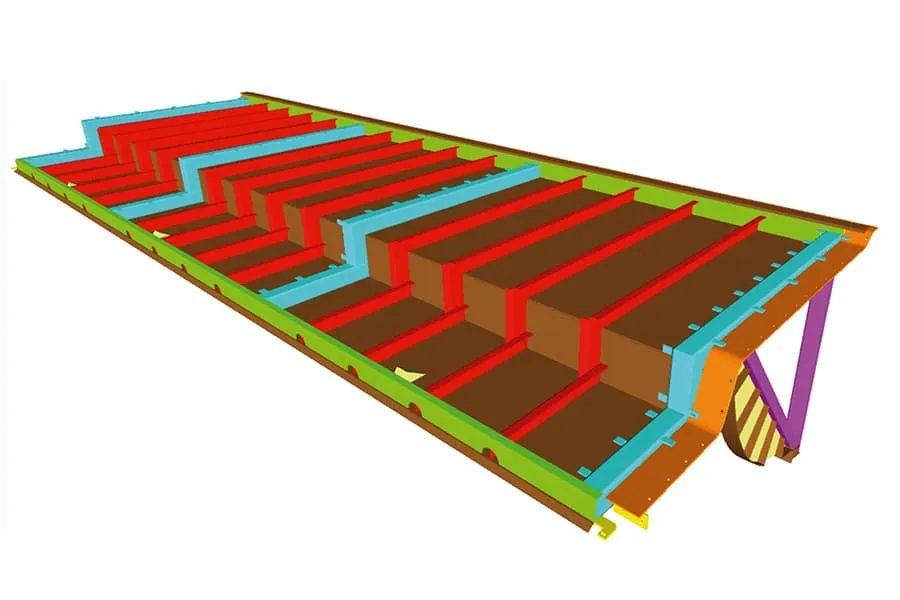
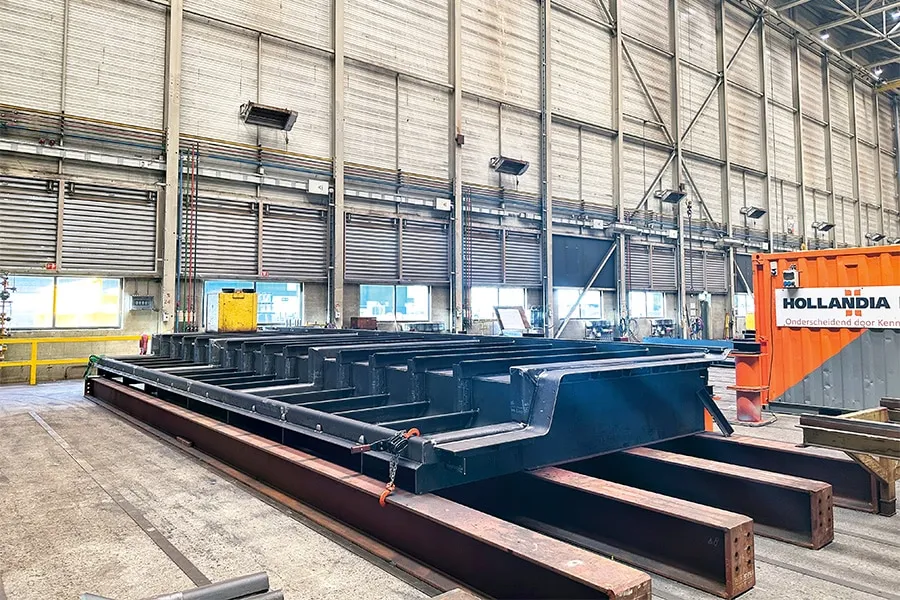
Dutch clients also turn to Hollandia Infra, particularly when projects become more complex. “Our task on the Vlotterkering® at Steyl-Maashoek has two parts,” says Rob Schippers, project manager at Hollandia Infra. “One is to demonstrate that it is watertight, and the other is to design, manufacture and install the flaps and hand them over in working order. The first part involved building a full-scale mock-up, 3 metres high, at our yard in Krimpen aan den IJssel. It took quite a lot of time and effort, but working together we were able to demonstrate to Waterschap Limburg that we can guarantee the required level of watertightness.” The self-closing barrier concept consists of twelve linked flaps, each with three floats, connected by a rubber seal from Trelleborg to form a single floating unit. “At the ends, we are manufacturing two gate barriers, each also with a float and rubber seal. Because the flap is hinged, the rubber seals undergo considerable deformation at the corners. Together with Trelleborg, we have had to work hard to optimise and fine-tune the design.”
Hollandia Infra is currently manufacturing the flaps. They are scheduled to be installed in Steyl in the second quarter of next year.
Een zakelijke vraag aan Trelleborg Ridderkerk B.V.? Get in touch
Who worked on Vlotterkering®

Keep following this
Get an email when a new story is published. No account needed.
- ProjectVlotterkering®
- ThemeFlood protection and climate-resilient water management
- SubjectWater infrastructure
- CompanyTrelleborg Ridderkerk B.V.







