









Diversity. Flexibility. Quality.
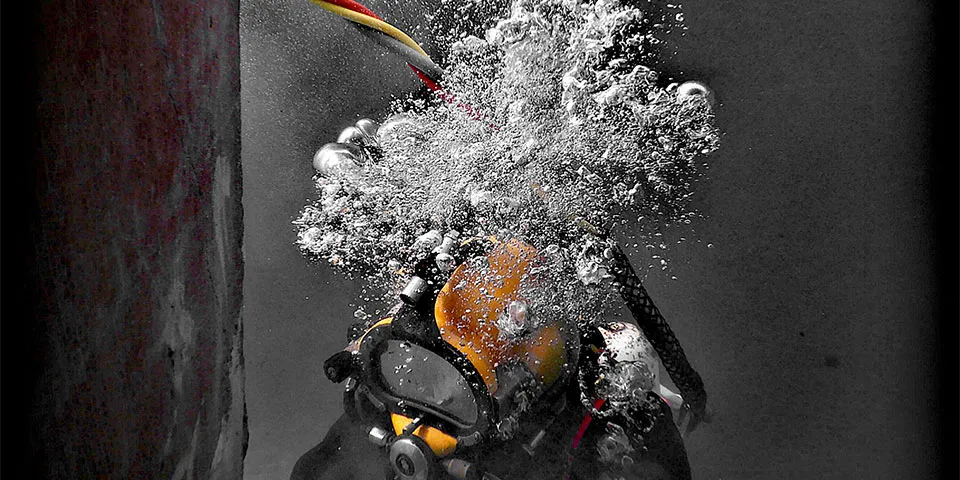
The three pillars of a specialist diving company working in civil underwater construction.
One of the major players in civil underwater construction, with long-term contracts with Haven Bedrijf Rotterdam NV and Gemeente Rotterdam, Duikbedrijf COW is known for its skilled divers and specialist equipment.
Since 2003, Duikbedrijf COW has worked on civil engineering projects in and around water throughout the country for RWS, local authorities, contractors and industry. Fred Burchartz, co-owner of Duikbedrijf COW, talks about the organisation’s diverse range of disciplines. “We handle all kinds of work on cofferdams, as well as the renovation of concrete structures, core drilling, welding and burning, video inspections, lock renovations, wall thickness measurements, injection, salvage and surveying. Wherever we work and whoever we work for, we can turn our hand to a huge variety of tasks, are highly flexible and always strive for quality.”
Assistance with fendering
Burchartz gives an example of a civil engineering project: the construction of the second lock chamber at Eefde, where Duikbedrijf COW has carried out a wide range of tasks since the project began. Rijkswaterstaat manages the Eefde lock complex and commissioned its expansion. “Before this project began, fendering had already been installed on the IJssel side. Our certified welders installed the permanent structure, then positioned and fitted the horizontal timber fenders underwater.”
Wet cofferdam
At Eefde lock, the cofferdams for the downstream head, upstream head and lock chamber were excavated under water. Diving work is required throughout the process, from the initial inspection through to installation of the underwater concrete floor. Burchartz explains that when a wet cofferdam with underwater concrete is chosen, it is vital that all the work is carried out safely, professionally and efficiently. “The Gewi anchors installed from ground level before excavation, for example, have to be cleared of their grout columns. These are approximately 200 mm in diameter. Our skilled workers remove them using a hydraulic grab and/or jackhammers, without damaging the Gewi threads. The divers then have to position and secure the plates at exactly the right height. Once the underwater concrete has been poured, the plates become part of it and act as tension anchors, holding the concrete floor in place against the groundwater pressure.”
Sheet pile wall repairs and cleaning
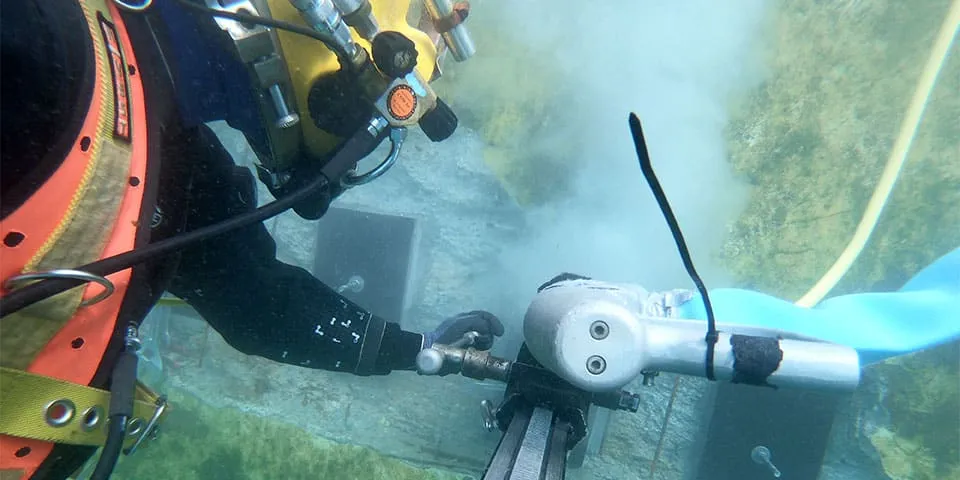
“Sometimes a project requires repairs to earth-retaining structures or other structural repairs, for example when a sheet pile has slipped out of its interlock. Working with the client and structural engineer, our certified welders carry out repairs to prevent the soil behind the sheet piling from entering the cofferdam, so that concrete can then be poured without problems.” Burchartz continues: “To ensure a good, watertight bond, the contact surface between the underwater concrete and the sheet piling must be cleaned at high pressure.”
Underwater concrete
“When placing underwater concrete, you can use a tremie pipe fitted with either a valve or a float. For the upstream and downstream heads at Eefde lock, a valve was chosen because these are smaller cofferdams without strut frames. The lock chamber, by contrast, was poured using a float, because the entire floor had to be reinforced concrete. There are several crucial factors when placing reinforced underwater concrete: the excavation tolerances are smaller when digging under water, and the design of the reinforcement cages plays a major role. This includes their dimensions and strength, as well as how the prefabricated reinforcement elements are connected.” Burchartz says the lock-wide reinforcement cages, fabricated elsewhere, were brought in over the water, shipped to the old lock and lifted into the new chamber by COW. “We made all the necessary preparations to ensure that the cages could be placed one by one at the right height. Our divers position the cages at the right height, clear of the bottom, with minimal tolerance. They then connect the cages to one another and weld them to the sheet piling and piles to secure them. In total, that meant 110 metres of reinforcement on the ground, ready for the concrete to be poured. You also have to take into account the flow
capacity of the underwater concrete.”
The mix design and flow spread of the underwater concrete were adjusted to 650-750 mm to ensure good flow. Consistent concrete quality and a constant supply are crucial to achieving a good result, which is why a float was used to pour the large lock chamber from above.”
Colloidal concrete
Burchartz names the placement of colloidal concrete as the final discipline involved in the Eefde lock project. “It is used to bind riprap stones together and prevent them from being washed away.” COW has a pouring and recording system that ensures the right quantity of colloidal concrete is placed in the right location.”
Underwater specialisms
In addition to the disciplines mentioned above, Duikbedrijf COW is known for various other underwater specialisms, such as those used for lock maintenance and inspections. COW has specialists and purpose-built equipment for working in urban areas to inspect old quay and bridge structures. “Reconstructing and renovating historic structures is a specialised trade. So is carrying out high-quality concrete repairs in both fresh and salt water under a strict protocol. Installing anodes to protect combined and sheet pile walls is another of COW’s specialisms,” says Burchartz. “We do this mainly for various port authorities, such as HBR, Groningen Seaports and Zeeland Seaports, where high standards apply to preparation, supply, working methods, record-keeping and safety. We are proud to have completed a large number of projects to our clients’ satisfaction.”
Above-water specialism
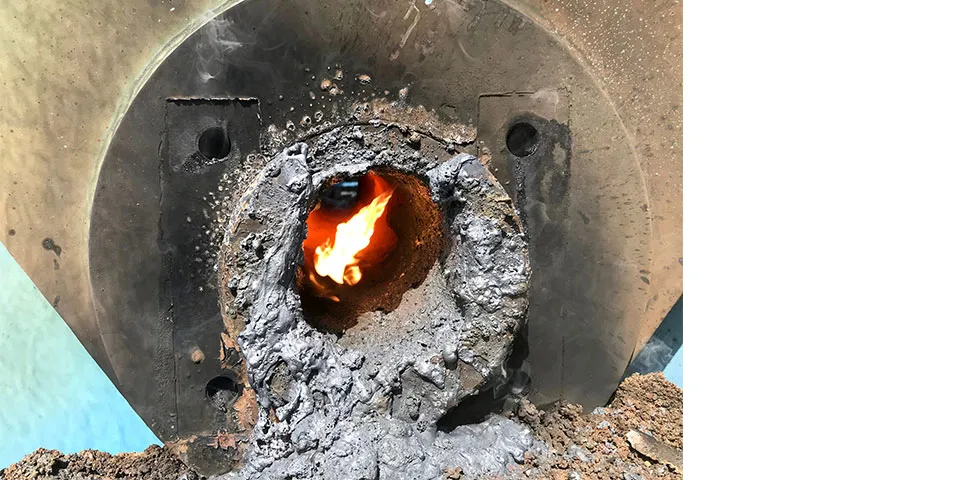
Alongside its underwater work, COW is also known for its specialism in removing shafts without causing damage, above water. “This often takes place high above the water, for example on cranes used to lift containers in ports. A thermal lance is used to remove a seized or worn shaft without damaging the bearings or surrounding structure. It takes considerable skill,” says Burchartz. “You have to cut through a shaft using 13 bar of oxygen and temperatures of up to 5,200 degrees. And all under enormous time pressure, because a seized shaft means downtime. Our skilled workers can remove almost any size of shaft in a matter of hours, allowing a new shaft to be installed.” The same approach can also save time on major projects where time is critical. Demolition work, such as removing an old railway bridge with doubled steel beams, can be carried out in a fraction of the time required by a conventional cutting torch. The savings on hiring very heavy cranes and planning the railway diversion are obvious.”
Flexibility
Alongside its wide range of disciplines, flexibility is one of COW’s key pillars, and something its clients greatly value. “We are known for acting quickly, scaling up and responding whenever needed. Our emergency contracts mean we are on call for clients 24/7, and many emergencies are resolved within just a few hours. If that is not possible, we carry out an emergency repair and apply a permanent solution at a later stage.”
Quality
“Whether it is a long-term project or an urgent job, we always strive for quality. But without a motivated team that is passionate about its work, we would be nowhere. You do not become an all-round diver overnight. It takes years of training and experience, and there is always more to learn. The fact that Peter Bosman and I both have a diving background is an advantage for COW, because we understand that this trade has to be passed down from one generation to the next. To ensure quality, we aim to make our people all-round divers as quickly as possible, supported by our own experienced staff and our regular pool of highly experienced freelancers. We also encourage them to specialise in the areas they are passionate about. That is how you bring out the best in people and get the best results. One person can prepare and carry out a highly technical job down to the last detail, while another can plan and report on an inspection just as meticulously. And then there are the guys who are not happy until all the anodes scheduled for the day have been installed from the deck and recorded according to protocol.”
COW’s work quality is reflected not only in the individual certification of its welders. COW is also the first company in the Netherlands to be certified to the applicable standard for welding procedures. In addition, COW holds ISO certifications and VCA** certification for the petrochemical industry, the highest VCA level a contractor can achieve, demonstrating the required expertise. Burchartz concludes: “Duikbedrijf COW is not only one of the major players in civil underwater construction, but also an absolutely reliable partner with the right expertise.”
A business enquiry for Duikbedrijf C.O.W. BV? Get in touch
Companies in this story
Keep following this
Get an email when a new story is published. No account needed.
- SubjectWater infrastructure
- CompanyDuikbedrijf C.O.W. BV







