









Continuous monitoring of vibrations and deformation during the widening of the Julianakanaal
Text Suzanne van Gaale Beeld Fides
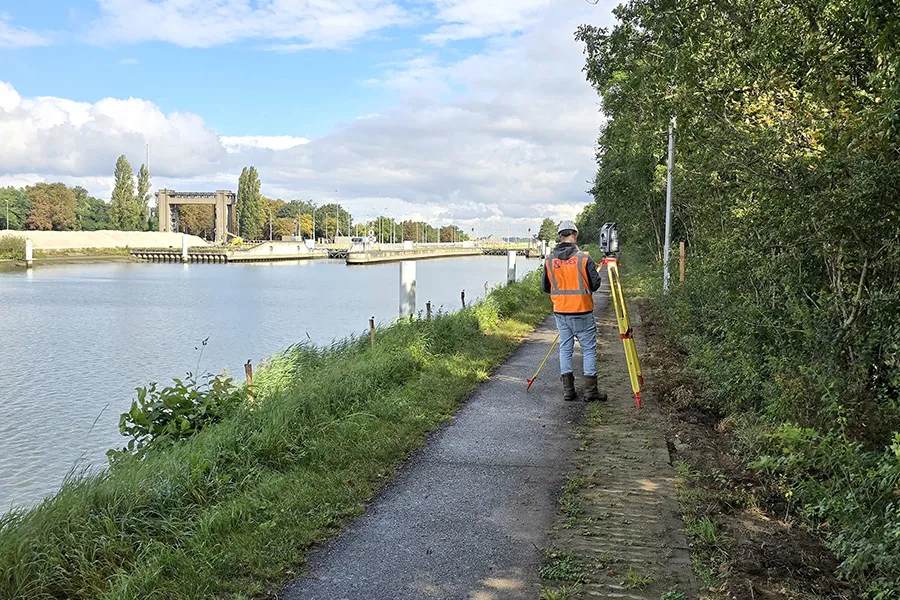
Safety and certainty come first. That is why vibrations and deformation are monitored almost continuously during the widening and deepening of the Julianakanaal in Limburg. Building damage assessment and consultancy firm Fides Expertise was commissioned to carry out the measurements. Fred Pannekoek, monitoring specialist, explains why everyone benefits from this careful approach.
Fides’s expertise and experience are proving invaluable on the Julianakanaal project. The project is unusual, which makes it a fresh challenge for the consultancy. “We mostly monitor buildings,” says Fred. “Here, however, we are monitoring the lock complex, the bridge abutments over the Julianakanaal, the temporary dam and the houses along the Julianakanaal. Van den Herik-Sliedrecht has chosen to monitor everything as a precaution, to avoid taking any risks.” Fides Expertise is carrying out the work in close collaboration with MOS Grondmechanica, with ongoing coordination with Van den Herik. “Our role is to ensure that all the measurements are accurate. MOS is responsible for interpreting the data. It’s a very good partnership.”
Monitoring contractor
Fides Expertise specialises in monitoring the effects of construction, demolition and infrastructure projects to prevent damage and disruption. This includes noise, vibration and deformation. Fred says: “We sometimes describe ourselves as a monitoring contractor. We also carry out building surveys and risk assessments, and draw up monitoring plans. In fact, we do everything that can and should be included in a monitoring programme. The aim is to keep construction projects under control. We are taking on increasingly complex projects, such as the renovation of the Binnenhof in The Hague and quay repairs in Utrecht city centre.”
Tilt sensors on the dike
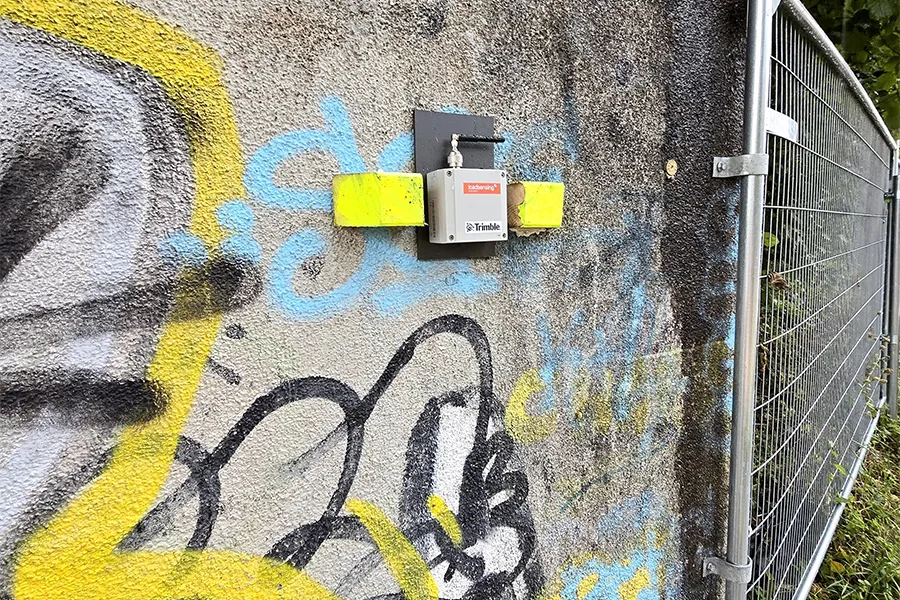
The dike was monitored mainly while the canal was being pumped out. In the preparatory phase, MOS identified locations in the dike where water was present. These were monitored during the works. “If you pump out the canal while there is water in the dike, doing it too quickly could cause the dike to fail,” Fred explains. “Obviously, that is not what you want. Measurements were taken on the dike and at the lock complex every time the water level was lowered by a metre. We also fitted tilt sensors to the bridge abutments to detect any potential tilting. The sensors trigger an automatic alarm, so if anything shifts or starts to lean, we are notified immediately.” In practice, the tilt sensors proved extremely accurate. The alarm was triggered several times. “It wasn’t because the abutments were at risk of subsiding, but because the concrete expanded in the sun. The deformation was therefore temperature-related.”
Inclinometer measurements at the bridge abutments
Fides carried out inclinometer measurements at the bridge abutments. Monitoring the so-called inclinometer casings gives a picture of horizontal ground deformation. “If the abutments were to settle while the canal was being pumped out, even by a very small amount, we would detect it early. Pumping could then be stopped immediately so that the necessary measures could be taken. This was not necessary in practice. The process had been very carefully planned and controlled. In a worst-case scenario, you don’t want so much deformation to occur that the bridge has to be closed.”
Continuous monitoring of the dam
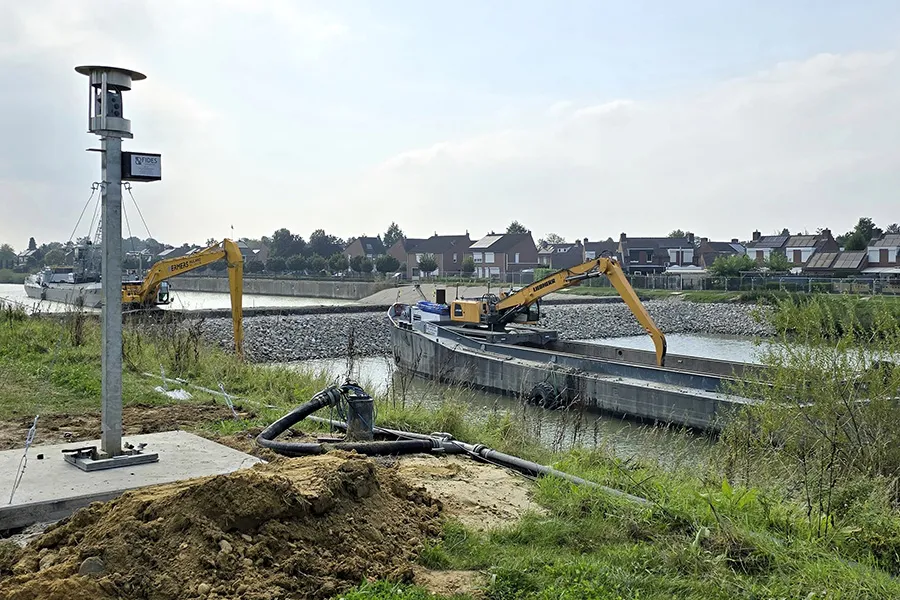
At the temporary dam, Fides carried out a monitoring process similar to the one used at the bridge abutments. Fred says: “The dam is designed with such a large safety margin that, in theory, nothing can happen to it. But Van den Herik has opted for extra certainty and safety, because many people are working behind the dam in the construction pit. We installed monitoring points in and on the dam, and then set up a robotic total station (RTS). This lets us take measurements 24/7. The instrument has an accuracy of 0.5 seconds of arc, which is the highest available. In practice, we achieve an accuracy of a few tenths of a millimetre. If the dam moves even slightly, we see it straight away.”
Precautionary measures at homes
The team also took great care at the various homes along the Julianakanaal. “Residents were concerned about subsidence. That is why we took baseline measurements before work began. We also carried out building surveys, taking photographs of the homes and recording any visible defects. During mechanical works, vibration measurements are being taken at a number of homes.”
Collaboration
Asked what makes this project special, Fred replies: “For me, it is the excellent collaboration with Van den Herik and MOS Grondmechanica. We have very direct lines of communication, partly thanks to our dedicated WhatsApp group. Whenever we noticed anything, we could coordinate immediately. Communication between us comes naturally, and Van den Herik takes all risks seriously and acts decisively. We are seeing more and more partnerships like this in practice.”
Question about this story? Ask your question
Keep following this
Get an email when a new story is published. No account needed.
- SubjectWater infrastructure







