









Collaboration crucial to major repair project at Linne weir
Storm Ciara, which swept across the Netherlands in early February, caused considerable disruption. Among those affected were two push barges that broke loose in the strong winds and high river flows, eventually coming to a halt against the Linne weir. The result?
At least four yokes, the steel uprights forming part of the weir structure, were damaged, meaning the stability of the weir could no longer be guaranteed.
Ensuring long-term stability
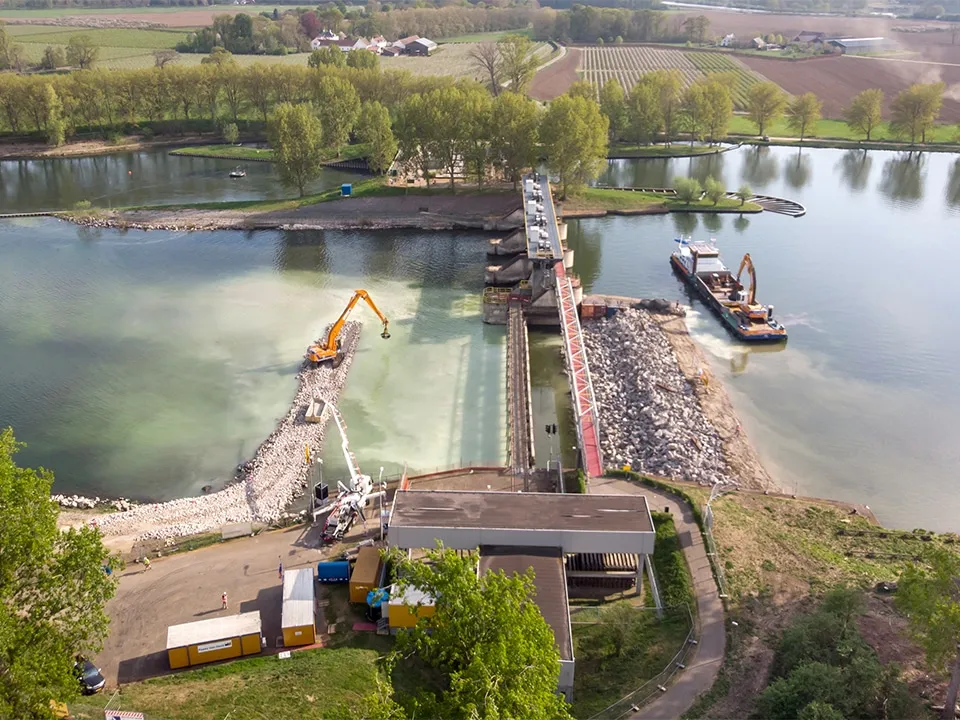
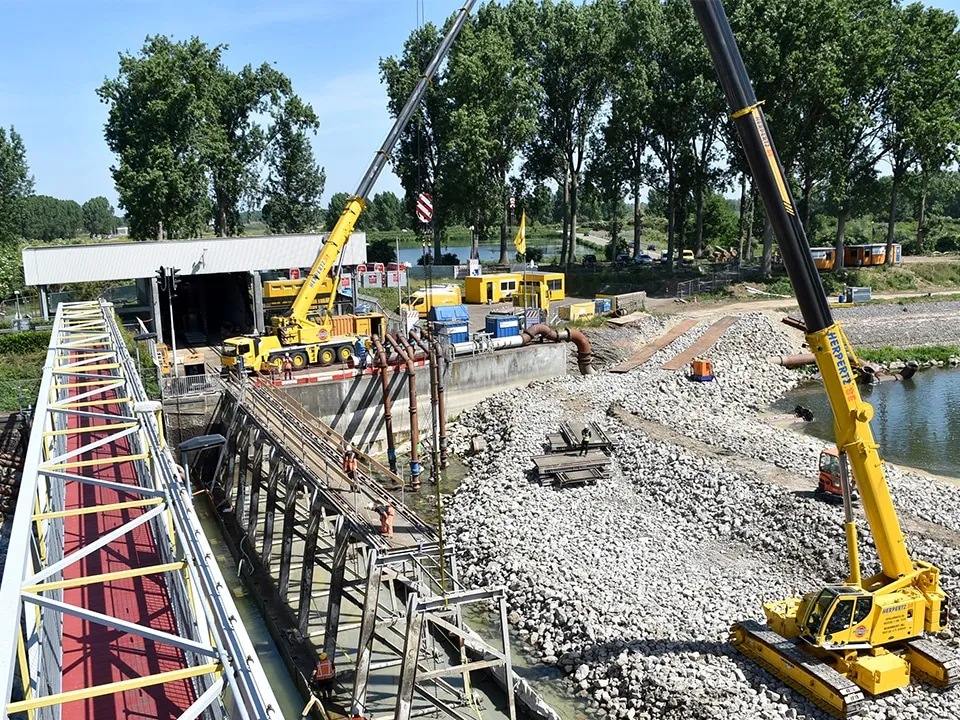
Immediately after the incident, maintenance contractor Combinatie Mourik-Dynniq was called to the site on behalf of Rijkswaterstaat, and Mourik Infra was added to the crisis team. “We wanted to monitor the stability of the weir continuously, so Mourik Infra set up a real-time monitoring system,” says Jens op het Veld, technical manager at Rijkswaterstaat. “To secure the stability of the weir and enable the damage to be inspected and repaired, Mourik Infra approached Paans Van Oord to build a temporary rockfill dam in the Meuse. Building a rockfill dam is almost everyday work for Paans Van Oord. But building one in fast-flowing water, upstream and just four metres from a weir? ‘That can rightly be called a challenge,’ says Peter Brand, work planner at Paans Van Oord. ‘It was a race against time and the water. But thanks to the intensive efforts of everyone involved, excellent collaboration and our high-quality equipment, we were able to restore safe water conditions in a short time.’ The dam takes over the weir’s water-retaining function, keeping water levels at the required level even when inflows decline.
A huge undertaking
“Repairing the Linne weir is a huge undertaking, normally preceded by around two years of preparation,” explains Op het Veld. Roel van Oudheusden, project manager at Combinatie Mourik-Dynniq, adds: “There are many technical challenges, all under considerable time pressure. That only works if Rijkswaterstaat and the contractor collaborate exceptionally well. After careful consideration and in close consultation, it was decided to build a rockfill dam downstream as well, creating a dry cofferdam.” Op het Veld says: “Rijkswaterstaat already had the weir’s renovation on its schedule, to be carried out at some point in the next five years, so we decided to replace all the yokes. Inspecting the other yokes, which showed no visible damage, would have been very time-consuming, and of course we wanted to guarantee the stability of the entire structure.”
Critical dimensions
On behalf of Mourik Infra, engineering firm Boorsma was responsible for the complete design of the weir renovation, including the yokes. The design was developed in close consultation with Rijkswaterstaat, which took responsibility for the design decisions in order to save time. Jan Wessels, an adviser at Boorsma, explains that the yokes have a similar geometry to the old ones, but a different shape, and comply with current standards. For a project of this kind, it is a major advantage to have the design and engineering for hydraulic engineering (the rockfill dam), geotechnical engineering, concrete and steel structures, and mechanical engineering all carried out in-house. Linne was Boorsma’s third major weir renovation. The weirs at Sambeek and Belfeld had previously been renovated, also on behalf of Mourik Infra. Wessels says this is certainly not routine work: “Linne, too, presented our specialists with plenty of design challenges.”
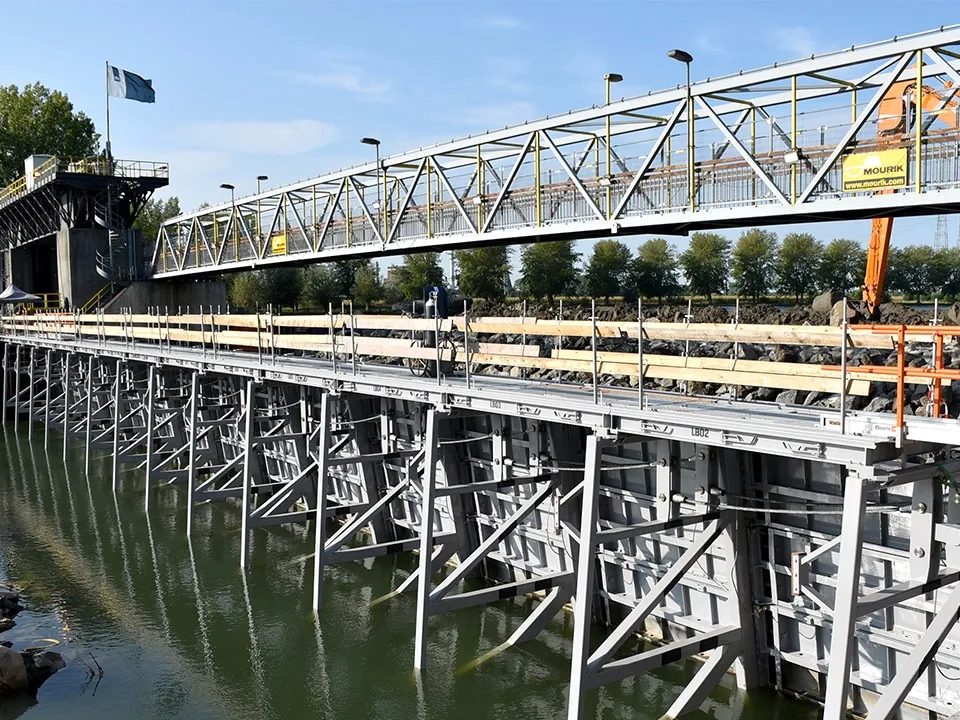
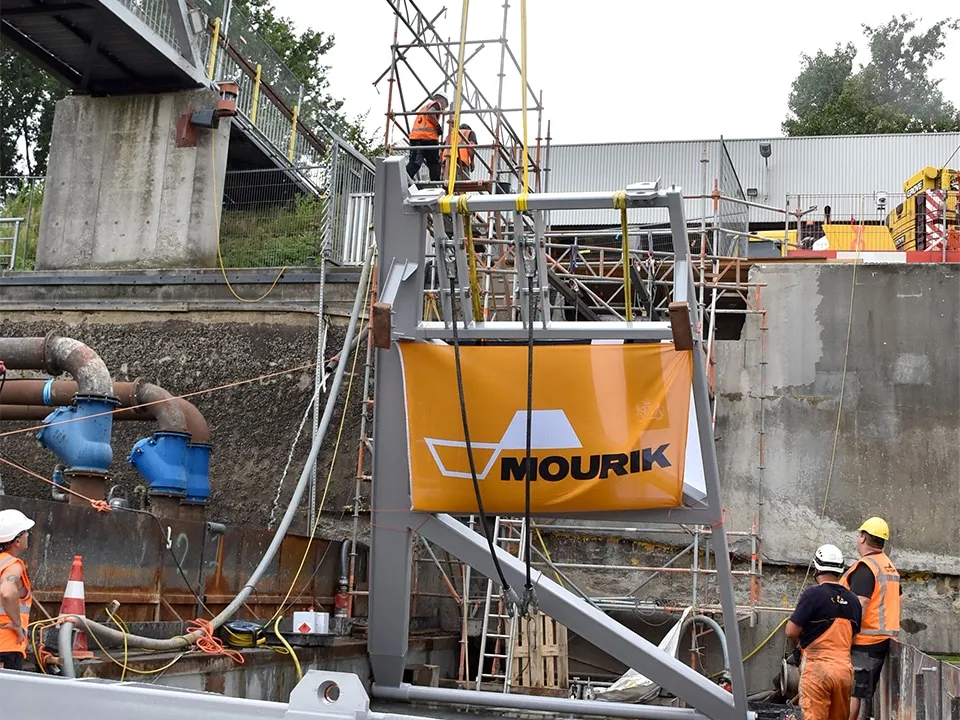
The yokes were manufactured at Mourik Infra’s Echt site. The tight dimensional tolerances and the unusual combination of materials to be welded together called for all the expertise Mourik Infra could muster. Van Oudheusden explains: “With such a tight schedule, design and fabrication have to happen at the same time. So you start with the components that are most critical to the schedule. Technical challenges arise during the work, but thanks to the close communication between the project teams and swift decision-making by Rijkswaterstaat, you get the job done.”
Outstanding collaboration
Inge Beckers, project leader at Mourik Infra, cites the need to reinforce the rear pivot point of the yokes as one example. “The weir must, of course, comply with current standards and last another twenty years. By modifying the design of the yokes, we brought the weir into line with current standards.” New bridge sections were also designed and a winch system installed. Op het Veld says: “Because the yokes are connected to one another by cables, a single push of a button allows a 65-tonne winch to raise and lower them all at the same time.” Following a busy period of design, fabrication and preparations, installation of the first of the weir’s fourteen yokes began at the end of August. Work to rebuild the weir continued at full pace, and by 1 November 2020 it was once again fully capable of independently holding back the water in the Meuse. Just in time for the start of the high-water season.
The message is clear: thanks to the project teams’ problem-solving skills and the mutual trust between them, it was possible to deliver a project of this scale within such a tight timeframe, without a tightly defined contract. “Even during the coronavirus pandemic, and of course to the required high standard,” concludes a satisfied Op het Veld.
A business enquiry for Mourik? Get in touch
Companies in this story
Keep following this
Get an email when a new story is published. No account needed.
- SubjectWater infrastructure
- CompanyMourik
- CompanyVan Oord







