









Climate-resilient, water-robust approach to sewer system in Eindhoven street in Strijp as part of climate adaptation
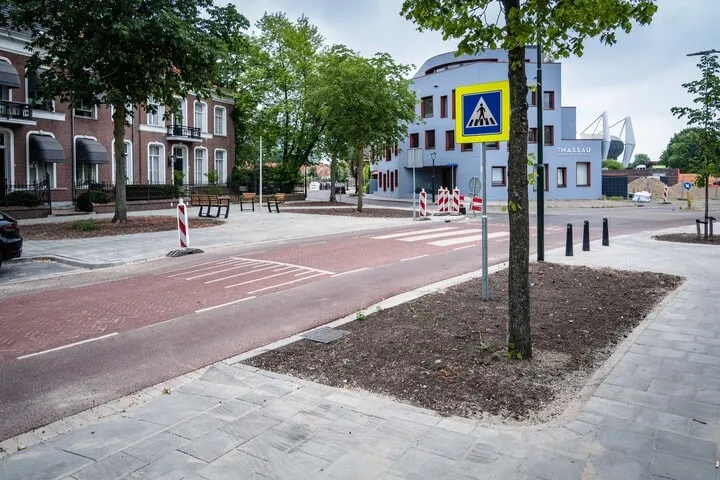
The Hastelweg in Eindhoven’s Strijp district is currently being made climate-resilient and water-robust.
To ensure the city is better prepared for more extreme downpours in the future, Eindhoven is carrying out a number of projects to convert the old sewer system into a separate system with a foul water sewer and a surface water sewer. At the same time, a water storage facility is being built in this street, with capacity to store up to 60 mm of rainwater during peak rainfall.
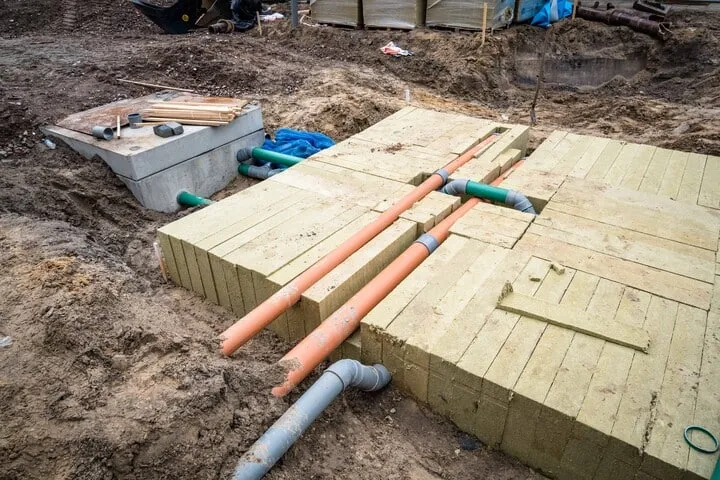
For the project in Strijp, Eindhoven has specifically chosen Rockflow (part of ROCKWOOL Group) to compare this stone wool water storage system with other underground water storage solutions already used in the city. This will make it possible to establish through practical experience which solution is best suited to which situation in future projects.
As part of climate adaptation, every municipality in the Netherlands is required to map the areas of the city at risk of flooding and heat stress. This is necessary to make society less vulnerable to climate disruption. Everyone is now aware that the climate is changing. As a result, more and more municipalities are paying attention to the issue, particularly after one climate record after another was broken over the past three years, with the driest summer on record in 2018 and the heaviest cloudbursts ever in 2019. Statistics from the KNMI show that in 2019 the number of days with extreme rainfall (>50 mm of precipitation per day) had increased by 60% since the 1960s. Water problems cannot be solved simply by taking measures in public spaces. From an ecological perspective, making urban areas water-robust and climate-resilient requires a broader approach than the local application of technical solutions.
Leading the way
Eindhoven is one of the leading municipalities in the Netherlands when it comes to making the city’s residential and working environments water-robust and climate-resilient. Frank van Ekert, Urban Water Management Adviser at Eindhoven City Council, says that Eindhoven has around 1,300 km of sewer pipes. Eindhoven has a complex sewer system, with all the pipes interconnected. “Most sewer pipes have a service life of 60 to 80 years, after which they need to be renovated,” he explains. “Based on inspections, around 6 km are renovated each year. To date, 500 km of sewer has been extended or replaced with a separate sewer system comprising foul water and rainwater pipes.” Sewer systems in the Netherlands have overflows that discharge excess water into surface water during peak rainfall, which eventually flows into nature areas. In the Netherlands, surface water, meaning water in streams, lakes, canals and rivers, is relatively more polluted than in other European countries. Eindhoven has 29 overflows.
Retaining water where it falls
As the climate changes rapidly and peak downpours become increasingly severe, the city’s sewer system can no longer cope with all the water, resulting in flooding. The city has also become much denser, with more paved surfaces, more residents and businesses, and more connections to the sewer system. “As part of our policy, we are now working to reduce the risk of flooding in projects in private spaces,” says Van Ekert. “Since 2019, Eindhoven has required water storage to be incorporated into new projects in private spaces, as an additional provision to capture and retain up to 75 mm of rainwater within the project area. This is an increase on the water policy in place before 2019,” says Van Ekert. That policy required additional water storage of 42 mm per m2 whenever the increase in paved area exceeded 250 m2. “Under the current policy, at least 25 mm and up to 75 mm of water storage must be provided for all new paved areas, regardless of the previous paving situation. However, the greener the plan, the lower the requirement in mm,” says Van Ekert. “But storage is also needed in public spaces. That is why it is important to find out which solution is most effective for capturing excess water during peak rainfall. Ideally, rainwater should be retained in the area,” says Van Ekert. “Infiltration may be one solution, as it is desirable during dry periods, but it is difficult in Eindhoven and is not the approach we want to pursue. For our city, temporary water storage followed by controlled discharge is the only realistic option. It is important for us to gain experience in installing and managing facilities that capture excess water during peak rainfall,” says Van Ekert. During renovation of the sewer system in the Hastelweg in Eindhoven, Rockflow’s stone wool water storage system is being trialled as a technical solution for temporarily retaining rainwater where it falls. “The Hastelweg slopes towards the Willemstraat,” says Van Ekert. “Water flows to the lowest point, where it can cause significant flooding. That is why this project includes a water storage facility capable of storing and retaining 60 mm of rainwater. This will not completely solve the flooding in the Willemstraat, but it will reduce it,” says Van Ekert.
Technical solution
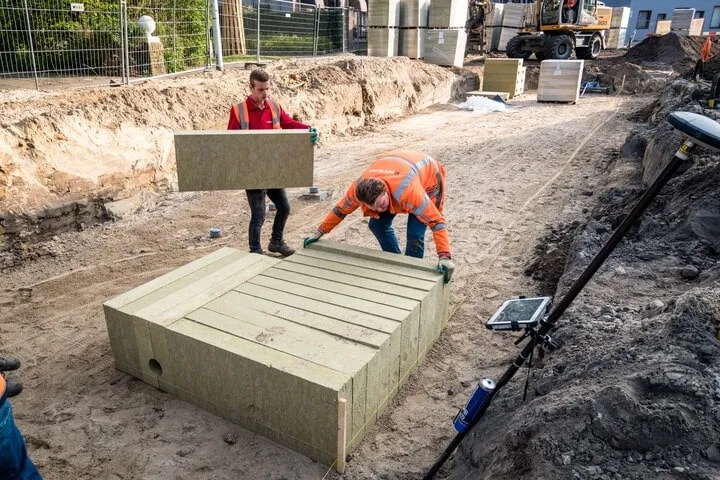
Rob Driessen, Market Developer at Rockflow, is involved in the Hastelweg project. He explains that peak downpours never last longer than 15 minutes on average, but produce enormous volumes of water. “Rockflow’s stone wool storage system can capture a large proportion of floodwater.” Driessen explains that in the Hastelweg the municipality faces a number of constraints arising from the existing situation. The Hastelweg is a narrow street with trees, where people also need to cycle and park. Underground water storage using the Rockflow system is virtually the only solution. The groundwater level in this area is relatively high. “The system is fairly easy and flexible to install, can be cut to size and adapted to fit into a confined space,” explains Driessen. “Stone wool is a natural mineral product that cables can be routed through and holes can be drilled into, and it does not require plastic crates. Rockflow is not a sealed system. It can be installed and used without the material leaking or being damaged,” Driessen explains. “The system can help this district through the energy transition in a climate-resilient and water-robust way. If more underground utilities are needed in the future, such as fibre-optic or electricity cables, stone wool is an ideal, flexible material,” says Driessen.
Biodiversity
Sabine van Rooij is a researcher and landscape ecologist at Wageningen University & Research. “Focusing only on a small playground is of little use when trying to solve flooding there,” she says. “Of course, a technical solution may be needed to deal with flooding at the playground, but the problem must first be considered in a wider context. By making use of the opportunities the landscape offers to allow water to seep into the ground and drain away more slowly within and upstream of the urban area’s natural system, the water system can be made more climate-resilient,” Van Rooij suggests. “Trying to prevent flooding in an area where all the streams converge is literally like mopping up with the tap running. Flooding cannot be solved through sewer renovation or other underground solutions alone,” says Van Rooij. “Ideally, you want to tackle this problem in a much more robust way than with local technical solutions alone. If land use and the layout of the city and its upstream hinterland are based on the natural subsoil, and the landscape’s potential for preventing flooding is harnessed, flooding and desiccation can be tackled robustly. This not only improves water quality naturally, but also benefits the landscape, biodiversity and the living environment in and around the city.” More green, flower-rich areas in and around cities can also help keep the urban environment liveable. They counteract heat and make the living environment more biodiverse, reducing the risk of pests such as oak processionary caterpillars. “Achieving the 2050 climate targets requires much more than applying technical solutions at local level to prevent flooding. We need to strive for a more integrated solution and consider the relationship between cities and the surrounding landscape. An integrated approach to water problems must play a prominent role in every construction plan in the Netherlands if cities are to remain liveable. This requires cooperation between various parties. It is not something that one organisation, such as a municipality, can solve alone,” says Van Rooij.
Integrated approach
Hiltrud Pötz, architect and director of Atelier GROENBLAUW, advises Eindhoven City Council on greening and cooling the urban area. She says that an integrated approach to making the city more water-robust and climate-resilient is indeed more effective than dealing with flooding on an ad hoc basis. “Technical solutions are necessary. Eindhoven is investigating which solution is best suited to each place and purpose, including through the use of Rockflow. There are several good solutions for greening public spaces. Space can always be created.” According to Pötz, making the city water-robust and climate-resilient calls for an integrated approach in which municipalities work together with traffic experts and sewer managers, building owners, architects and suppliers of innovative technical solutions. “An integrated approach makes it possible to make the best assessments and choices to minimise flooding in the city,” says Pötz.
Een zakelijke vraag aan ROCKWOOL Rainwater Systems? Get in touch
Companies in this story
Keep following this
Get an email when a new story is published. No account needed.
- SubjectWater infrastructure
- CompanyROCKWOOL Rainwater Systems







