









Bentonite mat sealing a crucial element of the Julianakanaal project
Text Suzanne van Gaale Beeld Rijkswaterstaat / Naue
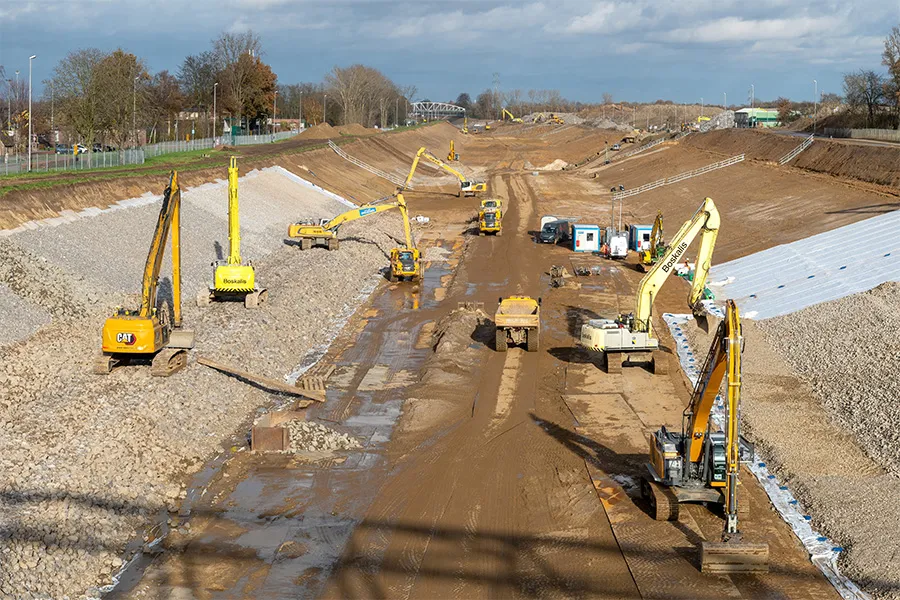
The widening of the Julianakanaal is being carried out over a total length of around 4 kilometres between Berg aan de Maas and Sluis Born. Around half a million square metres of bentonite mats are providing a water-resistant layer on the canal bed. This makes them one of the most crucial elements of the project. “The system was thoroughly tested before the first metre was laid,” says Rijk Gerritsen, technical director at Naue Nederland.
Rijkswaterstaat and Van den Herik-Sliedrecht faced a dilemma: how could they seal the bed of the Julianakanaal in a robust, durable and safe way, while ensuring efficient construction? “A key consideration was the very short construction period available, around 6 to 8 months,” says Rijk. “The conditions in Limburg’s subsoil, with its high gravel content, together with the stone armouring covering the seal, also called for a highly robust sealing system. Naue’s bentonite mats scored positively on all these points.”
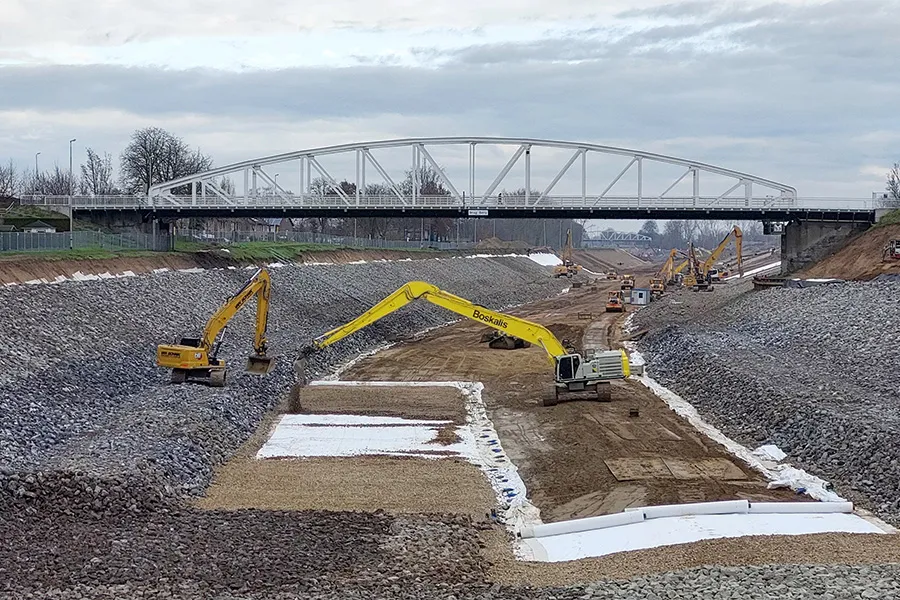
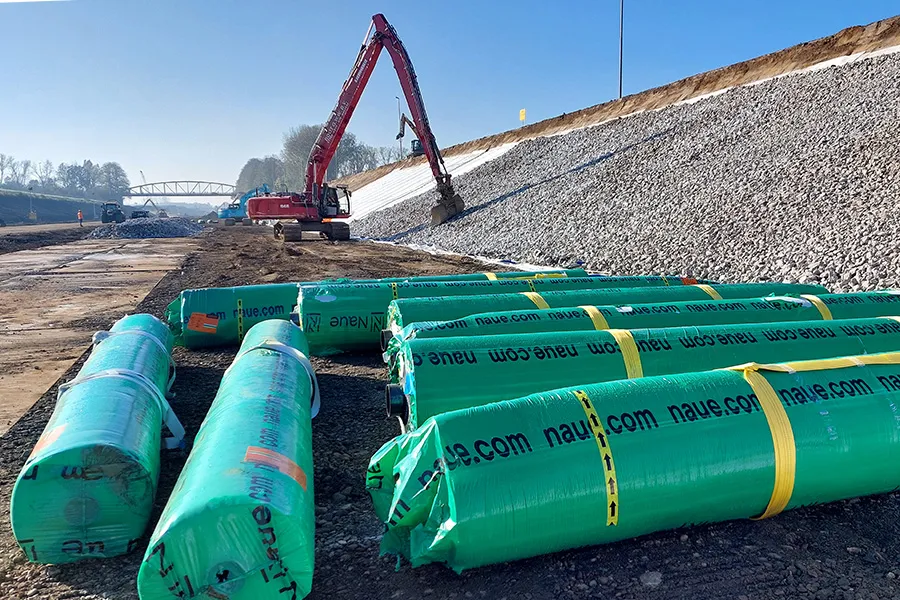
Widening the Julianakanaal, with bentonite mats being installed on the canal bed and banks. Once installed, the sealing layer is covered with layers of stone of varying grades.
High-quality geosynthetics
The German family-owned company Naue specialises in geosynthetics for the civil engineering sector. “Naue invented the bentonite mat almost 40 years ago, and these products continue to be developed,” says Rijk. “Our high-quality geosynthetics enable smarter design and construction of hydraulic engineering structures. We also develop high-performance geosynthetic materials designed to deliver a technical service life of 50 to as much as 120 years.”
Extensive testing
The bentonite mats for the Julianakanaal are around 2 cm thick and are a heavy-duty grade. They were extensively tested in advance in field trials. “The challenging conditions at the Julianakanaal were simulated and tested beforehand, including the gravel and stones in the Limburg subsoil. Tests included driving a crawler crane over the mats and dragging a ship’s anchor across the stone armouring. Naue’s bentonite mats passed all the tests without damage.”
Huge undertaking
Every batch of bentonite mats undergoes extensive laboratory quality testing before being transported to Limburg. “It is a huge undertaking, involving production, quality assurance, logistics and installation,” says Rijk. “Eight to twelve lorries a day are transporting bentonite mats to Limburg, almost 400 lorries in total.”
Installation
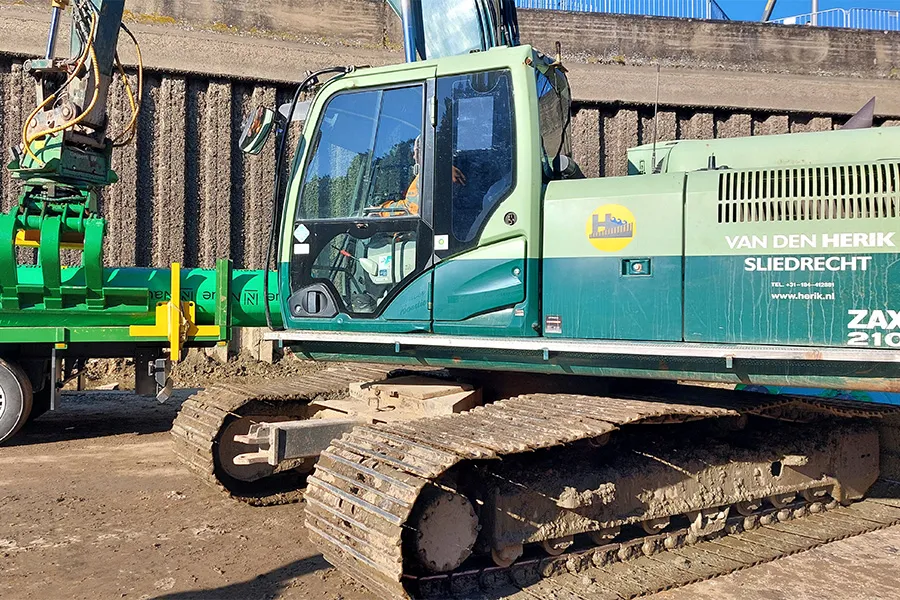
Once on site, the next challenge is installing the mats simultaneously in the three separate work areas. This requires extensive coordination. Each work area has its own construction team. The bentonite mats are therefore installed in close coordination with the contractors on site, including main contractor Van den Herik and subcontractors such as Boskalis, Jac Rijk, FL, Ermers grondverzet and many others. “This project is a real team effort. It makes me, my colleagues and many other project partners immensely proud.”
A smart solution
According to Rijk, choosing bentonite mats as the optimal solution is well suited to a megaproject such as the widening of the Julianakanaal. “They are robust and watertight, and installation is largely unaffected by the weather. Using a carefully planned construction method and specialist teams, the bentonite mats can be installed at a rate of many square metres per day. This makes them a smart, sustainable and cost-effective solution for hydraulic engineering projects such as the Julianakanaal.”
Question about this story? Ask your question
Keep following this
Get an email when a new story is published. No account needed.
- SubjectWater infrastructure







