









Sustainable use of materials: a priority for circular working in civil engineering
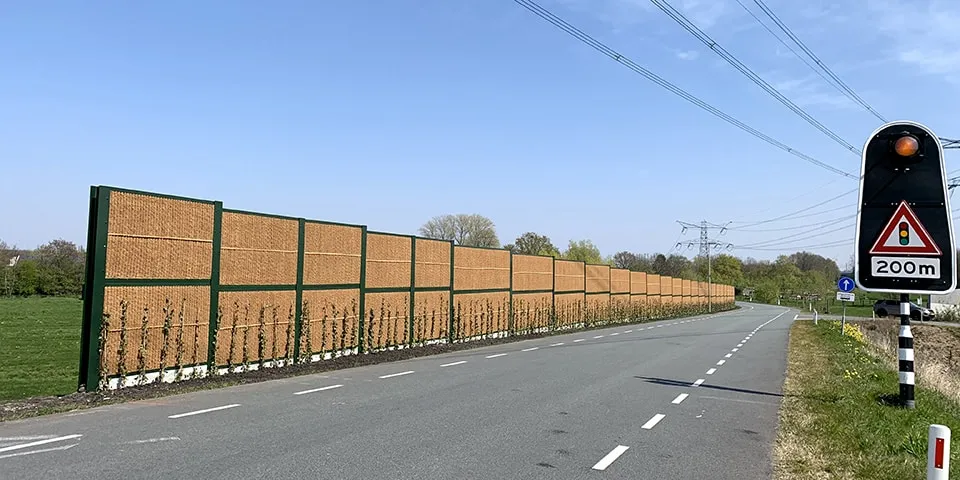
‘Circular’ has almost become a quality mark. Virtually every local authority, construction company and architect is working on it. With nature as the inventor of circular processes, it is hardly surprising that people are looking at how recyclable and sustainable materials can be used. Especially when the finished product is often found in a green landscape.
One company working hard to give functional products a natural, attractive appearance and build them in a circular and sustainable way is Kokosystems. Originally from Westland, the company produces and supplies turnkey solutions for a range of noise challenges in the commercial and residential sectors. Arjan Kick, project manager at Kokosystems, says: “We develop ‘green noise barriers’ that offer not only aesthetic but also ecological added value. This gives us a very high score in MEAT tendering processes.”
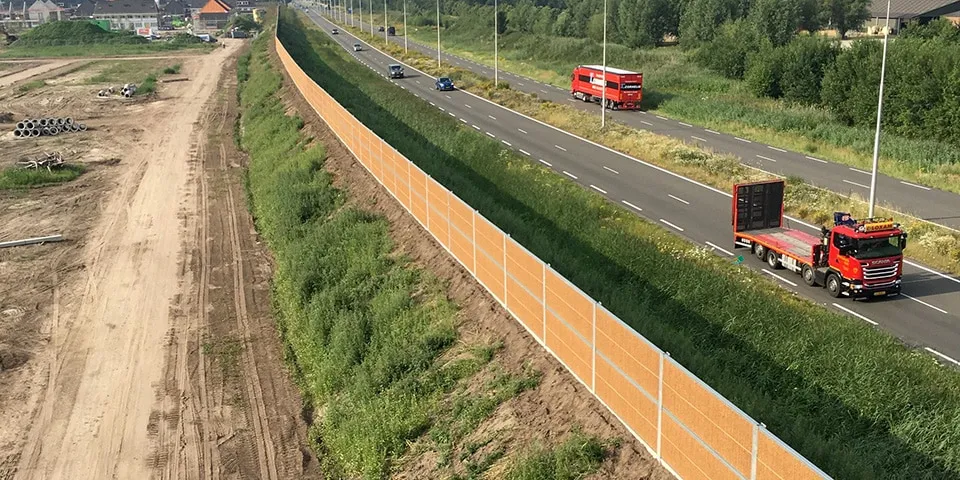
Kokowall noise barrier, H=2.5m and L=900m, on an earth bank alongside
the Dalem residential area.
Materials
“For our Kokowall® noise barriers, we use renewable coconut fibre, recycled plastic for the tubes and recyclable steel as a sustainable material. All Kokosystems noise barriers incorporate a sound-insulating panel that provides the actual sound insulation. The outside of the barriers is finished with coconut fibre, which provides the ideal surface for various climbing plants to take hold. This means they are very well received in residential areas and alongside motorways.”

Kokowall HA-Minwol noise barrier, H=3.5m–H=4.2m and L=155m, installed alongside the tennis courts at ‘Tenniscentrum De Kegel’ in Amstelveen, at ground level and on the roof of the car park.
Versatility
“Every project and every setting is different, so the solution is often bespoke,” says Kick. “We can provide a suitable noise-reduction solution for any situation because we handle everything in-house. We guide, advise, engineer and deliver. The modular design of the Kokowall® noise barrier means it can be built to any dimensions, in any colour scheme or configuration, and in a relatively short construction period.” Kick cites several projects as examples: “We built the De Goog noise barrier in Muiderberg for RWS. The barrier, 100 metres long and 2.5 metres high, not only looks very attractive, it also significantly reduces noise nuisance for local residents. For Bouwbedrijf Netjes BV, we installed a barrier alongside the tennis courts at the National Tennis Centre in Amstelveen (Sportpark De Kegel). A real eye-catcher!” One unusual aspect of the project was that a structure had to be built at ground level on one side, while on the other it had to be anchored to the roof of a car park. “That makes good collaboration essential!” The side facing the tennis courts is finished with a layer of mineral wool, covered with windbreak fabric and plastic mesh. The side facing local residents has been planted directly, giving it an attractive appearance and minimising the impact of the tennis courts as much as possible. Finally, Kick mentions the noise barrier in the Dalem residential area in Tilburg. “We previously installed 450 metres of noise barrier there on an earth bank. Now we are building another 450-metre barrier in the same area, in a mirror-image layout, between the residential area and the provincial road.”
Question about this story? Ask your question
Keep following this
Get an email when a new story is published. No account needed.
- ThemeLower emissions and more reuse
- SubjectSpecials







