









Sustainable projects with sheet piles made from scrap
Text Roel Bijlard Image ArcelorMittal
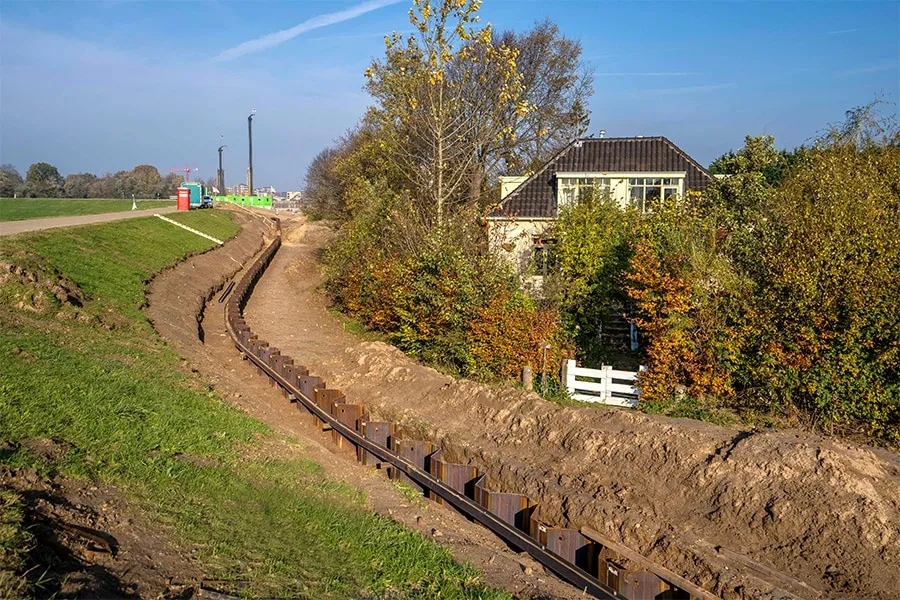
Making Dutch construction more sustainable is essential. For many projects, the environmental impact of the chosen solution and structure must be assessed. This is done using Life Cycle Assessments (LCA) and Environmental Product Declarations (EPD). Both documents report emissions, including the CO2 emissions released during the production of specific products. These emissions are converted into an Environmental Cost Indicator (MKI) to enable accurate comparison and assessment.
ArcelorMittal’s hot-rolled steel sheet piles from Luxembourg are the sustainable solution for foundations. EPDs specifically for the Dutch market are available for all AZ, AU and PU sections. As these sheet piles are produced from approximately 100% scrap in an electric arc furnace, their environmental impact is much lower than that of sheet piles made from iron ore in a blast furnace.
Reducing CO2 emissions is an important element in every project, but an LCA also looks at other categories, including the depletion of (fossil) resources, eutrophication and acidification of the environment. The Netherlands has also specifically chosen to include four additional toxicological indicators in the environmental impact assessment of a product. Adding up the different stages for each emission makes it possible to determine the total environmental impact of the sheet pile over the course of the project. However, it is difficult to
compare different types of emissions with one another. The Netherlands has therefore chosen to apply a conversion factor to each emission, so that everything is expressed in euros as an MKI.
Sustainable and efficient steel production
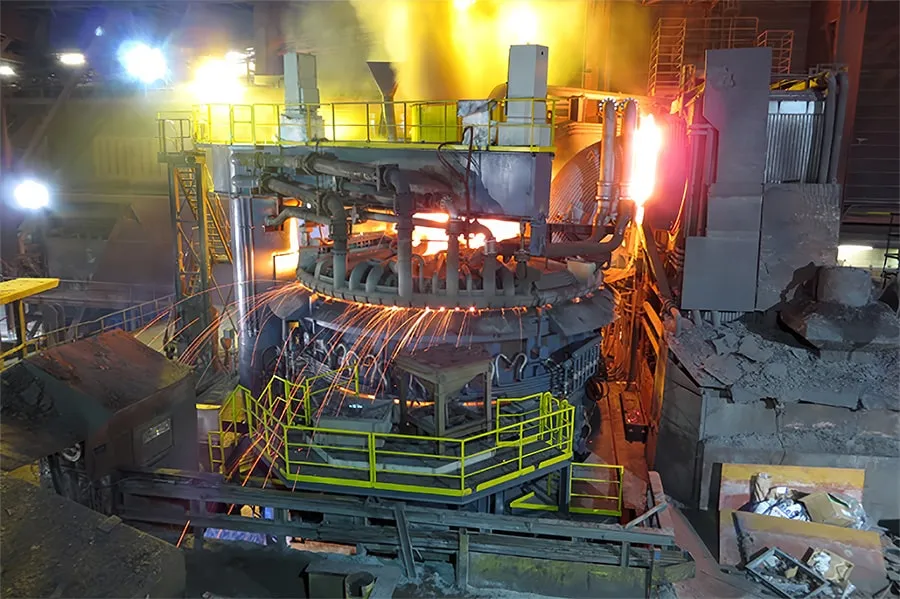
All ArcelorMittal AZ, PU and AU sheet pile sections are produced in Luxembourg from scrap in an electric arc furnace, with no iron ore involved. This means no primary raw materials are extracted from nature, making it a sustainable method of steel production. It also generates less waste than the blast furnace process, while CO2 eq. emissions are approximately 5 times lower.
A comparison of the Global Warming Potential (GWP, CO2 equivalent) and Environmental Cost Indicator (MKI) of the generic sheet pile sections in the National Environmental Database reveals significant potential benefits from using ArcelorMittal sheet piles compared with the reference values. A sheet pile produced from blast furnace steel has a GWP of 2.120 kg CO2-eq/ton, contributing to a total MKI of €275,- per ton for the production stage. For the same type of sheet pile produced in Luxembourg, emissions can be as low as 359 kg CO2-eq/ton, contributing to a total MKI of €44,30 per ton for the production stage. The relatively short transport distance from the factory in Luxembourg to the Netherlands, by road or inland waterway and including HVO100, further contributes to a sustainable solution. Choosing ArcelorMittal as a supplier can reduce CO2 emissions and the MKI value by 77% for the production stage (A1-A5). Electrically installing the sheet piles on site can cut CO2 emissions by a further +/-100 kg CO2-eq/ton, reducing emissions and the MKI by another 5%.
The total MKI over the product’s entire service life depends on the extent of recycling, reuse and disposal in landfill at end of life. These factors must be determined for each project, as they depend on the application, environmental conditions and project lifetime. For example, up to 100% of the sheet piles in a temporary sheet pile structure can be reused, further reducing the environmental impact over their service life.
Reduce, Reuse, Recycle
Environmental impact can be reduced not only during the production process. Another way to make environmental gains is to reduce the number of kilos of steel driven into the ground. Thanks to innovations in sheet pile sections and steel grades, today’s sheet piles are on average 30% lighter than they were 30 years ago. The 800 mm-wide AZ sheet pile range has a unique strength-to-weight ratio. Every saving in material use leads to a more economical design, as well as substantial gains in sustainability and CO2 emissions.
Steel sheet piles are also highly suitable for reuse in temporary applications, such as temporary construction pits. It is important to take the sheet pile’s reusability into account in the design. A sheet pile in a fully optimised design may be less suitable for reuse than a heavier section. If a sheet pile that is 15% heavier can be reused up to eight times more often than the lighter alternative across one or more projects, this represents a substantial improvement in cost and sustainability. We facilitate this process by offering sheet piles for hire and under buy-back agreements. However, used sheet piles are not often permitted in permanent works, even though they can often perform just as well as new sheet piles. The key difference is that the entire emissions from the production stage do not need to be included for a used sheet pile, as some of those emissions have already been accounted for in previous temporary applications.
Damage caused by frequent reuse and/or corrosion will eventually mean that sheet piles no longer meet the requirements for (re)use. The same applies to steel sheet piles removed from the ground after 100 years. All sheet piles that are no longer reused are fully recycled and used again as raw material for the electric arc furnace. The cycle from scrap to steel sheet pile and back to scrap is now complete, ready to be repeated for the next project.
Een zakelijke vraag aan ArcelorMittal Projects Europe B.V.? Get in touch
Companies in this story
Keep following this
Get an email when a new story is published. No account needed.
- ThemeUnderground construction
- SubjectSpecials
- CompanyArcelorMittal Projects Europe B.V.







