Grond/Weg/Waterbouw Nederland is part of Louwers Mediagroep: 45+ trade platforms in the Netherlands, Flanders and Wallonia. Trade magazines, websites, newsletters, video and podcasts, since 1987.
How can we meet our climate and circularity targets for 2030 and 2050 when almost 96% of all infrastructure tenders have no sustainable selection criteria? This is the shameful conclusion of Bouwend Nederland’s study, ‘Sustainability in public procurement’1). We can catch up by drawing up and applying criteria more quickly, linking them to existing solutions and validating them against reliable, fact-based data. The timber sector is therefore working to make this data available and help clients in the civil engineering sector take advantage of the ‘low-hanging fruit’. There is work to be done.
Circularity is about taking action
CO2 reduction is the key award criterion
The World Green Building Council2) concludes in its report ‘Bringing Embodied Carbon Upfront’ that a 40% reduction in CO2 emissions from materials and structures could be achieved by 2030 by using timber. These claims are also supported by national and international life cycle assessment (LCA) studies. The Province of Groningen has already acted on this, using CO2 performance and the findings of LCA studies as award criteria for the iconic 800-metre-long, 3.5-metre-wide cycling and pedestrian link, the ‘Blauwe Loper’. This resulted in sustainably produced tropical hardwood being selected as the most environmentally friendly material option.
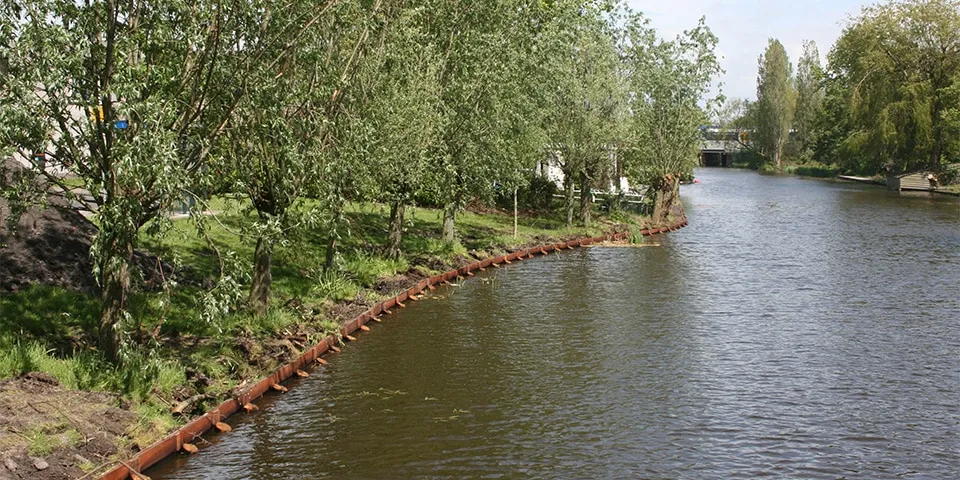
‘Timber revetments have an excellent environmental score’. (Image: Centrum Hout)
The proposed measure has at least a lower environmental cost indicator (MKI) than existing solutions
With this in mind, Rijkswaterstaat (RWS) commissioned a study into the benefits of replacing standard road furniture with existing bio-based alternatives. The conclusion was that substantial environmental (MKI) and climate gains (CO2 emissions) could be achieved (see Table 1). RWS is therefore now consistently including timber solutions in its variant studies. Municipalities and provinces are also showing increasing interest in installing timber road furniture. For example, the Province of South Holland has opted for timber safety barriers, noise barriers, road portals and bus shelters as part of the redesign of the N211. More and more provinces and municipalities are interested and joining the ‘Hout in de gww’ supply chain collaboration.
Environmental data for timber safety barriers, road portals, decking (for bridge decks and boardwalks) and 12 variants of timber revetments (photo 1) have recently been added to the national environmental database3), making it possible to include these products in calculations.
De floorlift-methode is heel breed inzetbaar en geschikt om verzakkingen in betonconstructies te verhelpen.The proposed measure is circular according to the principles of the McArthur Foundation
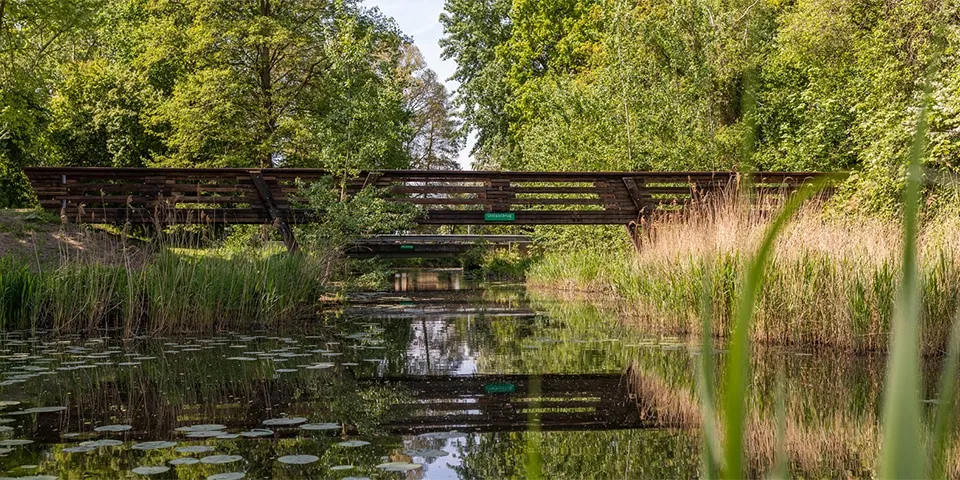
Timber and other bio-based materials from sustainably managed sources are inherently part of a closed loop (biological cycle), making them naturally circular. Combined with their ability to perform well against the technical Rs, timber is effectively ‘CirculaiR-Plus’ and essential to achieving circularity targets. However, research by Nibe4), commissioned by the Netherlands Enterprise Agency (RvO Nederland), shows that 98% of the opportunities for bio-based materials in construction remain untapped. This presents opportunities, and experience shows that putting them into practice is straightforward: for example, new ‘circular’ bridges have already been built using timber from old bridges, some over 60 years old, including in Almere (photo 2), Westervoort and soon Nijmegen.
For more information about timber species, applications or environmental performance (LCA and CO2 reduction), visit: www.houtindegww.nl and www.houtdatabase.nl.
To receive updates on supply chain collaboration in civil engineering, join the LinkedIn group #ketensamenwerkinghoutindegww.
Sources
Bouwend Nederland: ‘Sustainability in public procurement: analysis 2018’, September 2019: www.bouwendnederland.nl/publicatiespublicaties.
WorldGBC: ‘Bringing Embodied Carbon Upfront’, April 2019: www.worldgbc.org/embodied-carbon
Nibe (July 2019), 18 LCA studies and EPDs for safety barriers, road portals, decking and timber revetments (12 variants), for inclusion in the NMD: www.houtindegww.nl
Nibe, ‘Potential of bio-based materials in construction: a study of the possibilities and impact’, commissioned by the Netherlands Enterprise Agency, 14 June 2019: https://www.nibe.org/nl/nieuws/potentiebiobased
Find the right company in the sectorSearch by product, field, region or project in the company directory and across all Grond/Weg/Waterbouw Nederland articles.
We use cookies to keep the site working properly. With your consent, we also use cookies for statistics and third-party banners. Read more in our privacy and cookie statement.