









On the way to porous asphalt with twice the service life

The dream is becoming reality. For LATEXFALT of Koudekerk aan den Rijn, three developments to extend the service life of porous asphalt on national roads are now bearing fruit. Managing director Dr Ir Bert Jan Lommerts: “We can already guarantee that our innovative emulsion technology products can extend the service life of existing porous asphalt roads by 5 years. Research has also shown that a second treatment adds another 3 to 4 years. In addition, you can opt for porous asphalt made with improved bitumen technology at the start of the process, which can gain you another 5 years. Much of our dream of doubling the service life of porous asphalt has come true. And, on the back of the extensive research, we will soon be able to recycle porous asphalt from national roads into new, high-quality porous asphalt.”
Twelve years ago, LATEXFALT embarked on a new sustainability strategy, which included using scientific research to look for ways to extend service life in particular. This could significantly reduce damage to road surfaces and cars, maintenance and repair costs, the amount of raw materials needed for replacement, and disruption to road users. Lommerts explains: “Porous asphalt has been around since 1972. Most national roads are now surfaced with it, with all the benefits that brings in terms of water drainage and noise reduction. Everyone knows the advantages, but there are disadvantages too. In particular, the porosity of the surface layer is vulnerable to erosion caused by traffic and freeze-thaw cycles. This is due to the ageing of the bitumen used, which hardens and becomes less effective at binding the aggregate. The key question for us was whether we could develop a rejuvenation mechanism: a system that would allow the bitumen to perform its function for longer. A kind of Vichy or Nivea rejuvenating cream for porous asphalt.”

Asphalt dermatology
Lommerts often talks about ‘asphalt dermatology’, drawing a parallel with rejuvenating human skin. The management took a serious approach to development. Around ten years ago, the company hired its first chemical researchers, including Irina Cotiuga from Romania and Sayeda Nowrozon Nahar from Bangladesh. They went on to study in the Netherlands at TU Delft and TU Eindhoven, while also focusing on research and development at LATEXFALT. Lommerts: “They earned their academic degrees and are now renowned scientists who, among other things, have managed to get to grips with the ageing process of bitumen. They did this in collaboration with several universities. Their work also helped lay the foundations for our three roadmaps: sustainable bitumen through new bitumen technology, extending service life with Modimuls ZV and Modiseal ZX technology, and recycling through rejuvenation technology when reusing milled asphalt. This completes the cycle and puts us on the path to optimal sustainability throughout the life cycle.”
Everyone around the table
Lommerts points to the wide range of stakeholders involved: the oil industry, bitumen and asphalt producers, companies that enhance materials such as his own, contractors and clients, with Rijkswaterstaat acting as the client for national roads. “We did not stay in our laboratory, but took part in development projects with various partners. All the stakeholders are around the table. We shared research findings, carried out trials together and analysed the results. In short, we have done a great deal to build market confidence in these innovations. This is not hot air; it is tangible sustainability for the 5,500 km of porous asphalt national roads in the Netherlands.”
LATEXFALT is finding a receptive audience at Rijkswaterstaat and among contractors that enter into contracts with a maintenance component. “We have already carried out several projects to extend service life using an initial emulsion layer. The technique has proven itself in practice. The results also dovetail perfectly with Rijkswaterstaat’s new method for measuring aggregate loss from porous asphalt. Our treatment has been shown to reduce that loss significantly. We also guarantee the results of this treatment. With our other roadmaps, covering bitumen technology and 100% recycling, we are on the cusp of making them a reality, but further development is needed before we can offer guarantees. We are close, though. Personally, I believe that in a few years we will be able to guarantee a doubling of service life.”
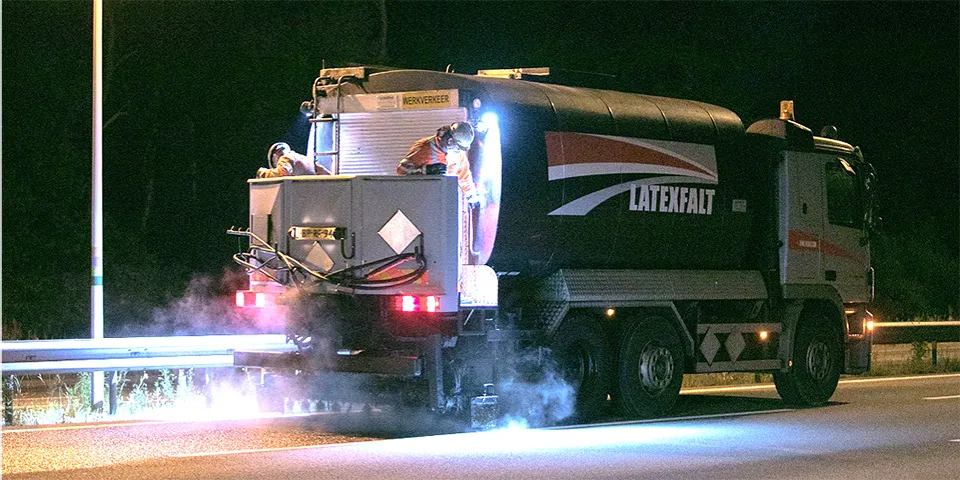
The technique has proven itself in practice.
Validated technology
When emulsion technology is used to extend service life, the porous asphalt structure remains nicely open after the spray truck has passed. The pores do not become blocked. “It is like sun cream that is absorbed into the skin. The effectiveness of extending service life by five years or more has been demonstrated, and this technology has now also been validated.
Bert Jan Lommerts concludes: “I still have a dream: that in 25 years’ time we will have motorways made with the best bitumen products to ensure high initial quality, which can be ‘rejuvenated’ several times during their service life and, at the end of their cycle, can be used entirely as raw material for new roads. All parties still have a few steps to take, but we are closer than ever.”
Question about this story? Ask your question
Keep following this
Get an email when a new story is published. No account needed.
- ThemeExtending the life of roads and civil engineering structures
- SubjectSpecials







