









On the road to ZOAB with double the service life

The dream is now within reach. For LATEXFALT of Koudekerk aan den Rijn, three developments to extend the service life of ZOAB asphalt on motorways are becoming a reality. Managing Director Dr Ir Bert Jan Lommerts: “We can already guarantee that our innovative emulsion technology products can extend the service life of existing ZOAB roads by 5 years. Research has also shown that a second treatment adds another 3 to 4 years. In addition, you can opt for ZOAB made with improved bitumen technology at the start of the process, which can gain you a further 5 years. Much of our dream of doubling ZOAB’s service life has come true. And, in the wake of the extensive research, we will soon be able to recycle ZOAB from motorways into new, high-quality ZOAB.”
Twelve years ago, LATEXFALT launched a new sustainability strategy, which included seeking ways to extend service life, particularly through scientific research. This could significantly reduce damage to road surfaces and cars, maintenance and repair costs, the quantity of raw materials needed for replacement, and disruption to road users. Lommerts explains: “ZOAB has been around since 1972. Most motorways are now surfaced with ZOAB, with all its advantages in terms of water drainage and noise reduction. Everyone knows the benefits, but also the drawbacks. The porosity of the surface layer is particularly vulnerable to erosion from traffic and freeze-thaw cycles. This is due to the ageing of the bitumen used, which hardens and becomes less able to bind the aggregate. The key question for us was whether we could develop a rejuvenation mechanism: a system that would allow the bitumen to perform its function for longer. A kind of Vichy or Nivea rejuvenating cream for ZOAB.”
Asphalt dermatology
Lommerts often talks about ‘asphalt dermatology’, by analogy with rejuvenating human skin. The management took a serious approach to development. The first chemical researchers were recruited about ten years ago, including Irina Cotiuga from Romania and Sayeda Nowrozon Nahar from Bangladesh. They came to study in the Netherlands at TU Delft and TU Eindhoven while also focusing on research and development at LATEXFALT. Lommerts: “They earned their academic degrees and are highly regarded scientists who have, among other things, managed to understand the ageing process of bitumen. They did this in collaboration with several universities. Their work also helped lay the foundations for our three roadmaps: sustainable bitumen through new bitumen technology, extending service life with Modimuls ZV and Modiseal ZX technology, and recycling through rejuvenating technology when reusing planed asphalt. This completes the cycle and sets us on the path to optimal sustainability throughout the life cycle.”
Everyone at the table
Lommerts points to the wide range of stakeholders involved: the oil industry, bitumen and asphalt producers, refiners such as his own company, contractors and clients, with Rijkswaterstaat responsible for the motorways. “We haven’t stayed in our laboratory. We’ve taken part in development projects alongside various parties. All the stakeholders are at the table. We’ve shared research findings, carried out trials together and analysed the results. In short, we’ve done a great deal to build confidence in these innovations across the market. This isn’t hot air, it’s tangible progress towards sustainability for the 5,500 km of ZOAB motorways in the Netherlands.”
LATEXFALT has found a receptive audience at Rijkswaterstaat and among contractors taking on contracts that include a maintenance component. “We’ve already completed several projects to extend service life using an initial emulsion layer. The technique has proven itself in practice. The results also dovetail perfectly with Rijkswaterstaat’s new method for measuring aggregate loss in ZOAB. Our treatment has been shown to reduce that loss significantly. We also guarantee the outcome of this treatment. As for the other roadmaps, involving bitumen technology and 100% recycling, we’re close to making them a reality, but further development is needed before we can offer guarantees. We’re nearly there, though. Personally, I can see us guaranteeing a doubling of service life in a few years’ time.”
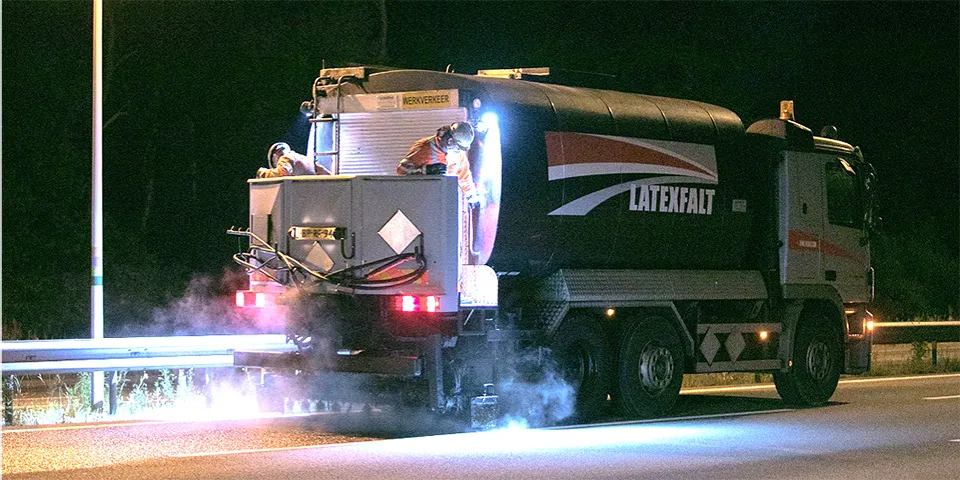
The technique has proven itself in practice.
Validated technology
When emulsion technology is used to extend service life, the ZOAB structure remains nicely open after the spray tanker has passed. The pores do not become clogged. “It’s like sunscreen that absorbs into the skin. The effectiveness of extending service life by five years or more has been demonstrated, and this technology has now also been validated.
Bert Jan Lommerts concludes: “I still have a dream: that in 25 years’ time we’ll have motorways built with the best bitumen products for high initial quality, which can be ‘rejuvenated’ several times during their service life and fully reused as raw material for new roads at the end of their cycle. All parties still have a number of steps to take, but we’re closer than ever.”
Question about this story? Ask your question
Keep following this
Get an email when a new story is published. No account needed.
- ThemeExtending the life of roads and civil engineering structures
- SubjectSpecials







