









Land subsidence a serious problem in peatland areas
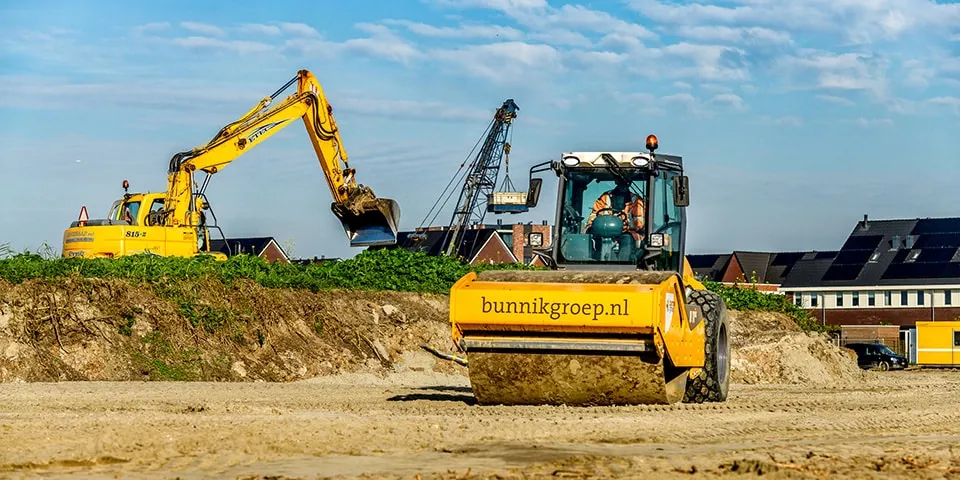
The Dutch peatland areas have been grappling with severe flooding for years as a result of land subsidence. After heavy rainfall, the streets flood and homes fill with water. As a specialist in areas with weak soils, Bunnik Groep is making an important contribution to making neighbourhoods and villages in peatland areas climate-resilient. We join Luuk Tamminga to visit a ‘weak soil’ rehabilitation project in Kockengen and De Kanis.
According to Tamminga, climate adaptation is a hot topic in the Dutch peatland areas. “The combination of increasingly intense rainfall and land subsidence means that streets in these areas are increasingly prone to flooding, with all the consequences that entails. It is a serious problem. The local authorities in this area have joined forces in the Platform Slappe Bodem to tackle land subsidence. In the former municipality of Reeuwijk, we were already the ‘in-house contractor’ for weak-soil rehabilitation before the municipal merger with Bodegraven, Reeuwijk. Reeuwijk is among the top ten areas with weak soils, and the ground here is in really poor condition.”

As a specialist in areas with weak soils, Bunnik Groep is making an important contribution to making neighbourhoods and villages in peatland areas climate-resilient.
Unique characteristics
Bunnik Groep is based in the Groene Hart, right in the heart of the weak-soil area. “Since we were founded more than fifty years ago, we have focused on managing public spaces,” Tamminga continues. “We work across four disciplines, and we are seeing growing market interest in sustainable rehabilitation of weak soils. Every village, neighbourhood and street has its own unique characteristics and calls for an individual approach. For example, our approach in Kockengen is completely different from the one we take in De Kanis, a village centre in the municipality of Woerden.” Kockengen, also nearby but part of the municipality of Stichtse Vecht, is being made fully climate-resilient over a ten-year period. The project has been under way since 2014 and is being carried out in phases (ten in total). Of the five phases awarded so far, Bunnik Groep has been commissioned to deliver four. One of these phases covered 125 homes and had a contract value of €3 million. By comparison, the project in De Kanis also affects 125 homes, but has a contract value of more than €10 million.
Sustainable methods
De Kanis is experiencing severe settlement due to its soft peat soil. Tamminga explains: “In some places, the public space has subsided by more than 60 centimetres. Here we are using a unique method to build a settlement-free concrete structure on piles beneath the streets. We lay a sand bed on top for the utility services, and then construct the public space above it. The initial investment in this structure may be high, but it guarantees a service life of one hundred years. In Kockengen, we are also replacing the existing foundation, including the tar-bound asphalt, with lightweight foundation material. The utility services are then laid on top, and the paving is reinstated. We are also raising the level of public green spaces and residents’ gardens.”
Bunnik Groep has all the knowledge and expertise in-house to deliver peatland rehabilitation projects entirely from A to Z. “We are regularly asked to carry out the work as part of a construction team. But we are also seeing these commissions increasingly being awarded under UAV-GC contracts. As a specialist in areas with weak soils, we are exceptionally well equipped to do this,” Tamminga concludes.
Question about this story? Ask your question
Keep following this
Get an email when a new story is published. No account needed.
- ThemeFlood protection and climate-resilient water management
- SubjectSpecials







