









Jetties for service harbour enter final design phase
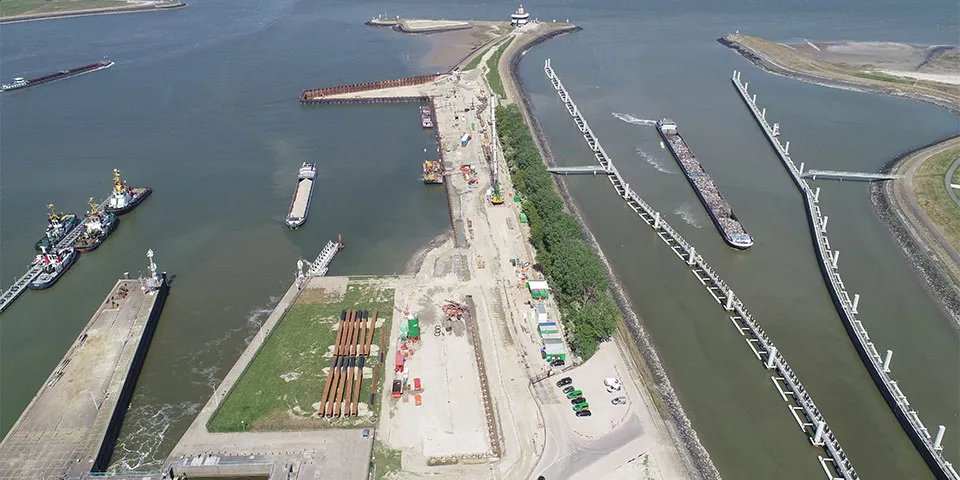
The service harbour at the Nieuwe Sluis in Terneuzen will, of course, need to be equipped with the necessary jetties. Van der Zalm Metaalindustrie BV has secured this excellent contract. The company is responsible for the design and construction, as Simon Knaap explains.
“The harbour is in the outer harbour on the Westerschelde and has a usable length of 375 metres and a width of around 88 metres. It is completely rectangular, with a recess in the embankment. We are responsible for all floating structures and bridges within the harbour,” Knaap begins. “These include a service jetty, berthing jetties, access jetties, a number of finger jetties, a heavy-duty vehicle bridge and three access bridges. We will design, manufacture and install all of them.”
Floating pontoon
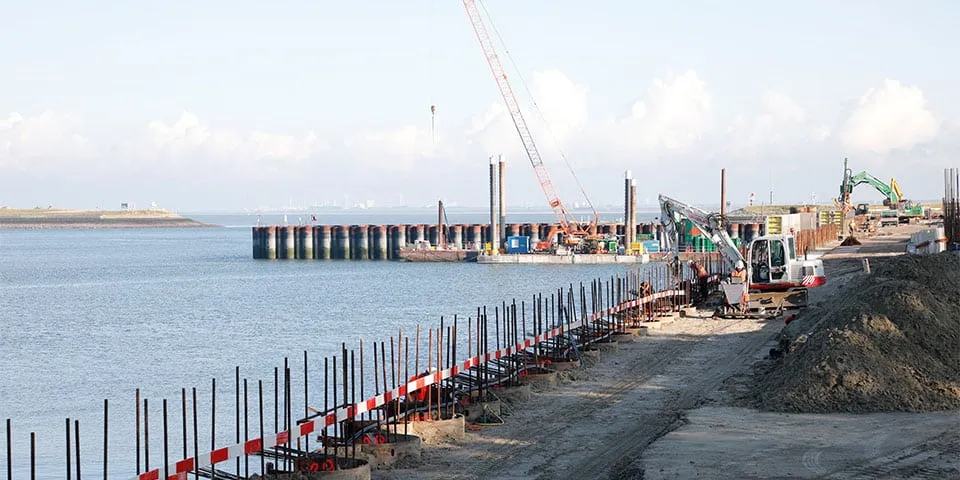
“The service jetty is intended for loading and unloading goods and for use by emergency services. The jetty is about 100 metres long and 12 metres wide, and consists of three sections. These will be floating pontoons moored to a number of piles. The jetty will be accessed via the 43-metre-long, 4-metre-wide service bridge, which is hinged at one end to the retaining structure. The other end rests on rollers on the service jetty to accommodate the large variations in water level,” Knaap explains.
On the East Berthing Jetty, he says: “This pontoon structure is 280 metres long and will be divided into 45-metre modules. The jetty moves up and down along piles and will have plastic fender beams along the berthing line. It can be accessed via two walkways, using the same hinged and rolling arrangement as the service jetty.”
Design challenges
Everything is still at the design stage, with the substantial forces that may arise in the service harbour being taken into account. Knaap says: “There is a lot of wave action in the right-hand corner of the service harbour, more than elsewhere in the harbour. For the jetty, this means waves can rebound, collide and reflect back. We are allowing for wave heights of 2.8 metres at 4-second intervals, which could occur once every 100 years according to Svasek studies. At such times, the whole structure could be lifted into the air, creating a challenging engineering problem for us. That is why we are working closely with VNSC and external specialists on analyses and calculations. Detailed dynamic studies are needed to design a safe jetty.”
Access jetty and East Berthing Jetty
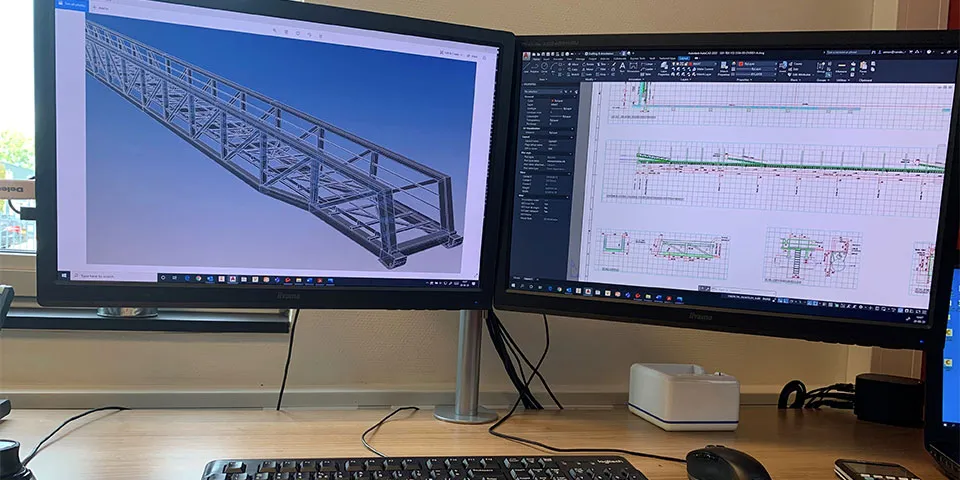
An access jetty is planned on the north-west side of the service harbour. “It consists of a floating tube with a landing, secured to tubular piles. The jetty will provide access to the wave screens and allow small boats to moor.” The wave screens are designed to reduce incoming wave energy by around 80%.
Like the service jetty, the planned East Berthing Jetty will be built to withstand heavy loads. This is necessary to accommodate larger boats and absorb impacts in the event of an emergency. Knaap concludes: “We are working hard on the design and have completed the preliminary design phase. The detailed design is now being developed, and we expect to complete it in September. We also expect to finish the construction design this year.”
Question about this story? Ask your question
Who worked on Dienstenhaven
- contractorVan Driessche & De KosterMentioned in Control building and harbour services building taking shape
- contractors' joint ventureSassevaartMentioned in Control building and harbour services building taking shape
- contractors' joint ventureTriconMentioned in Control building and harbour services building taking shape
- contractors' joint ventureBouwbedrijf VrolijkMentioned in Control building and harbour services building taking shape
Keep following this
Get an email when a new story is published. No account needed.
- ProjectDienstenhaven
- SubjectSpecials







