









Infrastructure replacement and renovation
We face the biggest maintenance challenge in our history. Over the coming years, Rijkswaterstaat will replace and renovate dozens of bridges, tunnels, locks and viaducts. Many were built in the 1950s, 60s and 70s and are in urgent need of refurbishment. It is a huge undertaking in which collaboration between the government and the market is more important than ever.
Jan Slager, Director of Replacement and Renovation at Rijkswaterstaat and speaker at the Infrastructure Management and Maintenance conference.
Replacement and Renovation Programme
Through its Replacement and Renovation Programme for bridges, tunnels, locks and roads, the Ministry of Infrastructure and Water Management aims to renew, upgrade and make existing infrastructure more sustainable. Much of the existing infrastructure is decades old. In the meantime, not only has the infrastructure changed, but so too has transport, and consequently the loads placed on bridges and viaducts, among other structures. When existing infrastructure is replaced or renovated, consideration is given to how it will be used in the future. The decision-making process also takes account of the changing environment and its impact on the infrastructure.

“You can’t simply replace existing infrastructure. A bridge, for example, was designed to meet the criteria that applied at the time. One option is to look at how the bridge could remain in service for decades to come. In that case, we would extend its service life. Smart monitoring is needed to do this, using data. This allows us to measure changes in loading and determine whether more intensive maintenance is needed. Another option is to replace the bridge. In that case, we need to consider whether to build the same type of bridge again or whether future needs call for something different.”
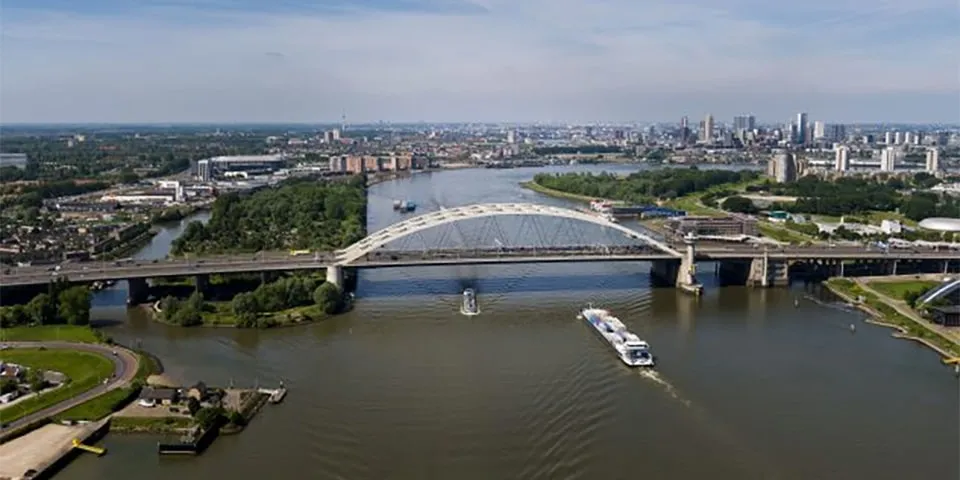
Source: Rijkswaterstaat. A16 and Van Brienenoordbrug over the Nieuwe Maas.
Forecast
Rijkswaterstaat prepares a forecast of what needs to be replaced or renovated in the coming years. This is done every two years and can be seen as a kind of vehicle roadworthiness test. Rijkswaterstaat manages the road and waterway networks. “We need to look at how we are going to organise this. We can’t do everything at once, or, so to speak, the whole of the Netherlands would grind to a halt. Our partners, including municipalities and provinces, face the same challenge.”
Preventing failures
One noticeable consequence of ageing infrastructure is failures that lead to roads and waterways being temporarily closed. “Failures have a major impact on the road and waterway networks, so we want to prevent them. We do still experience failures from time to time, for example when motors reach the end of their service life or when maintenance is carried out too late. Measurements can help us get ahead of this and carry out repairs in good time. That means maintenance can be done when it is most convenient, rather than when it becomes unavoidable. This causes less disruption for users and the surrounding area. It also often saves money.”
Data in infrastructure
We want to prevent these failures as much as possible. Monitoring bridges that are not yet on the replacement list, for example, can help. “Monitoring provides data that tell us about a bridge’s condition. We make that data available to the market. Together with market players, we want to move towards predictive maintenance, with the aim of preventing failures.”
Innovation in infrastructure
The maintenance challenge is not limited to the Netherlands, but affects much of Western Europe, including Germany, Italy and Belgium. This means the Netherlands can join forces with other countries on infrastructure innovation to extend the service life of infrastructure. For example, comparative research is being conducted worldwide into smart methods of using data to predict infrastructure service life.
Looking to the future
“The replacement and renovation of infrastructure in the Netherlands will never be finished. We are currently looking about 30 years ahead. Everything built in the past now needs to be replaced or renovated. Once that is done, the infrastructure built now or recently will need to be adapted. Alongside renovation, there is also routine maintenance. Given the scale of this challenge, we need to do things differently from before. We must recognise that this is not a one-off task that we can complete and then leave behind. This means we need to take a more systematic approach to infrastructure replacement and renovation, considering future use, future functionality and new criteria such as circularity and sustainability. The further ahead you look, the more uncertain the future becomes. What, for instance, will the rise of autonomous cars and drones mean for the loads on infrastructure in the future? These questions are now on the agenda, but we cannot yet provide the answers. We are developing our own ideas about possible future scenarios, but we are also discussing them with the market.”
Dialogue with the market
“We are now working with market players to determine how we will deliver this programme together. This also involves the knowledge and capacity needed to tackle the maintenance challenge. Many employees will retire over the coming years. At the same time, technical training programmes are not producing enough potential new employees to fill the gap. This affects not only us, but market players too.”
Setting priorities
“I don’t know whether sufficient funding will be available to deliver all the challenges ahead. Of course, we prepare a forecast, but it is only later, once more extensive research has been carried out, that we gain a clearer picture of the actual costs. Based on technical urgency, available capacity and funding, as well as the political choices involved, we will prioritise what needs to be replaced or renovated first. Safety will, of course, always come first.”
Question about this story? Ask your question
Keep following this
Get an email when a new story is published. No account needed.
- ThemeExtending the life of roads and civil engineering structures
- SubjectSpecials







