









Huge CO2 savings and a very low ECI
through the use of sustainable, circular cement-free concrete
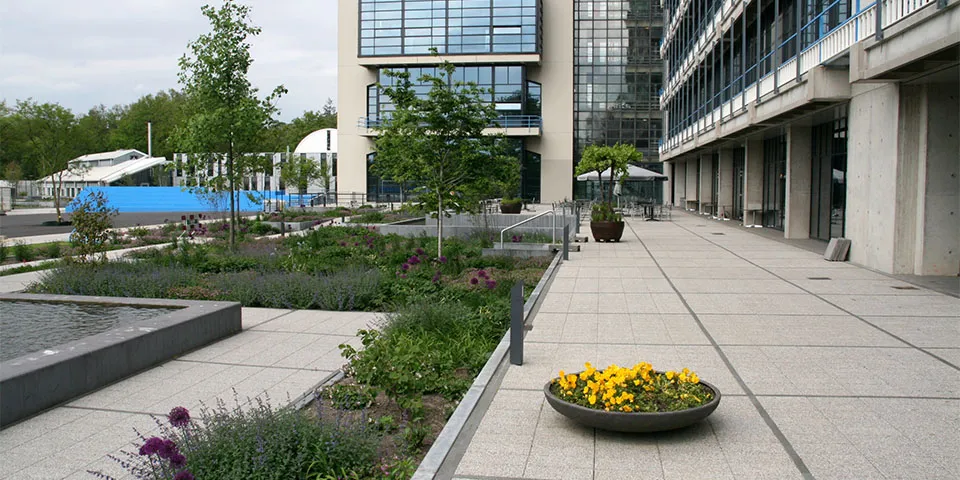
The De Hogekamp renovation project, a faculty building at the University of Twente, has saved no less than 50 tonnes of CO2 . That is equivalent to the annual consumption of around five households. This substantial saving was achieved by using around 17,000 cement-free kerbs and concrete paving blocks. On a green campus such as this, the University of Twente opted for this sustainable solution from v.d. Bosch Beton, a producer of paving materials for the professional market.
“With the supply of the very first cement-free Reduton® products, v.d. Bosch Beton achieved a European first on a project for the province of Overijssel using grass pavers, later in Rotterdam with the first paving blocks, and on the University of Twente campus in Enschede with a range of products,” says Berry Mullink, Head of Sales at v.d. Bosch Beton. “This has delivered demonstrably significant sustainability gains.”
Sustainability
The cement industry is responsible for around 8-10% of global CO2 emissions. This is why v.d. Bosch Beton, with innovative sustainability as a key pillar of its business, has further developed its Reduton® cement-free concrete into a range of products. These are increasingly being used in projects where a low Environmental Cost Indicator (ECI) score is a priority. Mullink says: “The government’s 2030 targets are clear, but far from everyone is responding to them. But in ten years’ time, they will be a reality.” Mullink explains that the company has been in business for 106 years and has always been at the forefront of responding to market requirements and needs. “We are not afraid to stick our necks out. Precisely because we know what is happening in the market and have extensive contacts with public authorities, we get to work supplying the market with the right products.”
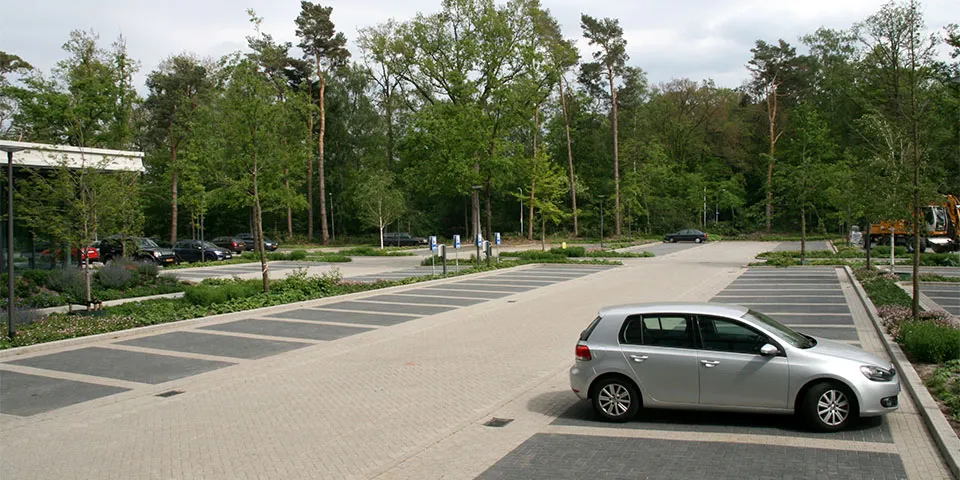
Around 17,000 cement-free paving units: the sustainable solution supplied by v.d. Bosch Beton for the green campus.
A technical feat
And that is how Reduton® came about. “Concrete was discussed at a high technical level at Eindhoven University of Technology, where the right people met. One had an idea, and we had the factory.” SQAPE Geopolymer Technology and v.d. Bosch Beton tested the product and further developed it into the Reduton® we have today. It is used in products such as paving blocks, kerbs and edging restraints, grass pavers and slabs. “Expertise, trust and good collaboration can lead to sustainable choices, as this shows once again.”
Geopolymerisation
The sustainability lies in the fact that no cement is used in this concrete, but geopolymers act as an inorganic binder. In addition, it is made largely from circular raw materials. “Reduton® has the same quality as conventional cement concrete,” says Mullink. “All our products are certified, and we also provide a verified and audited ECI calculation.” He concludes: “To keep the circular economy truly moving and prevent concrete from becoming society’s waste bin, with all kinds of materials simply being put into it, it is now important not only to supply circular products but also to demolish carefully and ensure concrete is no longer used for other purposes, but returned to concrete production. Only then will we be circular, make the greatest possible contribution to the environment, make infrastructure more sustainable and improve road safety.”
Een zakelijke vraag aan v.d. Bosch Beton b.v.? Get in touch
Companies in this story
Keep following this
Get an email when a new story is published. No account needed.
- ThemeLower emissions and more reuse
- SubjectSpecials
- Companyv.d. Bosch Beton b.v.
- CompanyBosch Beton







