









Ground stabilisation for the HWBP
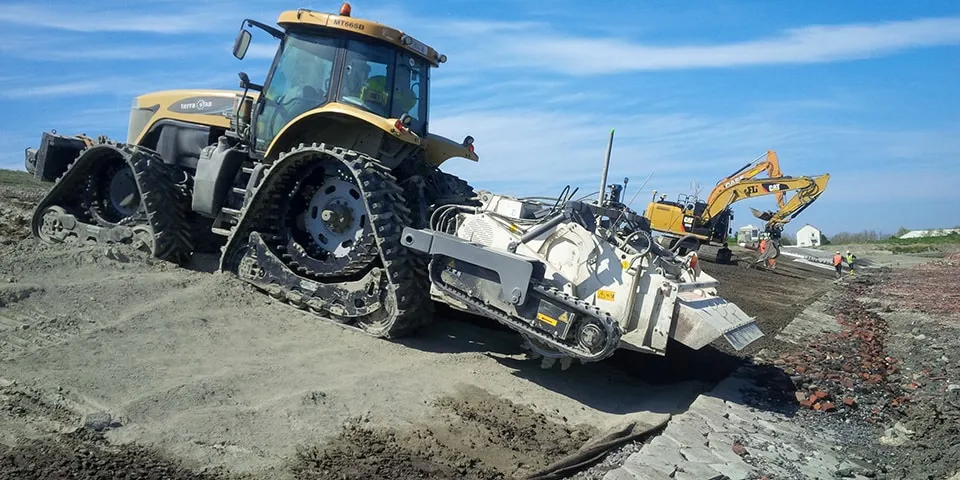
For dikes and water infrastructure, ground stabilisation is an attractive solution when ground improvement, semi-bound or structural foundations are required. These three applications for water infrastructure and dikes can be made more sustainable through ground stabilisation.
Ground stabilisation binds the existing materials in situ and upgrades them to the required structural strength. This can vary from project to project and is tailored to requirements. The material can be reused thanks to Terrastab’s range of binders, additives and specialist machinery for these applications. The structure can be built to withstand tidal conditions and has a minimal environmental impact.
100% REUSE
With its own laboratory, Terrastab makes it possible to reuse almost all soil materials using innovative additives. Terrastab is developing alternative binders and other innovations in partnership with TU Delft. With unique additives, we can reuse virtually all soil materials as a basis for ground improvement or structural stabilisation.
CO2 REDUCTION
Using fewer primary construction materials, reducing transport movements and building quickly all help cut CO2 emissions. We use material available on site or from other projects to create new foundations and pavements, avoiding the need for primary construction materials. Treating the material on site and working quickly enables us to save a considerable amount of CO2.
FAST CONSTRUCTION
Because our technique requires no material to be removed and little to be brought in, our structure can often be used quickly. Excavating, removing, bringing in and placing material often takes a long time on civil engineering projects. Terrastab’s technique causes less disruption to the surrounding area.
This was also the case with the dike strengthening project in Yerseke. The sea dike on the Oosterschelde near Yerseke had to be improved to meet safety requirements. Almost its entire length consisted of (marine) clay with such poor bearing capacity that it could no longer serve as foundation material for the stone revetment. The saline clay also allowed too much water to pass through, potentially creating dangerous conditions. The traditional approach would have been to excavate around 28,000m³ of saline clay and replace it with an 80 cm layer of granular blast furnace slag. Since the excavated clay first had to be stockpiled before it could be removed, this would have taken too long. The huge number of transport movements and the time required for processing would also have caused problems for the surrounding area.
Terrastab provided the solution by using the material on site and stabilising it to create a load-bearing foundation. This saved time, CO2, material and money on the project.
Een zakelijke vraag aan Terrastab Nederland B.V.? Get in touch
Companies in this story
Keep following this
Get an email when a new story is published. No account needed.
- ThemeUnderground construction
- SubjectSpecials
- CompanyTerrastab Nederland B.V.







