









Emission-free dewatering for 2.4 kilometres of new quay wall
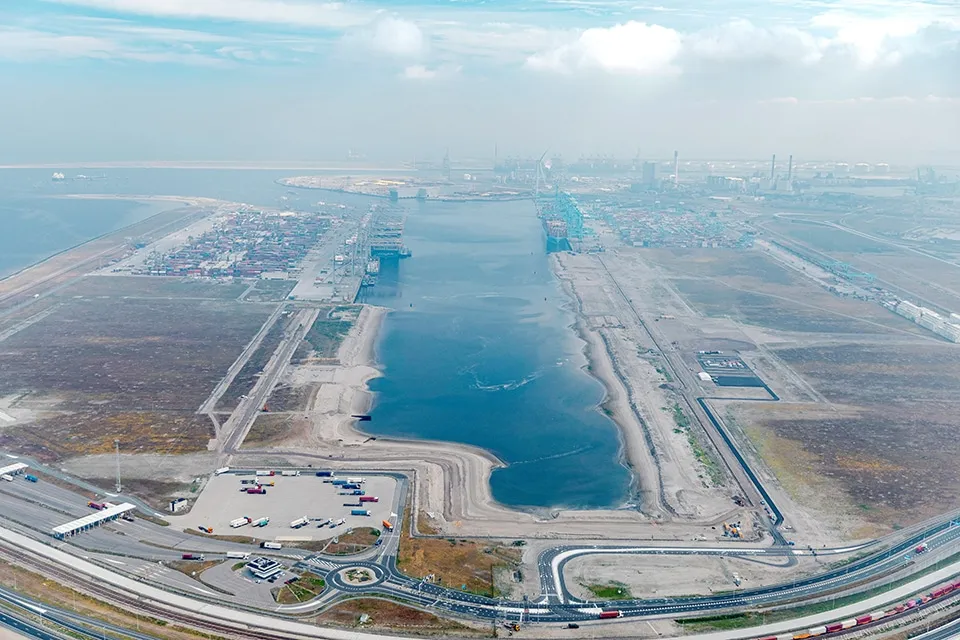
Container terminals in Prinses Amaliahaven on Maasvlakte II are expanding. This involves constructing 2.4 kilometres of new quay wall. The new deep-sea and inland shipping quays are being excavated in dry conditions. Henk van Tongeren Water & Techniek is creating a dry excavation pit and using no fewer than 138(!) electric piston pumps for dewatering. In this way, the family business is helping Port of Rotterdam Authority achieve its sustainability ambitions and significantly reduce CO2 emissions.
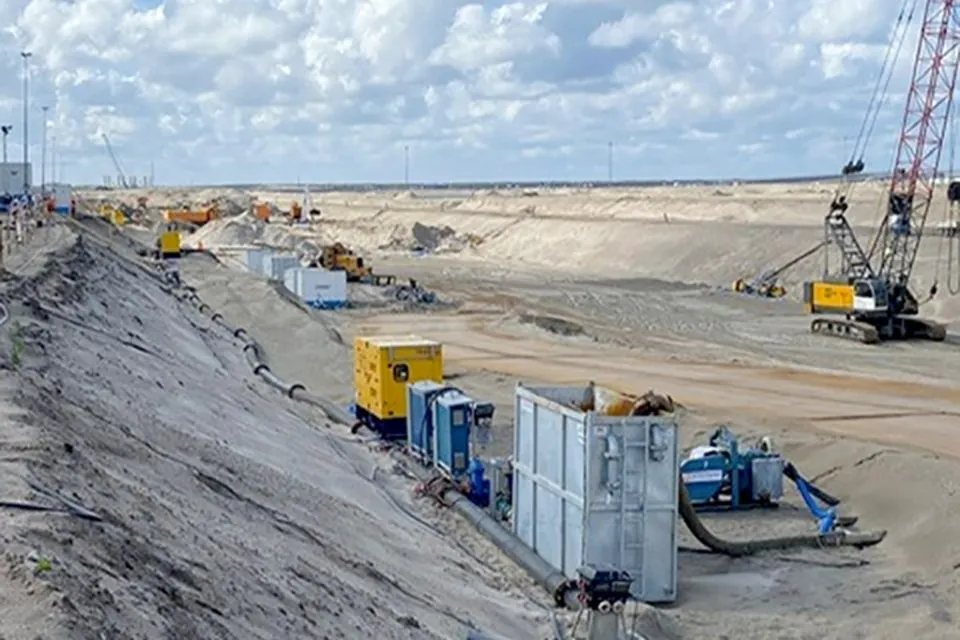
Dewatering a project on this scale requires meticulous preparation. “To leave nothing to chance and test our proposed method in practice, we first carried out a pumping test on both sides of the harbour, in collaboration with our sister company Tjaden adviesbureau voor grondmechanica,” says Roel Dibbelink, project manager at Henk van Tongeren Water & Techniek. “The results enabled us to finalise the dewatering design and determine the required capacity and discharge volumes.” The method involves installing many kilometres of drains, 4 to 6 metres deep, on both the landward and waterside. The drains are connected to piston pumps installed on so-called pump berms. The water is conveyed to the recharge area and the harbour via kilometres of discharge pipes and booster stations.
Real-time monitoring
Henk van Tongeren Water & Techniek has now installed the drains at the APMT quay and RWG quay. “We started installing the drains in summer 2021. The drain-laying machine is like a chainsaw that cuts through the ground. As it cuts, the drainpipe is fed in and lowered to the required depth.” A total of 10 kilometres of drains have been installed in several runs on the APMT side. On the RWG side, the total is 8.5 kilometres. “We are currently still working on the inland shipping quay, where just under 1.5 kilometres of drains are being cut in, in combination with filter-point dewatering.”
A further 67 monitoring wells have been installed. “Like the water meters, these can be read and analysed in real time. We also use recharge dewatering in combination with booster stations. Some of the water is returned to the ground. This prevents adverse impacts on the surrounding area, such as settlement of the rear crane track.”
Huge power requirements
The piston pumps are installed on various pump berms. “Each pump berm has around eight piston pumps running,” explains Dibbelink. “This keeps the excavation pit dry, allowing the sections between the pump berms to be excavated. This is done in three stages. After each stage, the pumps are moved, or rather, lowered. The pumps in operation move around 10 million m3 of water a year, using electricity alone! That naturally puts a heavy demand on the electricity grid, but this too was agreed with the client during the preparatory phase. Once the work is complete, the drains will be filled with grout to prevent possible subsidence. This method was also successfully tested after the pumping tests had been completed. In addition, we take water samples every month to monitor water quality. We leave nothing to chance.”
According to Dibbelink, the biggest challenge at Prinses Amaliahaven is not so much the dewatering itself as keeping the system running. “We are dealing with rounded sand grains, salt water and strong winds. It turns out to be a ‘toxic cocktail’ for the equipment. The pumps and above-ground pipework require much more maintenance than usual, but that is something Henk van Tongeren Water & Techniek can handle. The dewatering system will remain operational until April 2024.”
Een zakelijke vraag aan Henk van Tongeren Water & Techniek? Get in touch
Companies in this story
Keep following this
Get an email when a new story is published. No account needed.
- ThemeLower emissions and more reuse
- SubjectSpecials
- CompanyHenk van Tongeren Water & Techniek







