









Bufferblocks take on flooding and subsidence in Capelle
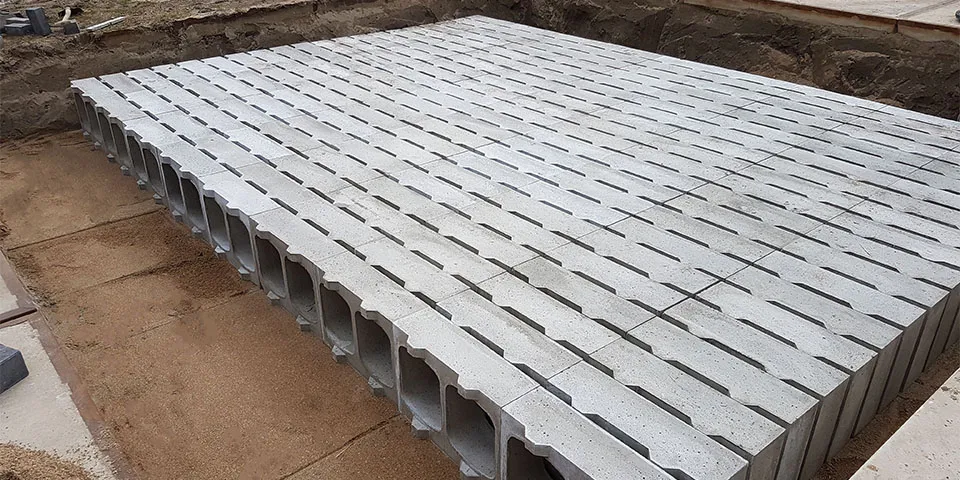
The first Bufferblocks will be installed in the ground in Capelle aan den IJssel from next week. The concept responds to a changing climate, with heavier rainfall and longer periods of drought. The municipality also sees the product as an important weapon in the fight against subsidence, and its use of Bufferblocks is a world first.
“We are a municipality with soft ground,” says project manager Dirk van den Heuvel, referring to the peat soil in Capelle. “That’s why we were looking for a lightweight raising material with water storage capacity.” This is part of the large-scale redevelopment of the Arica in Capelle, where work is being carried out on both the street level and the water management system.
Bufferblocks were selected for the project. Like infiltration crates, they store water underground, to be precise, 266 to 532 litres per square metre. According to Dorian Hill, co-founder of Bufferblock BV, the comparison ends there: “As well as their substantial water storage capacity, the blocks can withstand the heaviest traffic class. This means Bufferblocks can also be installed beneath a busy carriageway, leaving the pavement free for service connections to properties. The concept is also fully modular, giving you a great deal of flexibility in your design. That made working with utility network operators particularly straightforward, for example.”
Ideal for high groundwater levels
Another major advantage is that Bufferblocks can be installed just beneath the road. This makes the system particularly suitable for locations with high groundwater levels, which is exactly what persuaded Van den Heuvel. “Groundwater levels are high along the Hollandse IJssel, so we didn’t want to excavate deeply. You would also lose the water storage function,” he explains. Permeable paving could be used, but it was decided to install conventional gullies for ease of maintenance.
Inspired by the WaterStraat living lab
Through the European programme STAR2Cs, which focuses on climate resilience, the municipality received funding to implement a number of climate adaptation measures. The project manager and his colleagues drew inspiration from the WaterStraat, a living lab in Delft where various climate adaptation concepts are tested and further developed. Bufferblocks offer a win-win for the district in Capelle, where high groundwater levels ruled out other concepts. “With more intense downpours and longer periods of drought expected, you want to be able to retain water rather than discharge it straight away. It’s also a bonus that this helps prevent the peat from drying out and therefore limits subsidence.”
Sustainable and easy to maintain
Concrete is not only much more sustainable than plastic underground, it also lasts far longer. “Concrete is an extremely robust material with a service life of at least 50 years, which means you only need to dig up the street once every fifty years,” explains Dorian Hill. “You can also use robots designed for sewer systems to carry out inspections, and then flush any contaminated sections clean if necessary.”
It takes courage to be the first, says the alderman responsible, Marc Wilson. “It’s great to have a world first and be a trendsetter. Amsterdam, The Hague and Rotterdam all want to come and see what we’re doing here.”
Question about this story? Ask your question
Companies in this story
Keep following this
Get an email when a new story is published. No account needed.
- ThemeFlood protection and climate-resilient water management
- SubjectSpecials
- CompanyVan den Heuvel







