









Accelerating towards a sustainable future
“Many local authorities and provinces are looking for solutions in the areas of circularity and CO2 reduction. By sharing knowledge and experience with the market, we hope to help others make positive progress towards meeting their climate targets. Recycling concept Cycle for Concrete and cement-free CERO concrete can contribute to this.” So says Rinke Veld, Commercial Director at Struyk Verwo Infra.
The company is the market leader in the civil engineering sector for concrete paving products and has pursued an active CSR policy since 2011. Sustainability is embedded in the company and in active collaboration across the supply chain. Various sustainable products and solutions have been developed in recent years.
Recycling concept with a positive impact
“Cycle for Concrete (C4C) is an excellent example of a paving concept that has a positive impact on the environment. This recycling concept significantly reduces the use of virgin raw materials. At the end of their service life, concrete paving materials are collected, crushed and the resulting concrete aggregate is processed by Struyk Verwo Infra as a high-quality raw material for new concrete products. The result is entirely new concrete paving products in any desired appearance, made with the maximum possible amount of circular concrete. By working with sister companies that also belong to parent company CRH, we can, depending on the client’s requirements, reuse up to 100% of the clean concrete rubble collected as a high-quality material. This helps public authorities to work in a fully
circular way with concrete.”
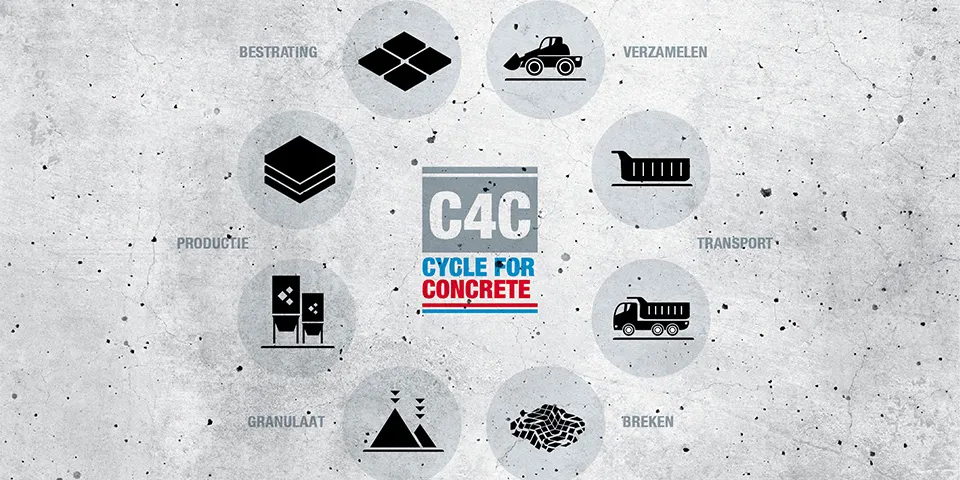
Cycle for Concrete, schematic representation of the supply chain.
Extremely low CO2 footprint with cement-free CERO concrete
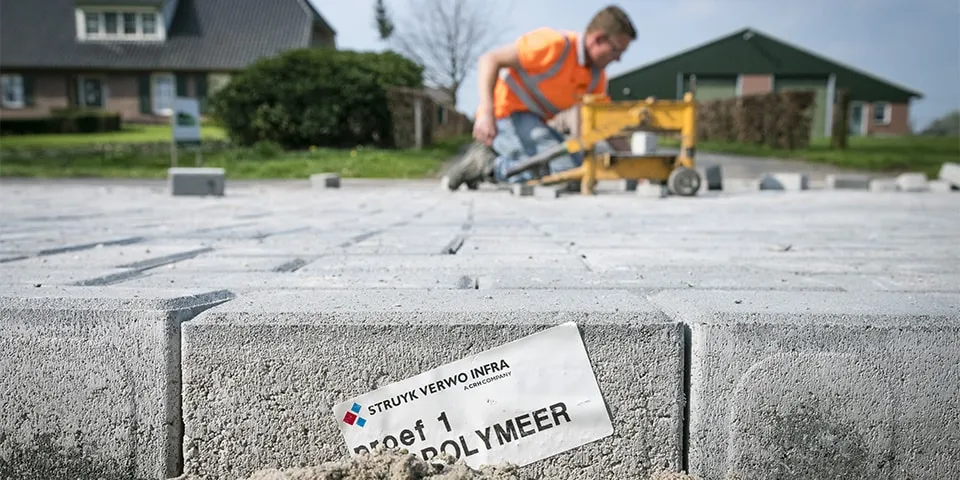
“Cement is the most polluting component of concrete products. To reduce concrete’s CO2 emissions, you can use more environmentally friendly cement. Switching to an alternative binder with a very low CO2 footprint is an even better option. Struyk Verwo Infra has invested in technology that replaces cement with geopolymer. The products are available under the name CERO. Compared with the most polluting cements, CERO reduces CO2 emissions by up to 70%; compared with more sustainable cements, the reduction is up to around 35%. This has significantly lowered the Environmental Cost Indicator (MKI) score.” Geopolymer was developed by SQAPE, a joint venture between CRH and Renewi Actua. Geopolymer concrete is a stable, dimensionally stable material that looks the same as cement-bound (conventional) concrete. For Struyk Verwo Infra, it is essential that concrete waste can be reused at the end of its service life as concrete aggregate in new concrete. Research by SGS Intron demonstrates that geopolymer has the same properties as traditional concrete in this respect. In its second life, geopolymer aggregate can be used in the production of both geopolymer and traditional concrete. Combined with Cycle for Concrete, this makes an ultimate contribution to achieving climate targets. “Using CERO cement-free concrete, with its low MKI score, accelerates the transition to a sustainable future,” says Rinke Veld.
CERO sustainability benefits
• Extremely low CO2 footprint for paving products
• Environmental Cost Indicator (MKI) score per m3 more than halved
• Can be combined with secondary
raw materials (residual flows) if required
• Helps supply chain partners achieve their own climate targets
• Has the same civil engineering properties as conventional concrete
Question about this story? Ask your question
Companies in this story
Keep following this
Get an email when a new story is published. No account needed.
- ThemeLower emissions and more reuse
- SubjectSpecials
- CompanySGS INTRON B.V.







