









Working together to build sustainable roads
Text Roel van Gils Image Bouwend Nederland
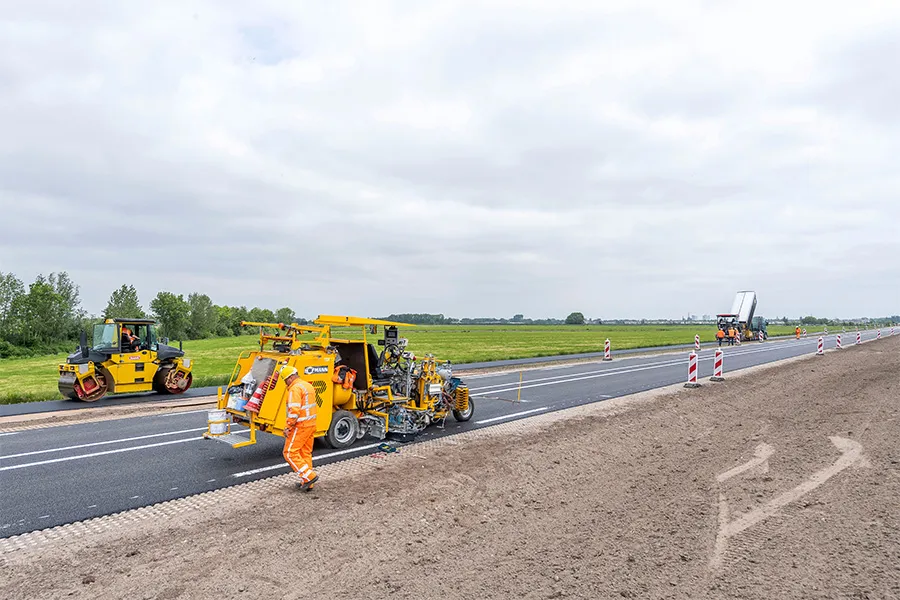
The Bituminous Works Group (VBW) of Bouwend Nederland promotes the use of asphalt. Like the rest of the Netherlands, the asphalt industry is working to become more sustainable. The introduction of Warm Mix Asphalt is an important milestone, but it does not stop there. Work is even under way on a ‘Delta Plan for Sustainable Road Pavements’, with the aim of bringing people together to build sustainable roads. A conversation with Stefan de Munck, Chair of the Bituminous Works Group.
“As an industry, and therefore through the VBW too, we are working hard to become more sustainable, both in production and in laying asphalt,” De Munck begins. “In 2021, we jointly set the ambition of phasing out Hot Mix Asphalt and switching to Warm Mix Asphalt. Over the past year and a half to two years, we have worked hard to take this forward together with clients such as Rijkswaterstaat, provinces and municipalities, and to establish a shortened approval process. Since then, all production units across the country, the asphalt plants, have been taking steps towards Warm Mix Asphalt or have already made the switch.”
Overcoming reluctance
Since mid-2024, we have seen Warm Mix Asphalt specified in an increasing number of contracts. “That is a positive development,” says De Munck. “Serious progress is being made on all sides, by producers and clients alike, large and small. As a sector, we can be proud of that. It shows once again that we really need each other. We may want to make our mixes more sustainable, but clients have to come on board too. Warm Mix Asphalt became the standard on 1 January 2025, but that does not mean we can phase out Hot Mix Asphalt entirely. This is because approval processes for specific situations can sometimes take a long time. What we can certainly say is that reluctance to use Warm Mix Asphalt has been overcome, among both clients and contractors.”
Delta Plan
And now, on to the next steps! “Simply lowering the temperature will not be enough,” says De Munck. “Work is now under way to establish the National Platform for Sustainable Road Pavements. The initiative came out of a session at our Asfaltdag event several years ago. Our members gave a presentation there, concluding that it would be good to put together a kind of delta plan for sustainable road pavements. Structural progress towards a more sustainable sector requires close cooperation between government bodies, businesses and knowledge institutions. The National Platform for Sustainable Road Pavements (NPDW) brings clients, contractors and knowledge institutions together to pool expertise and jointly choose the best approach. The Delta Plan for Sustainable Road Pavements provides the foundation, setting out concrete targets and steps to reduce CO2 emissions, promote the circular use of materials and encourage innovation.”
A degree of certainty
The VBW is also in ongoing discussions about how to accelerate progress in asphalt production. “Our aim is to produce our mixes with as few emissions as possible. We are looking at alternative production methods to reduce gas consumption, such as using hydrogen and electric heating. These are comparable to the steps taken to introduce Warm Mix Asphalt. We also realise that this will require major investment. As an industry, we are willing and able to make those investments, but we need a degree of certainty that we will be able to use these methods in the years ahead. That is why we are involving clients in these developments too, to build a clear picture of what the market will look like in the coming years.”
Fresh blood
According to De Munck, Warm Mix Asphalt is certainly not the end point, but merely an interim step. “Ultimately, we are moving towards mixes that can be produced at even lower temperatures. That said, switching from Hot Mix to Warm Mix has already enabled us to reduce our carbon footprint by around 20 to 40 per cent.” But there is more to come. Finally, De Munck also wants to draw attention to sustainable employability. “We are seeing our industry get older. That is why we are already thinking about how we will get the work done ten years from now, and especially how to make our profession attractive again and bring in fresh blood. To this end, the VBW has set up several committees that are talking to training institutions, such as SOMA College in Harderwijk. Bouwend Nederland is also working hard to raise awareness of our industry among school pupils and their parents. We are certainly not standing still.”
Question about this story? Ask your question
Keep following this
Get an email when a new story is published. No account needed.
- ThemeExtending the life of roads and civil engineering structures
- SubjectRoad construction







