









Welding to the highest standards
Text Roel van Gils Beeld Lommers Welding Services
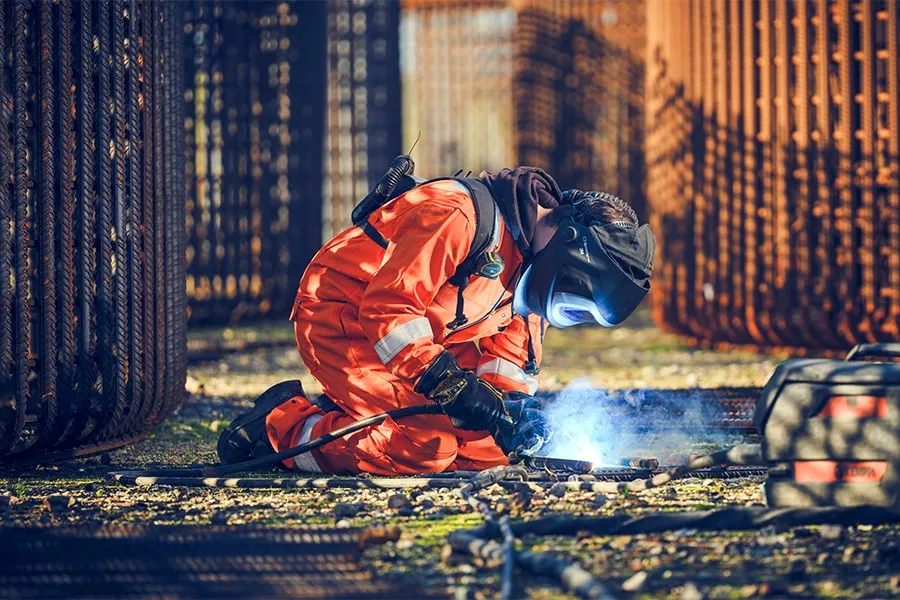
To enable the widening of the A1 between Apeldoorn and Twello, several existing structures are being widened. For the foundations, Lommers Welding Services is welding many thousands of reinforcing bar dowels to the sheet piles, to the highest execution classes. This process is often underestimated and requires considerable expertise, given the strict standards and changing conditions.
Heijmans asked Lommers Welding Services to advise on welding the many thousands of dowels while the project was still at the tender stage. “We were awarded the work more than a year and a half later,” says Michel van Dantzig of Lommers Welding Services. “Based on the drawings, we prepare the welding plan and produce the welding procedure specifications. Once these have been approved by Heijmans, we get to work. To extend the structures, we weld all the 32 mm-diameter reinforcing steel to the sheet piles on both sides, along with some additional welding on the walers and tie-rod connections. All of this is carried out to the highest execution classes, 3 and 4, and in accordance with ROK 2.0.”
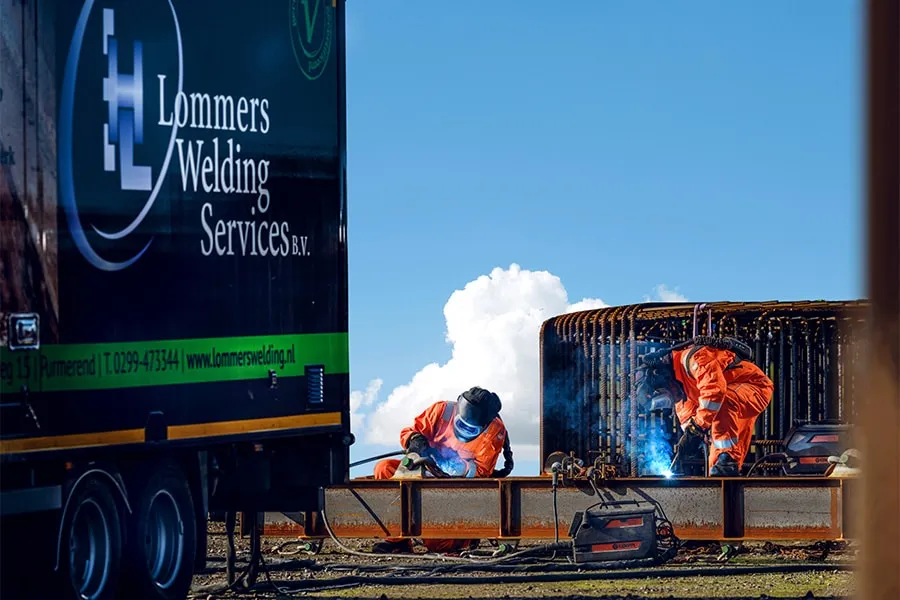
Harmonised standard
For projects like this, where the highest standards apply, Lommers Welding Services often calls on welding coordinator Raymond Brand. “We are seeing these stringent requirements applied to an increasing number of projects,” says Michel. “And quite rightly so. This is the foundation of a structure that will carry a lot of cars in the years to come. It simply has to be right.” Yet, according to Raymond, welding reinforcing bar dowels to sheet piles is still often underestimated. “There is much more to it than people often think. Until recently, there was no applicable standard for welding reinforcement. ROK 1.4 referred only to NPR 2053, ‘Welded joints in reinforcing steel and steel strips’. ROK 2.0 now makes a clear reference to NEN-EN ISO 17660-1, a harmonised standard. Lommers Welding Services is one of the first companies to prepare for this.”
Unique position in the market
Raymond acknowledges that NEN-EN ISO 17660-1 has been around for quite some time. “The standard describes how to qualify welding procedures and welders, how to maintain their validity, the range of qualification, and so on. “In practice, for a project such as the A1, that means carefully checking in advance what is required to carry out the work in accordance with the standard,” Raymond explains. “You can also see it as quality assurance.” Lommers Welding Services began obtaining welding procedure qualifications at an early stage under NEN-EN 1090. “It has an additional scope extension for reinforcing steel in accordance with NEN-EN ISO 17660-1 for load-bearing structures, and is audited separately for this. That is quite exceptional and gives the company a unique position in the market.”
Challenging welding conditions
Lommers Welding Services began welding on site in the summer of 2023. “The weather is certainly the biggest challenge,” says Michel. “We use the MIG/MAG welding process, which requires controlled conditions, in other words protection from rain and wind. As a result, during the winter months we carried out most of our work under tents or covers.” The welding conditions were therefore quite challenging. Raymond adds: “On top of that, the sheet piles are generally rusty, dirty and damp. None of those are things you want when welding. That makes the challenge even greater, but it is well within the capabilities of the welders at Lommers Welding Services.” According to the schedule, Lommers will complete the final weld at the end of March 2024. The welding work is also periodically checked against the standards to ensure a high-quality end result.
Question about this story? Ask your question
Keep following this
Get an email when a new story is published. No account needed.
- ThemeUnderground construction
- SubjectRoad construction







